


The US stock market has never before been this top heavy, and no easy solution, or indeed any solution, appears to be within the grasp of investors. The peak of the dot.com bubble seems quaint by comparison to the present market structure, with the top 10 weight currently standing at a resounding 33.35% of market capitalization. The diversification dilemma is real.
My goal in this blog post is three-fold. First and foremost, I will diagnose the illness pervading the US stock market. Second, I will examine why equal weighting — the back-up index strategy of choice — distorts a portfolio with far-from-equal exposures. Third, I will explain why a factor application can naturally distribute portfolio weights for ideal diversification. The factor portfolio has greater breadth than a market-capitalization portfolio, without the practical and performance liabilities of equal weighting.
Big Money, Bigger Problems
Mega-cap concentration has exploded, increasing by 115% from a 25-year low in 2015, when top 10 holdings accounted for 15.52% of total index weight. Having first surpassed the historic dot.com bubble concentration levels in 2020, concentration now stands at a 38% premium to such excesses. US stocks have long since crossed the concentration Rubicon.
The corollary to an increasingly top-heavy benchmark is that market diversification and breadth have never been more limited. This issue can be conceptualized by looking at the effective number of stocks provided by an index — the size of an equally weighted basket that provides equivalent diversification.
Exhibit 1.
The startling conclusion is that, despite the Russell 1000 nominally providing exposure to its namesake number of stocks, the index affords an effective diversification of only 59 stocks. This figure represents a historic low and a decrease to only 29.2% of the effective number of holdings (N) of 202 stocks achieved in 2014. Not only does market-cap weighting induce substantial single-stock risk, but the diversification provided by this foundational asset class has evaporated by 70% over the past decade. Hence, the concentration crisis.

Equal Weight to the Rescue? Unlikely…
If weighting by market cap is pushing portfolios to their breaking point, surely weighting companies equally can achieve the diversification for which investors are clamoring? For all the same reasons the market is so concentrated, the equal-weight methodology produces quite radical portfolio constructions, with outcomes perhaps even less desirable than the concentration itself. This is a classic case of the cure being worse than the disease.
Exhibit 2.
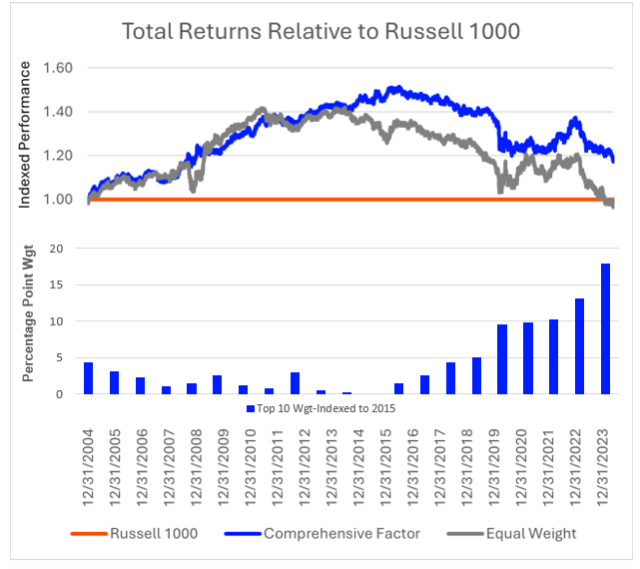
Notes: Relative returns of the Russell 1000 Equal-Weight Index and the Russell 1000 Comprehensive Factor Index to the Russell 1000 Index. Bottom window depicts the change in 10-Top index weight of the Russell 1000 from its minimum in 2015. Source: FTSE Russell Data, June 2024.
This is not your grandfather’s equal-weight market. What is often perceived as a simple alternative is no longer a substitute benchmark, but instead an aggressive active strategy. Specifically, equal weight suffers from significant operational costs, underperformance, questionable assumptions, and skewed risk bets.
As market-cap and equal-weight portfolios have diverged in structure, tracking error has soared to 8.05% on an annualized basis. This is the highest tracking error on record outside periods of market stress, even though volatility is only at the 21st percentile measured on a 20-year range. To illustrate just how extreme this tracking error is, the 60 largest active mutual funds in the US average 5.50% annualized tracking error. Yes, that’s correct, equal weight is far more active than the leading active funds owing to its onerous reallocation schema.
As a card-carrying active strategy, equal weight exhibits the familiar encumbrances of high turnover and tepid performance. The need to countermand all share-price movements at each rebalance means that the Russell 1000 Equal Weight Index has averaged 71.0% two-way turnover since 2000. Moreover, this turnover is historically inconsistent ranging from a low of 44% in 2012 to a high of 132% at the height of the dot.com bubble. This imprecision is a resonating theme of equal weighting.
Exhibit 3.
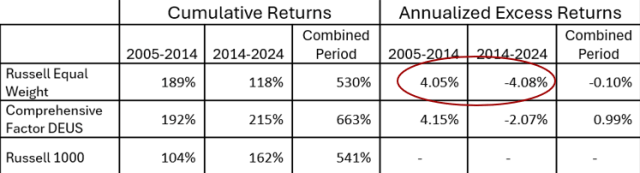
Notes: Decomposition of benchmark, equal-weight and multifactor returns around June 30 2014, the peak of equal weight returns. Source: FTSE Russell Data, June 2024.
Yet, it is the performance drag that most indicts the equal-weight framework. When returns have been so inequitably distributed, owning companies in equal measure has been a perilous approach. The mega caps did not achieve stratospheric concentration by performing poorly.
Indeed, equal performance was maximized when the degree of market concentration was minimized. The halcyon days for equal weighting were a decade ago, the absolute peak notched on June 30, 2014. Since then, the strategy has underperformed relentlessly in nearly every market condition.
Exhibit 3 illustrates this stark bifurcation in performance juxtaposed against changes in top 10 index concentration. Whereas equal weight outperformed by 405 basis points (bps) annualized from 2005 to mid-2014, it underperformed by nearly identical measure (408 bps) over the subsequent 10 years. In fact, for every one-point increase to top 10 index concentration from 2015 levels, the Russell 1000 Equal Weight Index lost 2.17 points of relative performance to its market-weighted counterpart.
Betting on Knowing Nothing
Why does this schism in equal-weighted returns emerge starting in 2014? While cap weighting assumes markets are efficient, with asset prices accurately reflecting all information, equal weighting takes the opposite approach. It assumes we cannot know anything about the market.
When concentration rests at manageable levels, this “know nothing” assumption still looms large, but equal weighting is implementable, nonetheless. On the other hand, as the market cap of the largest companies expands to 7,658 times the average size of the smallest 10 stocks in the Russell 1000, equally weighting these companies has long since passed credulity.
This size spread between largest and smallest companies is not only emblematic of the concentration dilemma, but indicative of why equal weighting fails in this market regime. In 2005, this size gap was a 224-fold multiple, increasing nine times to a 2,018 multiple by 2015, before expanding a further 3.8 times to present levels. This scale factor increase of 34 times means that a more calibrated method of achieving portfolio breath is necessary. The simple assertion that all companies are the same cannot span the gap.
Factoring in a Diversified Solution
In periods of hyper-concentration, equal weighting radically departs from market fundamentals, and indeed a return to these fundamental characteristics can foster the more balanced portfolio investors desire. By targeting independent drivers of historical outperformance, a multifactor model can achieve a more informed diversification along the lines of a structured risk profile.
Exhibit 4.
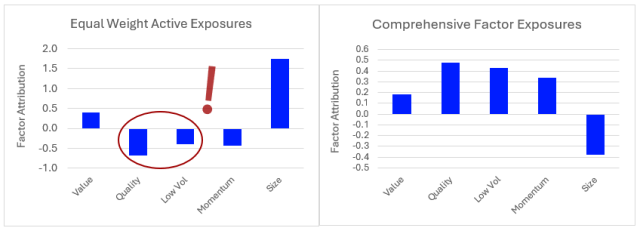
Notes: On left, active factor attribution of the Russell 1000 equal-weight index, on right of the Russell 1000 Comprehensive Factor Index. Source: FTSE Russell data, as of June 2024.
To illustrate the merits of this approach, the Russell 1000 Comprehensive Factor Index applied a fixed- and equal-strength tilt to each of the factors of value, quality, low volatility, momentum, and small size. Redistributing weight according to risk premia — as opposed to agnosticism — succeeds in increasing portfolio effective N to 385, a 554% improvement to market cap diversification.
On the performance front, a complete factor suite not only matches equal-weight’s best years of performance from 2005 to 2014, but it outperforms the latter by a factor of 1.17 over the ensuing 10 years in uncorrelated fashion. Hence, the multifactor model can outperform the benchmark by an annualized 99 bps over the complete history, compared to equal-weight’s annualized underperformance of 10 basis points.
When you compare the key risk bets of equal-weight and multifactor portfolios, the distinctions become clear. More than performance, expenses, or naïve diversification, it is the convoluted and unstable factor exposures that impugn equal-weight strategies. For instance, while a moderate skew toward value and away from momentum would be expected when holding companies equally, the significant underweights to quality and low volatility may come as an unwelcome surprise. Therein lies the underperformance.
In a concentrated market where cap weighting is increasingly strained, equal weighting would seem an obvious candidate for a more balanced portfolio. But in fact, neutralizing the concentration equal weighting produces results in a wildly unbalanced series of risk bets to the fundamental drivers of portfolio performance. In targeting equal exposure to these crucial risk premia, a multifactor methodology can be a restorative balance to US equities when more traditional measures fall short.