
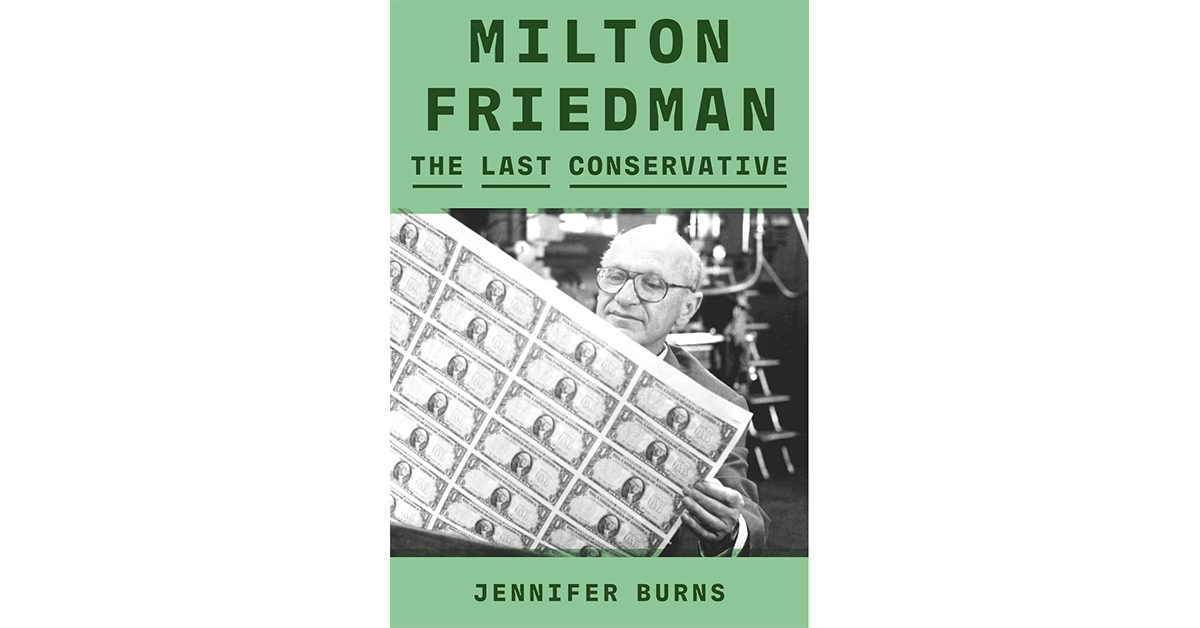

Milton Friedman: The Last Conservative. 2023. Jennifer Burns. Farrar, Straus and Giroux.
If you were asked to identify a famous economist based on the following facts, whom would you name?
- Voted for Democrat Franklin Roosevelt for president in 1936.
- Supported significant portions of Roosevelt’s New Deal, which some critics deemed
socialistic. - Favored moderate Dwight Eisenhower over conservative icon Robert Taft for the 1952
Republican presidential nomination. - Disdained anticommunist scourge Senator Joseph McCarthy.
- Attacked the fervently right-wing John Birch Society as “fundamentally wrong.”
- Considered the gold standard flawed.
- Said, in connection with public welfare, “[T]here are important functions that must be performed by the state,” too sensitive to be left “entirely to private charity or local responsibility.”
- Opposed “right to work” laws.
- Maintained that John Maynard Keynes was correct in arguing that the government must prop up demand during crises.
- Criticized supply-side economics and denied that tax cuts were consistently self- financing.
Milton Friedman (1912–2008) may not be the first name that pops to mind. Connecting him with these bullet points seems especially paradoxical in view of the subtitle of Jennifer Burns’s biography of the Nobel laureate — “The Last Conservative.”
Burns shows, however, that Friedman’s views on various issues evolved over time and that his libertarian outlook sometimes put him at odds with conservative orthodoxy, as in his advocacy of government-provided universal basic income.
Friedman unquestionably influenced public policy, notably through his campaigns to abolish the draft and institute school vouchers. The rationale for reviewing this book in Enterprising Investor, however, springs from Friedman’s economic contributions rather than his political views. Most famously, Friedman, working with Anna Schwartz, found that controlling the quantity of money was the key to maintaining stable economic growth.
This is not to say that the duo’s celebrated treatise on the topic settled the matter once and for all. As Burns documents, other prominent economists rejected the Friedman–Schwartz thesis or incorporated it into a synthesis dubbed the New Keynesianism. The Fed, for its part, alternated between managing interest rates and managing monetary aggregates. In short, Friedman did not entirely remake economic policy, yet he unquestionably remains a force to be reckoned with, someone whose ideals at the very least one might contrast to one’s own. On the first page of her introduction, Burns quotes Joe Biden on the campaign trail in 2020: “Milton Friedman isn’t running the show anymore!”
Friedman achieved his enduring place in the discussion in no small part through forceful defense of his propositions and skewering of opposing views. Burns maintains that Kenneth Arrow, Paul Samuelson, and James Tobin all declined opportunities to join the University of Chicago faculty because they dreaded the thought of having to face Friedman daily. Tjalling Koopmans told colleagues that Friedman’s relentless criticism threatened his sanity, leading him to take a leave of absence at a therapeutic music camp.
Ultimately, the value to investment professionals of Milton Friedman: The Last Conservative lies in the opportunity to gain a deeper understanding of economic theory by studying its history. Burns informatively traces the development of, and conflicts between, such concepts as Austrian economics, Keynes’s and Friedman’s (developed with Margaret Reid) contrasting theories of the consumption function, and the relative income and wealth-income hypotheses. Reading these narratives reminds the practitioner that any given economist’s forecast of GDP, inflation, or interest rates rests on premises that are far from being universally acknowledged as certainties. Neither will every economist concur with each of the author’s pronouncements. For instance, Burns blames the Great Depression–era bevy of bank failures primarily on fractional reserve banking. She does not mention state prohibitions of, or restrictions on, branch banking. Those unit banking laws led to vast numbers of banks being excessively concentrated in loans tied to a single industry that dominated the local economy.

In addition, Burns calls the abstraction of perfect competition “an unrealistic yet useful assumption.” She does not point out that Friedrich Hayek, a prominent figure in the book, strenuously argued that perfect competition was in fact useless as a heuristic point of departure. Perfect competition assumes perfect knowledge, thereby ignoring the essential feature of fragmented information and the all-important acquisition of knowledge through the market process.
Burns depicts Frank Knight explaining profits, which would not exist under conditions of perfect competition, on the basis of uncertainty. No less important, though, is the time value of money, which is absent from her discussion. Someone must advance the capital to construct the means of producing goods before they can be sold. The providers expect to be compensated for deferring the consumption that their money could alternatively fund.
In the end, though, it is Friedman’s economic interpretations, rather than the author’s, that matter most to the reader. At 575 pages including her lengthy Notes and Index sections, Burns’s book is not a quick read, but it is a lively one. She adorns the text with the sort of verbal play for which her subject was known. “But in the long run,” she writes, “Bretton Woods was dead,” alluding to a frequently cited — and widely misunderstood — remark by Keynes.
Burns embeds allusions in chapter titles, as well. For example, “Hidden Figures,” dealing with Friedman’s underrecognized female collaborators, borrows the title of a 2016 film about African-American women who played an important but, at the time, largely uncredited role in the US space program.
All in all, conscientious participants in investment decision making will derive both pleasure and professional enrichment from Milton Friedman: The Last Conservative.
If you liked this post, don’t forget to subscribe to Enterprising Investor and the CFA Institute Research and Policy Center.
* The reviewer thanks Gene Epstein for his suggestions. Any errors or omissions are solely the reviewer’s responsibility.
All posts are the opinion of the author. As such, they should not be construed as investment advice, nor do the opinions expressed necessarily reflect the views of CFA Institute or the author’s employer.
Professional Learning for CFA Institute Members
CFA Institute members are empowered to self-determine and self-report professional learning (PL) credits earned, including content on Enterprising Investor. Members can record credits easily using their online PL tracker.