
Business Insights
  • Home
  • Crypto
  • Finance Expert
  • Business
  • Invest News
  • Investing
  • Trading
  • Forex
  • Videos
  • Economy
  • Tech
  • Contact

Archives

  • November 2026
  • October 2026
  • September 2026
  • August 2026
  • July 2026
  • June 2026
  • May 2026
  • April 2026
  • March 2026
  • February 2026
  • January 2026
  • December 2025
  • November 2025
  • October 2025
  • September 2025
  • August 2025
  • July 2025
  • June 2025
  • May 2025
  • April 2025
  • March 2025
  • February 2025
  • January 2025
  • December 2024
  • November 2024
  • October 2024
  • September 2024
  • August 2024
  • July 2024
  • June 2024
  • May 2024
  • April 2024
  • March 2024
  • February 2024
  • August 2023
  • January 2023
  • December 2021
  • July 2021
  • November 2019
  • October 2019
  • September 2019
  • August 2019
  • July 2019
  • June 2019
  • May 2019
  • April 2019
  • March 2019
  • February 2019
  • January 2019

Categories

  • Business
  • Crypto
  • Economy
  • Finance Expert
  • Forex
  • Invest News
  • Investing
  • Tech
  • Trading
  • Uncategorized
  • Videos
Apply Loan
Money Visa
Advertise Us
Money Visa
  • Home
  • Crypto
  • Finance Expert
  • Business
  • Invest News
  • Investing
  • Trading
  • Forex
  • Videos
  • Economy
  • Tech
  • Contact
Subsidized vs. Unsubsidized Student Loans
  • Invest News

Subsidized vs. Unsubsidized Student Loans

  • July 19, 2025
  • Roubens Andy King
Total
0
Shares
0
0
0
Total
0
Shares
Share 0
Tweet 0
Pin it 0

As getting a college degree gets more expensive by the year, more and more students are relying on federal student loans to keep the dream alive. And when you get your award letter you might see listings for both subsidized and unsubsidized student loans.

However, all the language that is used to describe the different types of loans available to you can sound like coded jargon, yes?

In this post, we are going create a dent in that cloud of confusion.

Today we’ll talk about the differences between the terms “Subsidized” and “Unsubsidized student loans” when it comes to the Federal Direct Student Loan Program.

The William D. Ford Direct Loan Program is the largest loan program offered by the United States Department of Education. It's basically the “law” that defines what can and can't be done with student loans. 

The Subsidized and Unsubsidized loans are two of the four types of Direct Loans. These are the most common types of loans that undergraduates will get. Let's break down what they mean, what you need to know, and options if you need to borrow more.
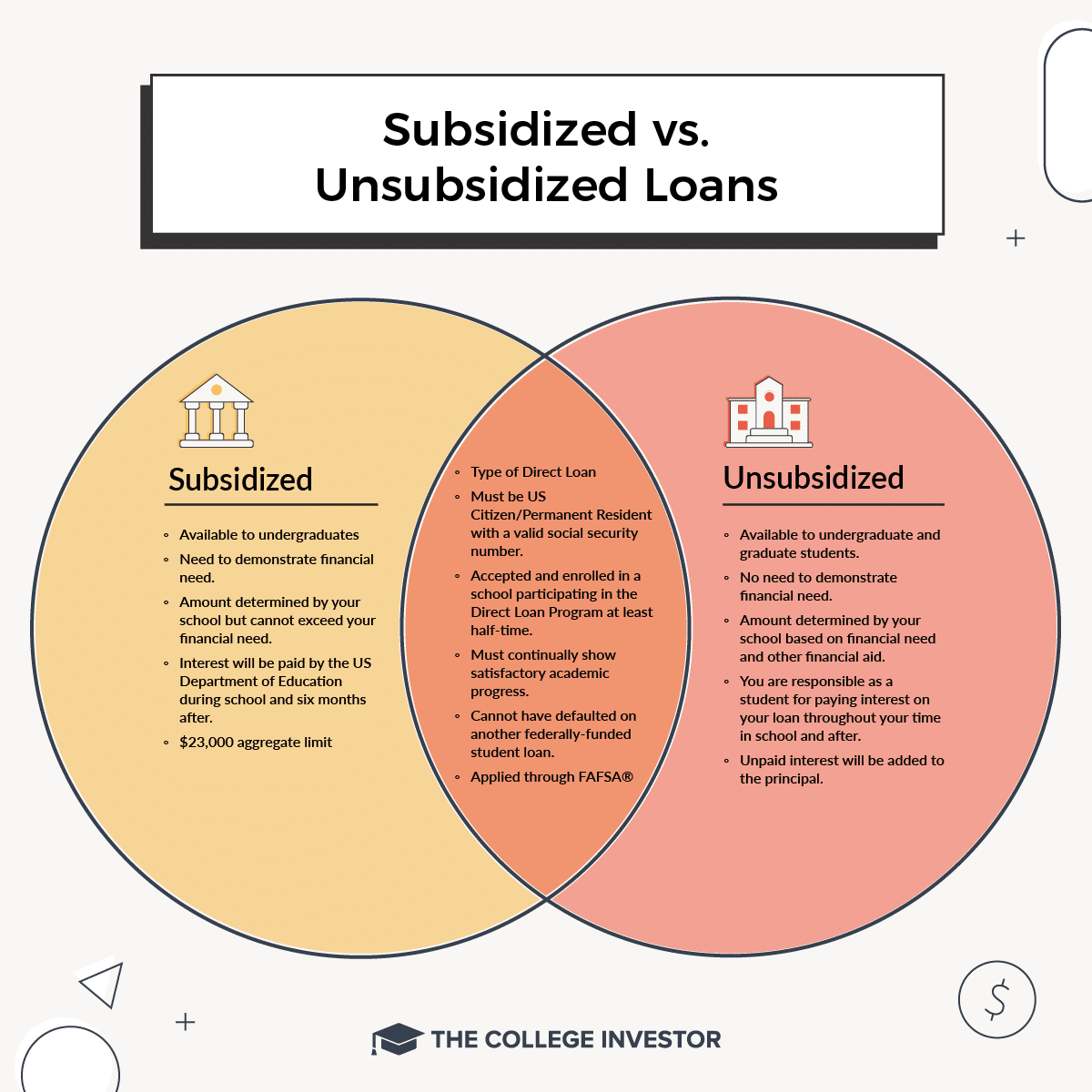
Table of Contents

Subsidized Student Loans
Unsubsidized Student Loans
Who Is Eligible For Direct Loans?
How Much Can You Borrow?
How Much Time Do You Have To Pay Off Your Direct Loans?
What If You Need To Borrow More?
Key Takeaways
Subsidized vs Unsubsidized Student Loans Infographic

Subsidized Student Loans

If you qualify for Federal Direct Subsidized Student Loans, you should definitely take advantage, as they are one of the best student loans you can get.

  • Direct Subsidized Loans are available to undergraduate students who have demonstrated financial need.

  • The amount you can borrow is determined by your school.

  • The loan amount will not exceed your financial need.

  • The US Department of Education will pay the interest on your loan while you are in school at least half time, during the first six months after you leave school (the grace period) and/or during an approved deferment.

Unsubsidized Student Loans

  • Direct Unsubsidized are available to undergraduate and graduate students. There is no need to demonstrate financial need.

  • The school you attend will determine your loan amount based on your financial need and other forms of financial aid you might be receiving.

  • Unlike the Subsidized program, you are responsible as a student for paying interest on your loan throughout your time in school and after you leave. (this is why this particular loan is “unsubsidized”). Any unpaid interests will be added to the principal.

Who Is Eligible For Direct Loans?

There are several factors to be aware of when it comes to qualifying for Direct Student Loans. There are also limits to how much you can borrow with Direct student loans.

  • In order to qualify for any Federal Student Loan program, you need to be US Citizen or Permanent Resident and have a valid social security number.

  • You must have been accepted and be enrolled in at a school that participates in the Direct Loan Program at least half-time.

  • If you are an undergraduate, you qualify both for the Subsidized and Unsubsidized Loans. As a graduate student, you only qualify for Unsubsidized Loan.

  • In order to continue receiving funds, you need to continue to show satisfactory academic progress.

  • You must not already be in default of another federally-funded student loan

  • If you determine from the above criteria that you are eligible, you would then move on to fill out the Free Application for Federal Student Aid (FAFSA®).

Something to note: Most males students need to be registered with the Selective Service in order to receive Federal Aid. 

How Much Can You Borrow?

There are different borrowing limits depending on if you're a dependent student or independent student. The limits also change based on what year of school you're in. 

If the amount your school determines is more than you actually need, you can also borrow less money – something that will come in handy if it is your goal to pay off your student loans faster.

When your loan is awarded, it will be sent directly to your school who will then apply the money to your school account to pay tuition and fees.

Here's the current student loan borrowing limits:

Year Of School

Dependent Student

Independent Student

First Year Undergraduate

$5,500 – No More Than $3,500 Subsidized

$9,500 – No More Than $3,500 Subsidized

Second Year Undergraduate

$6,500 – No More Than $4,500 Subsidized

$10,500 – No More Than $4,500 Subsidized

Third Year Undergraduate And Beyond

$7,500 – No More Than $5,500 Subsidized

$12,500 – No More Than $5,500 Subsidized

Graduate 

N/A

$20,500 – No Subsidized

Professional

N/A

$50,000 – No Subsidized

Note: All graduate and professional students are considered independent students. Also, graduate and professional students aren't eligible for subsidized loans. These loans also different than the Grad PLUS loan program, which was eliminated starting in 2026.

There is also a total loan limit you have to follow:

Dependent Students: $31,000, with no more than $23,000 subsidized

Independent Students: $57,500 for undergraduates, with no more than $23,000 subsidized

Graduate Students: Starting in 2026, $100,000 for graduate students. Prior to June 2026, the aggregate cap was $138,500.

Professional Students: Starting in 2026, $200,000. Prior to June 2026, the aggregate cap was $138,500.

How Much Time Do You Have To Pay Off Your Direct Loans?

With the Unsubsidized student loan, once you have graduated from school, you have a six-month “grace period” where you don’t necessarily have to make payments on your loan although you will have to pay any interest you accrued on the amount you borrowed.

In most cases, Subsidized student loan borrowers will not have to worry about payments until the grace period is over.

Your repayment period begins a day after the grace period ends – this holds both for Subsidized and Unsubsidized student loan borrowers.

Because you absolutely do not want to miss when your repayment begins, it is important that you communicate clearly with your loan servicer to get details the specific date your repayment period starts, how much you need to be paying and the methods of payments.

If for some reason, you are unable to pay the interest during the six-month grace period (under the Unsubsidized program) , the interest amount will be capitalized. This means that the interest amount will be added to the principal which can potentially increase the amount you have to pay each month.

Generally you will have between 10-25 years to pay off your student loans.

If you decide to consolidate your loans using the Direct Consolidation Program this time period is extended up to 30 years.

For both the Subsidized and Unsubsidized loans, you have the opportunity to use income-based repayment programs.

What If You Need To Borrow More?

Many people see those subsidized and unsubsidized student loan limits for undergraduates and don't know how they will afford to pay for college. And that's a rational fear if you were planning to borrow the full cost of college. But remember, paying for college is a pie – and there are a lot of different slices to choose from. 

For the full breakdown of the “best” way to pay for college, check out this article: The Best Way To Pay For College.

If you're already exhausted other options, and know your ROI on education, then you can look at private loans. 

We recommend students shop and compare private loan options before taking them out. Credible is an excellent choice because you can compare about 10 different lenders in 2 minutes and see what you qualify for. Check out Credible here.

We also have a full comparison tool on the Best Private Loans To Pay For College here.

Key Takeaways

  • If you are an undergraduate, your best option between these two loans is the Direct Subsidized Loan.

  • If you can borrow less on your loan, do it. You will have less to pay later.

  • The Department of Education will assign you a loan servicer once your loans are disbursed.

  • Make sure you know the contact information of your loan servicer and stay on top of any information they send you regarding repayment.

  • Take advantage of income-based repayment programs available to you.

We would love to hear your thoughts in the comments!

Editor: Clint Proctor

Reviewed by: Chris Muller

The post Subsidized vs. Unsubsidized Student Loans appeared first on The College Investor.

Total
0
Shares
Share 0
Tweet 0
Pin it 0
Roubens Andy King

Previous Article
Walmart is selling a 'soft'  summer dress for , and shoppers say it's 'very comfortable'
  • Trading

Walmart is selling a 'soft' $40 summer dress for $12, and shoppers say it's 'very comfortable'

  • July 19, 2025
  • Roubens Andy King
Read More
Next Article
RBC Capital Reiterates a Hold Rating on BP p.l.c. (BP), Sets a £4.50 Price Target
  • Business

RBC Capital Reiterates a Hold Rating on BP p.l.c. (BP), Sets a £4.50 Price Target

  • July 19, 2025
  • Roubens Andy King
Read More
You May Also Like
P!nk Announces First-Ever Las Vegas Residency, Set to Become Sphere’s First Solo Female Pop Headliner
Read More
  • Invest News

P!nk Announces First-Ever Las Vegas Residency, Set to Become Sphere’s First Solo Female Pop Headliner

  • Roubens Andy King
  • November 10, 2026
Make money with empty perfume bottles
Read More
  • Invest News

Make money with empty perfume bottles

  • Roubens Andy King
  • November 5, 2026
Why Do I Still Feel Like I Have Something to Prove?: Six Figures and the Seat I Was Already Sitting In – Perfection Hangover
Read More
  • Invest News

Why Do I Still Feel Like I Have Something to Prove?: Six Figures and the Seat I Was Already Sitting In – Perfection Hangover

  • Roubens Andy King
  • November 3, 2026
Mary J. Blige Calls Booing Heckler an ‘Idiot,’ Asks for ‘Polite’ Removal at Las Vegas Show
Read More
  • Invest News

Mary J. Blige Calls Booing Heckler an ‘Idiot,’ Asks for ‘Polite’ Removal at Las Vegas Show

  • Roubens Andy King
  • October 29, 2026
8 Cruise Tipping Mistakes That Can Make You Look Like a Rude Passenger
Read More
  • Invest News

8 Cruise Tipping Mistakes That Can Make You Look Like a Rude Passenger

  • Roubens Andy King
  • October 15, 2026
Kelly Clarkson Calls Brooklyn Store ‘Rude’ and a ‘Liar’ After It Denies Her Version of K Bird Dispute
Read More
  • Invest News

Kelly Clarkson Calls Brooklyn Store ‘Rude’ and a ‘Liar’ After It Denies Her Version of $15K Bird Dispute

  • Roubens Andy King
  • October 13, 2026
The High Street Wants Your Old Stuff Back: Where You Can Sell Furniture, Clothes and Tech
Read More
  • Invest News

The High Street Wants Your Old Stuff Back: Where You Can Sell Furniture, Clothes and Tech

  • Roubens Andy King
  • October 8, 2026
Scott Speedman Says Beau Bridges’ R.J. Decker Story ‘Isn’t Over Yet’ as His Love Triangle Gets Messier
Read More
  • Invest News

Scott Speedman Says Beau Bridges’ R.J. Decker Story ‘Isn’t Over Yet’ as His Love Triangle Gets Messier

  • Roubens Andy King
  • October 7, 2026

Recent Posts

  • ₹1,200/Hour Turf Business: Weekend Full, Phir Bhi Profit Kahan Gaya?
  • Never Throw Your Toll Slip #finance #shorts
  • P!nk Announces First-Ever Las Vegas Residency, Set to Become Sphere’s First Solo Female Pop Headliner
  • How To Invest In Gold (And What Kind Of Gold Is The WORST!)
  • Federal Reserve Board – Federal Reserve Board announces approval of two applications by Mutual Federal Bancorp, MHC, and MFB Bancorp, Inc.
Featured Posts
  • ₹1,200/Hour Turf Business: Weekend Full, Phir Bhi Profit Kahan Gaya? 1
    ₹1,200/Hour Turf Business: Weekend Full, Phir Bhi Profit Kahan Gaya?
    • November 11, 2026
  • Never Throw Your Toll Slip #finance #shorts 2
    Never Throw Your Toll Slip #finance #shorts
    • November 10, 2026
  • P!nk Announces First-Ever Las Vegas Residency, Set to Become Sphere’s First Solo Female Pop Headliner 3
    P!nk Announces First-Ever Las Vegas Residency, Set to Become Sphere’s First Solo Female Pop Headliner
    • November 10, 2026
  • How To Invest In Gold (And What Kind Of Gold Is The WORST!) 4
    How To Invest In Gold (And What Kind Of Gold Is The WORST!)
    • November 9, 2026
  • Federal Reserve Board – Federal Reserve Board announces approval of two applications by Mutual Federal Bancorp, MHC, and MFB Bancorp, Inc. 5
    Federal Reserve Board – Federal Reserve Board announces approval of two applications by Mutual Federal Bancorp, MHC, and MFB Bancorp, Inc.
    • November 9, 2026
Recent Posts
  • I Left Wall Street To Start A Coffee Business—Now It Brings In  Million A Year
    I Left Wall Street To Start A Coffee Business—Now It Brings In $3 Million A Year
    • November 8, 2026
  • Quantitative Aptitude: Mathematics Of Finance | CA Foundation Chanakya 3.0 FREE Batch 🔥
    Quantitative Aptitude: Mathematics Of Finance | CA Foundation Chanakya 3.0 FREE Batch 🔥
    • November 7, 2026
  • Best ETF | 💵 2000 USD invest | Global Invest
    Best ETF | 💵 2000 USD invest | Global Invest
    • November 6, 2026
Categories
  • Business (2,057)
  • Crypto (2,023)
  • Economy (368)
  • Finance Expert (1,687)
  • Forex (2,016)
  • Invest News (2,530)
  • Investing (2,040)
  • Tech (2,056)
  • Trading (2,024)
  • Uncategorized (2)
  • Videos (1,217)

Subscribe

Subscribe now to our newsletter

Money Visa
  • Privacy Policy
  • DMCA
  • Terms of Use
Money & Invest Advices

Input your search keywords and press Enter.