

Contemporary debates about Brazil’s growth potential – whether centred on the ‘middle income trap’, the slow pace of productivity growth, or the legacies of inequality – often frame it as a modern problem. Recent advances in historical national accounting suggest otherwise. New research on long run development demonstrates that some of Brazil’s growth challenges have roots stretching back centuries, in ways that carry implications for today’s policy choices.
A growing body of work in economic history has shown the value of reconstructing national accounts far back in time to shed light on modern performance. Studies for Asia, Europe, and Latin America (e.g. Ward and Devereux 2012, Abad and Van Zanden 2016, Broadberry 2021) have revealed how institutional legacies, labour-market structures, and patterns of market integration cast long shadows. These findings have increasingly shaped how economists think about persistent productivity gaps and divergent development paths.
Broadberry (2021) shows how centuries long trajectories illuminate present day constraints. The same logic applies to Brazil. Yet, until recently, we lacked a long-run GDP per capita series for the country before the 20th century – precisely the period during which many of the institutions and economic structures that shape Brazil today were forged.
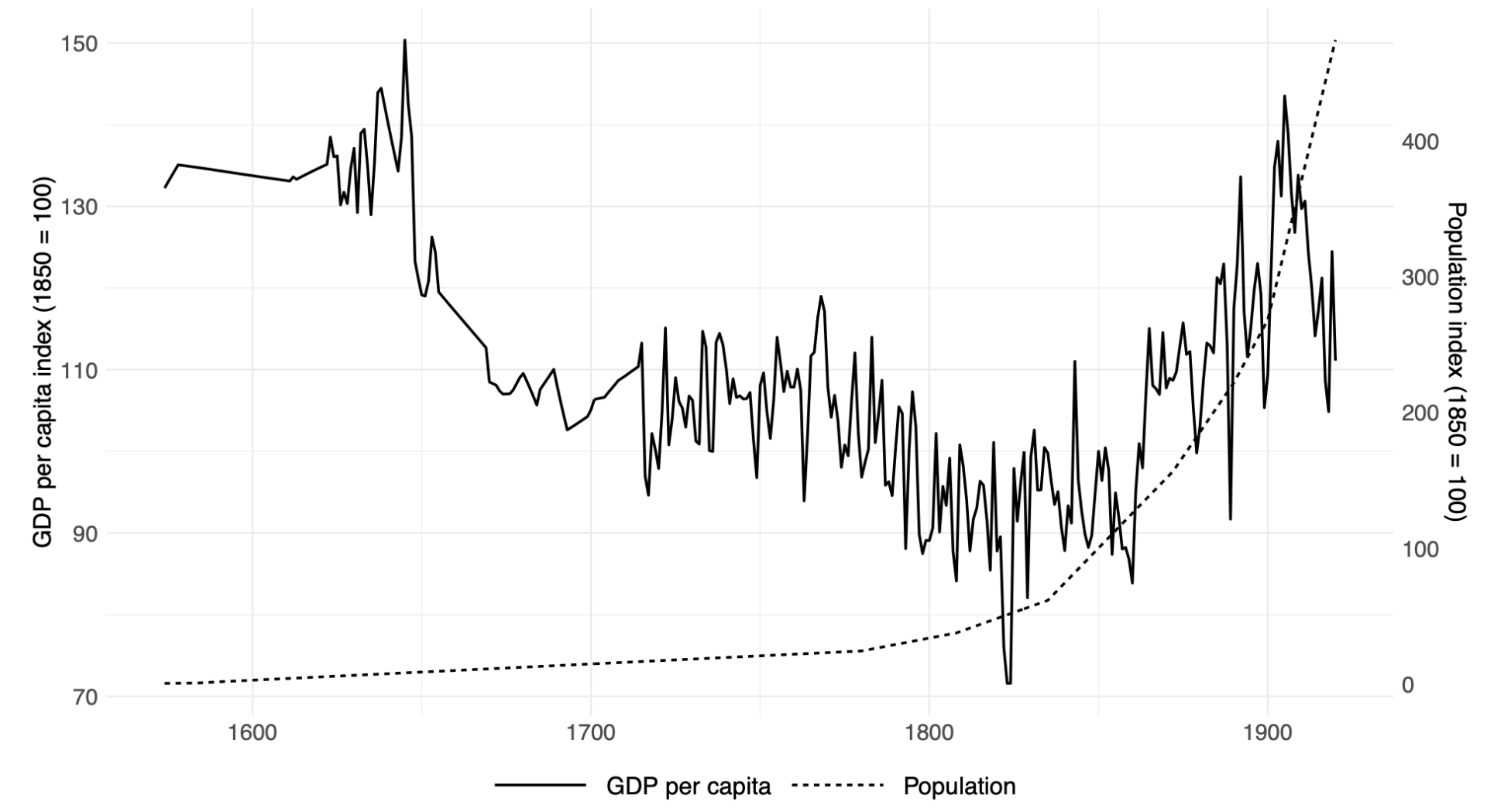
In a new paper (Lambais and Palma 2026), we advance the literature by constructing the first long-run series of Brazilian GDP per capita from 1574 to 1920, drawing on a new hand-collected dataset of over 30,000 archival observations of prices and wages from Bahia, Pernambuco, Rio de Janeiro, Rio Grande do Sul, and São Paulo (Figure 1). Our findings provide a fresh perspective on how the Brazilian nation emerged economically and why its modern growth constraints may be rooted deep in its past.
Figure 1 Real GDP per capita and population for Brazil, 1574–1920
A pattern of early high incomes and centuries of stagnation
One of our striking findings is that Brazil’s GDP per capita was surprisingly high in the late 1500s and early 1600s, comparable to Iberian Europe. However, this did not mark the beginning of a sustained take off. Instead, income levels declined over the 17th century and then remained nearly stationary for more than 200 years.
This prolonged stagnation is not unique. Other studies have shown similar patterns for parts of colonial Latin America (Abad and Van Zanden 2016) and for resource rich economies trapped in extractive institutional equilibria. But Brazil stands out for the duration of this low growth equilibrium and the absence of a structural break despite major shifts in export commodities, frontier expansion, or demographic change.
The 18th century gold boom created a brief upswing in incomes – a pattern consistent with the temporary effects predicted by classic resource boom dynamics. Recent work on Portugal’s contemporaneous ‘resource curse’ shows similar dynamics (Kedrosky and Palma 2025). Like in Portugal, the boom faded quickly in Brazil, leaving no sustained lift in productivity or living standards.
Institutions, slavery, and the foundations of the Brazilian economy
Why did such a large, resource-rich colony integrated into global commodity networks fail to achieve persistent growth? Earlier interpretations in Brazilian historiography often pointed to the structure of plantation agriculture, the dominance of latifundia, or limited domestic markets. Others, most notably the revisionist work of Leff (1972), argued that a large and elastic labour supply – sustained by slavery and later immigration – prevented the emergence of wage pressures that might have prompted productivity-enhancing change.
Our findings help reconcile these debates. Using a framework similar to broadly accepted approaches in long run historical national accounting (e.g. Palma and Reis 2019), we explicitly model the economic impact of slavery by accounting for the consumption patterns of enslaved populations, who represented roughly a quarter of Brazil’s population until the mid 19th century.
Slavery depressed effective demand, but the economy’s heavy dependence on coerced labour also slowed the incentives for technological change and mechanisation. This mirrors findings from other slave societies and is consistent with recent work examining the long-run consequences of slavery across the Atlantic world. Prohibitions of the slave trade in 1808, 1831, and finally in 1850 and the end of slavery in 1888 coincide closely with the first sustained rise in Brazilian GDP per capita, suggesting a tight link between the end of coerced labour and the onset of modern growth. Slavery was not the only factor, but our results indicate it was a central and previously under quantified one.
Independence and the slow rise of the 19th century
Independence in 1822 did not immediately transform the economy. Our reconstruction shows modest declines associated with the wars of independence and early nation building. But from the 1850s onward, Brazil experienced its first persistent increase in living standards, with per capita GDP rising at roughly 0.7% annually during the imperial period (1822-1888) and over 1% during the early Republic. This rise is associated with the expansion of the coffee economy, fall in mortality rates, early infrastructural improvements, and gradual institutional modernisation shown in the literature.
Still, Brazilian growth remained modest compared to the dramatic acceleration of contemporary industrialising economies in the North Atlantic. By 1920, Brazil had fallen decisively behind Western Europe and the US, even though it compared relatively well within Latin America and with Portugal.
International comparisons: A widening divergence
Setting Brazil alongside England, Mexico, Peru, Portugal, Spain, Sweden, and the US shows several defining features of Brazil’s long run path (Figure 2). Brazil saw centuries of near stationary income per head: from 1574 to the late 1800s, Brazil remained within a very narrow income band. This contrasts sharply with Northern Europe’s gradual early modern rise.
Figure 2 International comparisons, 1574–1920
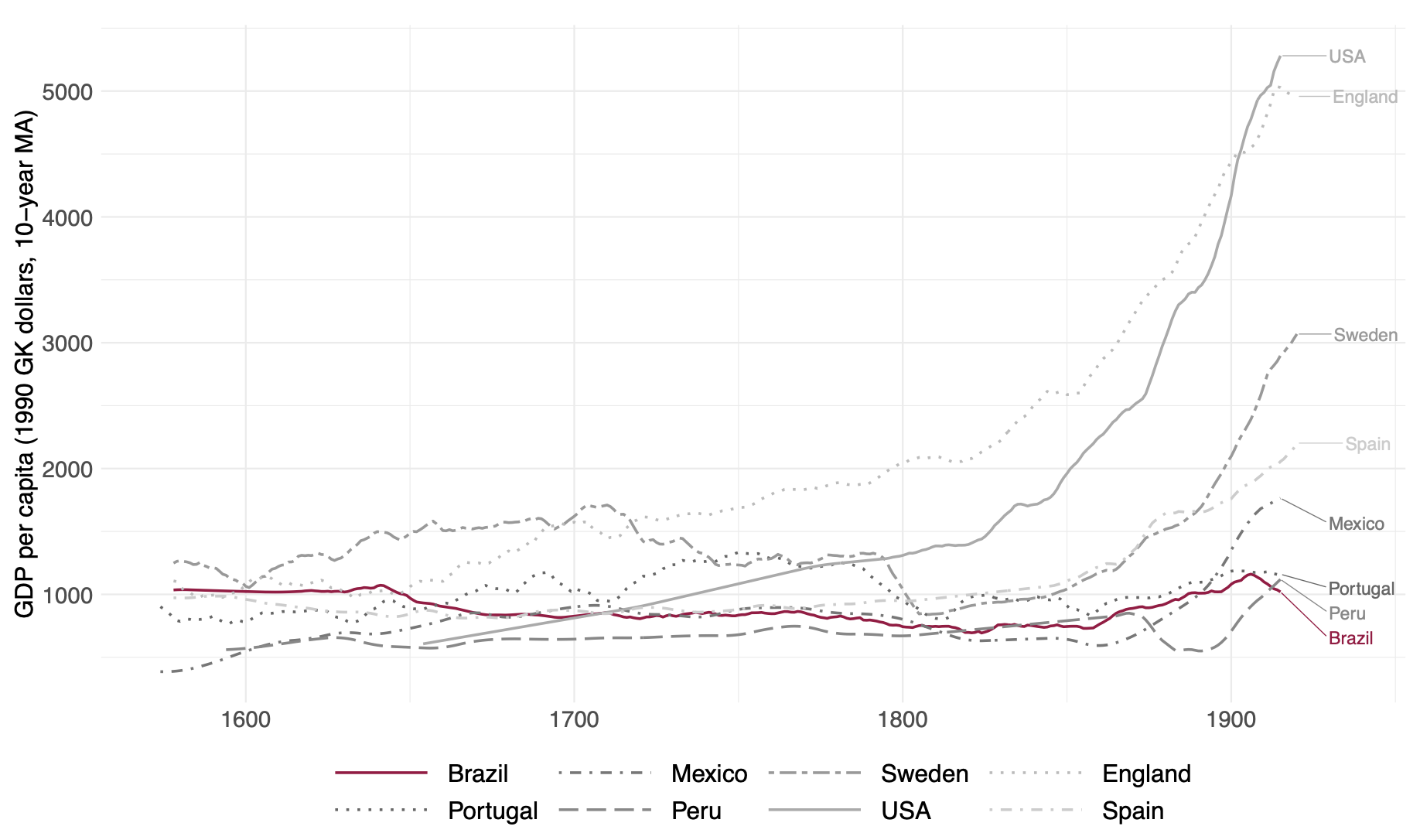
Relatedly, there were commodity booms without structural transformation. Short run surges in output – sugar in the early period, gold in the 18th century, coffee in the 19th – generated income spikes but did not durably raise productivity. Finally, there was late and only modest modern growth. Only after slavery’s decline and the partial deepening of domestic markets does growth emerge, by which point the global frontier had moved far ahead. In other words, Brazil did not fall behind because of a dramatic collapse, but because others accelerated while Brazil remained stuck at a low baseline.
Implications for today’s policy debates
This long-run history has implications for present-day Brazil. First, modern challenges have deep historical roots. The slow pace of productivity growth, weak domestic markets, and persistent inequality did not originate in the 20th century. They reflect an economic structure shaped by centuries of low effective demand, high inequality, and institutionally embedded coercion.
Second, our findings support the notion that economies with narrow consumer bases struggle to generate endogenous productivity gains. Brazil’s development path exemplifies this mechanism.
Third, inequality is not just a social issue, but also a growth issue. The legacy of slavery is visible not only in present-day inequality but also in the long shadow it cast over aggregate economic performance. Policies aimed at broadening market participation – through education, credit access, and productivity-oriented inclusion – address both social justice and growth potential.
Finally, institutional change takes time. Brazil’s eventual growth in the late 19th century followed significant institutional shifts. Today’s debates about judicial reform, tax reform, and state capacity should be understood through the same lens: institutional choices accumulate and shape possibilities over the long run.
Conclusion
The emergence of the Brazilian nation was not accompanied by early economic dynamism. Instead, for over two centuries, the economy remained remarkably stable and low by international standards. Only after the mid 19th century did Brazil begin its first sustained rise in incomes, and even then, the ascent was modest compared to the explosive growth of industrial leaders.
This long-run perspective reframes current debates. Brazil’s modern challenges stem not from decades of policy mistakes but from the deep economic structures formed across centuries. Recognising this history can help shape more realistic, and ultimately more effective, policy strategies for sustainable and inclusive long-run growth.
References
Abad, L, and J L Van Zanden (2016), “Growth under extractive institutions? Latin American per capita GDP in colonial times”, Journal of Economic History 76(4): 1182–215.
Broadberry, S (2021), “Accounting for the Great Divergence: Recent findings from historical national accounting”, VoxEU.org, 20 April.
Kedrosky, D, and N Palma (2025), “The cross of gold: Brazilian treasure and the decline of Portugal”, Journal of Economic History 85(3).
Lambais, G, and N Palma (2026), “How a nation was born: Brazilian economic growth, 1574–1920”, CEPR Discussion Paper 21341.
Leff, N (1972), “Economic retardation in nineteenth‑century Brazil”, Economic History Review 25(3).
Palma, N, and J Reis (2019), “From convergence to divergence: Portuguese economic growth, 1527–1850”, Journal of Economic History 79(2).
Ward, M, and J Devereux (2012), “The road not taken: Pre‑revolutionary Cuban living standards in comparative perspective”, The Journal of Economic History 72(1): 104–32.