


Many of the businessmen I know are well-versed in economics, but none uses the science in their daily work. No other science is so thoroughly ignored by its practitioners. The reason is that economics went astray by borrowing ideas from physics.1 This mischaracterizes commerce as a “closed equilibrium system.”2 Commerce is instead a complex, adaptive, and open system in constant disequilibrium.3
Economics should instead borrow ideas from evolutionary biology. After all, early economists were the first to recognize evolutionary processes. The political economist Thomas Malthus spoke elegantly about the “struggle for existence” in 1798.4 Charles Darwin even credits Malthus with his concept of “natural selection,” or “survival of the fittest,” which was his core insight in Origin of Species.5
Applying Malthus’s concept to biology, Darwin rightly noticed:
[C]an we doubt (remembering that many more individuals are born than can possibly survive) that individuals having any advantage, however slight, over others, would have the best chance of surviving and of procreating their kind? On the other hand, we may feel sure that any variation in the least degree injurious would be rigidly destroyed. This preservation of favourable individual differences and variations, and the destruction of those which are injurious, I have called Natural Selection, or the Survival of the Fittest.6Charles Darwin
The same is true of commercial firms. Many more firms are born than can survive. Advantaged firms, however slight the advantage, have the best chance to survive and expand while others die. Favorable variations are thereby preserved while injurious variations are destroyed. This is “natural selection.” Accordingly, commerce is evolutionary, and economics should recognize this reality.
To say commerce evolves is no metaphor. It is true in a technical sense. Any population subject to “cumulative selection” pressure will evolve, which is true if the population’s agents (1) replicate with fidelity, (2) have variable and heritable traits, and (3) replicate at rates based on their variable traits.7 Commercial products undoubtedly possess these characteristics:
Products are reproduced with great fidelity by firms, which means they replicate. Products also possess variable traits, and those traits influence a product’s replication rate. Ford, for example, cannot sustain, much less expand, the F-150 product line if consumers do not select the F-150 over substitutes, and consumer selection hinges on the F-150’s differentiating traits.8
This is not debatable. Furthermore, the focus should be on products, not firms, which is a Neo Darwinian view. Neo Darwinism revolutionized biology. The theory says the proper unit of evolutionary analysis is the gene, not the organism as Darwin had thought. Genes are the true “replicators,” in other words, and organisms are merely their “survival machines.”
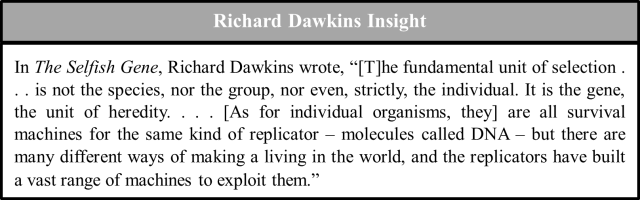
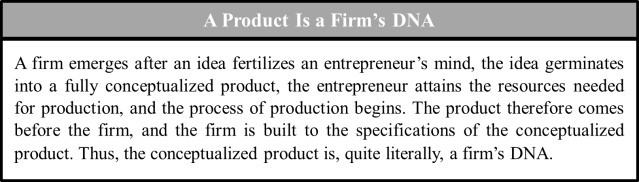
A similar hierarchy exists in commerce. A product, whether a good or a service, is a firm’s DNA, and products comprise many sub-units, or “premes.” The preme is the gene of commerce; they are the “units of heredity” differentiating product-lines. Accordingly, premes are the primary “replicators” of commerce, and firms, like organisms, are merely their “survival machines.”
The Firm Is a Commercial Organism
A firm, like an organism, is “an open system that survives through some form of exchange with its environment.”9 It requires energy to sustain itself. Without energy, a firm will surrender to the forces of entropy and dissolve into its surroundings. Like any organism, therefore, a firm must “make a living” by earning an energy surplus absent external infusions of resources.
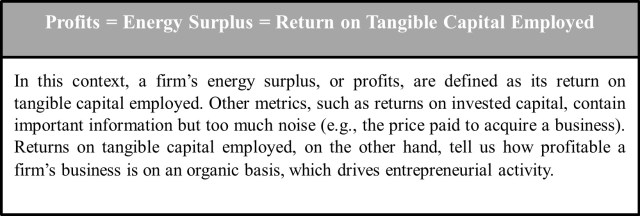
To earn an energy surplus, a firm’s energy intake, or revenues, must exceed its energy expenditures, or costs, including its cost of capital. That is, a firm must produce a product consumers deem more valuable than the resources employed by the firm in production. If achieved, a firm will earn an energy surplus, or profit, and survive. If not, a firm will earn an energy deficit, or loss, and die.
The more profitable a firm is, the more value it creates, and value creation determines the “fitness” of a firm. Thus, a firm that earns a 20% profit is “fitter” than a competitor earning 5%. The former is better adapted to the demands of its niche. “Fitter” firms will have higher survival rates and grow faster. Their products will thereby gain market share. This is how a species of industry evolves.
Investors should therefore prefer “fit” firms, or those earning large profits. Large profits attract competition, however. It signals to entrepreneurs an opportunity to create value of their own. To do so, entrepreneurs will replicate the differentiating traits of a “fit” firm’s product. How, then, can a “fit” firm sustain its economics? This is where an evolutionary perspective becomes most useful.

The Preme-Product-Firm Hierarchy: A New Model
Evolutionary theory is the best tool for assessing the sustainability of profits. Excess profits cannot be sustained without durable competitive advantages, and durable competitive advantages are best understood through an evolutionary lens. Such a lens must be properly focused, however, on the proper unit of evolutionary analysis. In commerce, this is the product and its “premes.”
A firm depends on consumers for nourishment. Consumer selection occurs at the product level, however, which means products, not firms, are the proper units of evolutionary analysis. More specifically, since the value proposition of a product (e.g., Ford’s F-150) depends on its various sub-units (e.g., engine, brand, style), the proper unit of analysis is best described as the preme.
Products, in other words, are like DNA. They are complex structures of subunits called premes, and premes, like genes within DNA, battle for inclusion in products. A preme is any attribute impacting a product’s value proposition. It can be as minor as employees saying, “My pleasure,” at Chick-fil-A or as major as iOS for Apple products.
Premes are thus the “premetic material” of products and their firms, and premetic material is all around us in the form of ideas. It floats about like pollen ready to fertilize a receptive entrepreneur’s mind. As such, premetic material mutates, or changes, at warp speed. It takes only a new idea. And mutations alter products quickly as entrepreneurs adopt the most promising bits of information.
As the product is altered, so too is the structure of the respective firm in the form of employee skills, operating processes, production equipment, raw inputs, vendors, distribution channels, etc. In other words, our theory counterintuitively suggests products create and shape firms in the same way DNA creates and shapes organisms. It is not firms that create and shape products.
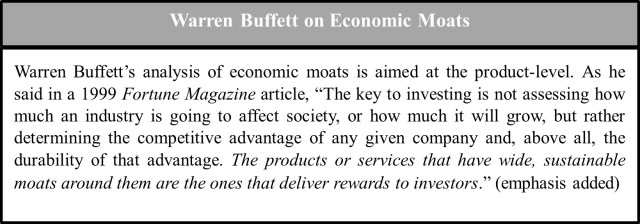
To earn excess profits, a firm’s product must offer consumers a superior, differentiated value proposition. This requires, by definition, premetic material unique to the firm’s product. Otherwise, profits will erode with commoditization as its premetics diffuse into competing product lines. Thus, the sustainability of a firm’s “fitness,” or excess profits, hinges on the rate of premetic diffusion.
Unique premetic material is the source of excess profit. For excess profits to be sustainable, then, some firm-specific attribute must forestall premetic diffusion into competing product-lines. Such attributes are competitive advantages or economic moats. There are many firm-specific attributes that forestall premetic diffusion, including brands, search costs, economies of scale, and more.
Two examples: Apple and Ford
Apple | A “Fit” Firm: Apple’s operating system, iOS, is a trait consumers value, and its proprietary nature forestalls diffusion. It provides durably differentiated premetic material for Apple, which, in turn, gives Apple a durable competitive advantage. As a result, Apple consistently earns more than 200% on tangible capital employed.10
Ford | An “Unfit” Firm: Ford has almost no unique premetic material. Its products are composed of sub-units, or premes, sourced from non-exclusive suppliers. Ford therefore lacks the raw material needed for a durable competitive advantage. As a result, Ford consistently earns subpar returns on tangible capital employed (i.e., 4.7% in 2023).11
The difference in profitability at Apple and Ford is due to the nature of each firm’s premetic material. Apple’s is unique; Ford’s is not. The former consistently earns excess profits; the latter does not. Apple is worth far more than tangible book value; Ford is not. Apple’s profitability is unique to its industry; Ford’s lack thereof is the norm for its industry.
Key Takeaway
Green with physics envy, the science of economics is focused on what can be measured. Economics today is akin to the drunk looking for his keys under the lamppost. When asked if that is where he lost them, he replies, “No. But this is where the light is.” We can and must do better.