

Across the UK and other developed countries, there is a growing perception that social progress has stalled. Public concern about inequality has risen, along with broader anxieties related to the rise of populism, declining trust in institutions, climate inaction and demographic pressures (see Benson et al. 2024, for example, for evidence from the UK).
Many of these broad concerns can themselves be connected directly back to economic, social, political, or geographical inequalities. In a cross-national analysis of 92 countries over the period 1995-2020, Rau and Stokes (2024) provide robust statistical evidence that economic inequality is strongly associated with the erosion of democratic norms and institutions.
In a new book (Johnson et al. 2026), based on work from the IFS Deaton Review: Inequalities in the 21st Century, we emphasise that material inequality cannot be understood or addressed in isolation. People care not only about income but also about the sources of income, the availability of meaningful work and progression in the labour market for themselves and their children, and the strength of their communities. Although redistribution through taxes and benefits matters, it cannot replace an economy that provides good jobs – secure, well paid dignified jobs with opportunity for career progression.
While headline measures of disposable income inequality have remained relatively stable, deeper structural forces – including stagnant real earnings, weak progression for low-educated workers, declining training and regional divergence – pose persistent challenges.
High inequality combined with prolonged economic stagnation since the global financial crisis of 2007-09 has been particularly corrosive. It has made life harder for those at the bottom of the earnings and skills distribution where incomes have stopped growing, and at the same time given greater advantages to those with access to wealth as inheritances and intergenerational transfers become increasingly important determinants of life chances. This has widened social, cultural, and political divides, especially between the highly educated and the rest, fuelling a narrative of an out of touch elite and undermining democratic legitimacy.
Social mobility has slowed: the circumstances into which people are born increasingly shape their opportunities. Structural economic changes – deindustrialisation, the shift to services and the concentration of high skill work in specific regions – have produced stark geographical divides between thriving places (notably London) and ‘left behind’ areas.
Inequality as a multidimensional dynamic process
We argue that in the face of these forces, inequality should be analysed as a multidimensional dynamic process not a unidimensional outcome. A full understanding must capture its evolution across the lifecycle, the interaction of family background, education and labour market trajectories, the role of firms and productivity, regional disparities, and the intergenerational transmission of advantage. It must also acknowledge how inequalities in health and disability can mirror and magnify these economic and social inequalities.
Using this framework, we focus on five core principles for thinking about inequality:
Inequalities of opportunity and outcome are intertwined
Highly unequal outcomes will inevitably generate unequal opportunities for the next generation. Education alone cannot eliminate these links as its effects depend on family background, labour market structures, and geography.
Income redistribution is necessary but insufficient
Cash transfers cannot repair relational harms – such as stigma, loss of autonomy, or the collapse of meaningful work – nor can they fully compensate communities damaged by economic change. Strong labour markets with skill development, effective industrial policy and good infrastructure and public services are essential.
Major economic policies must consider distribution
The disruptions from trade liberalisation, migration, climate policy, and macroeconomic stabilisation have adverse side-effects that too often have been ignored, producing long term social and political damage that later fuels populism and protectionism.
Initially fair market processes can still lead to extreme and unfair inequalities
Technological change, globalisation, and agglomeration create large ‘winner takes most’ outcomes that can undermine competition, entrench market power, reduce social mobility, and distort political influence.
Growth is essential
The UK’s unprecedented post 2008 stagnation has intensified intergenerational inequality, made wealth more important than income, reduced mobility, and undermined the fiscal capacity needed to support welfare services.
Redistribution and predistribution
While redistribution through taxes and benefits can in principle keep the lid on cross-sectional inequality of disposable income, it has become clear that redistribution alone cannot resolve deeper structural problems. Economic change – globalisation, technological progress, demographic shifts, climate transition – requires proactive shaping rather than passive compensation. A central theme is the importance of what some commentators have called ‘predistribution’: designing labour markets, education systems, public services, and economic institutions so that harmful inequalities are reduced before taxes and transfers intervene.
Within this agenda, we identify three overarching areas of particular challenge in the UK:
- The first is wealth and housing. Rising wealth and soaring housing costs have entrenched inequalities between generations and between renters and owners. Homeownership has declined sharply for the young, increasing the influence of inheritance and parental wealth.
- The second is geography. Spatial divides limit national productivity and restrict opportunities for those outside prosperous regions.
- Finally, health inequalities reflect the cumulative impact of social and economic disadvantages. Large and growing gaps in life expectancy illustrate the profound human consequences of inequality.
Refocusing policy responses
Without taking a stance on the minutiae of specific policy recommendations, we believe that there are some core areas where substantive debate is needed in order to refocus and redirect policy. The issues are complex and interrelated, and the policy choices are tough – if there were easy wins or low hanging fruit in any of these areas, it would been uncontroversial to implement them already. Real commitment requires confronting difficult trade offs and acting across multiple fronts.
Skills and human capital
A first set of policy discussions should relate to skills and human capital. The education system is vital, and it can be improved. It does not do enough to counteract the deep influence of family background, wealth, geography, and labour market structures. The way in which home environments and parental behaviours support children’s development and how family background and parental choices interact with the schooling and university system need careful consideration. But even then, too much expectation can be loaded on this system.
The GCSEs to A-levels to higher education pathway in England results in a system that is relatively high-stakes (internationally speaking) with little in the way of second chances. Simply expanding higher education alone may widen inequalities if better off groups benefit more from such changes.
The pathway for those who do not succeed academically at age 16 and age 18 is complex, poorly resourced, and in need of reform. The existing system needs to be supplemented by more extensive attention and support for further education, along with a continued emphasis on applied skills and training-based qualifications that match with new technologies. Firm-based qualification training at successful local workplaces, coupled with the development of social skills can significantly improve wage growth. Integrating training support with in-work benefits for parents could help to sustain attachment while promoting human capital accumulation.
Place-based policies and regional productivity
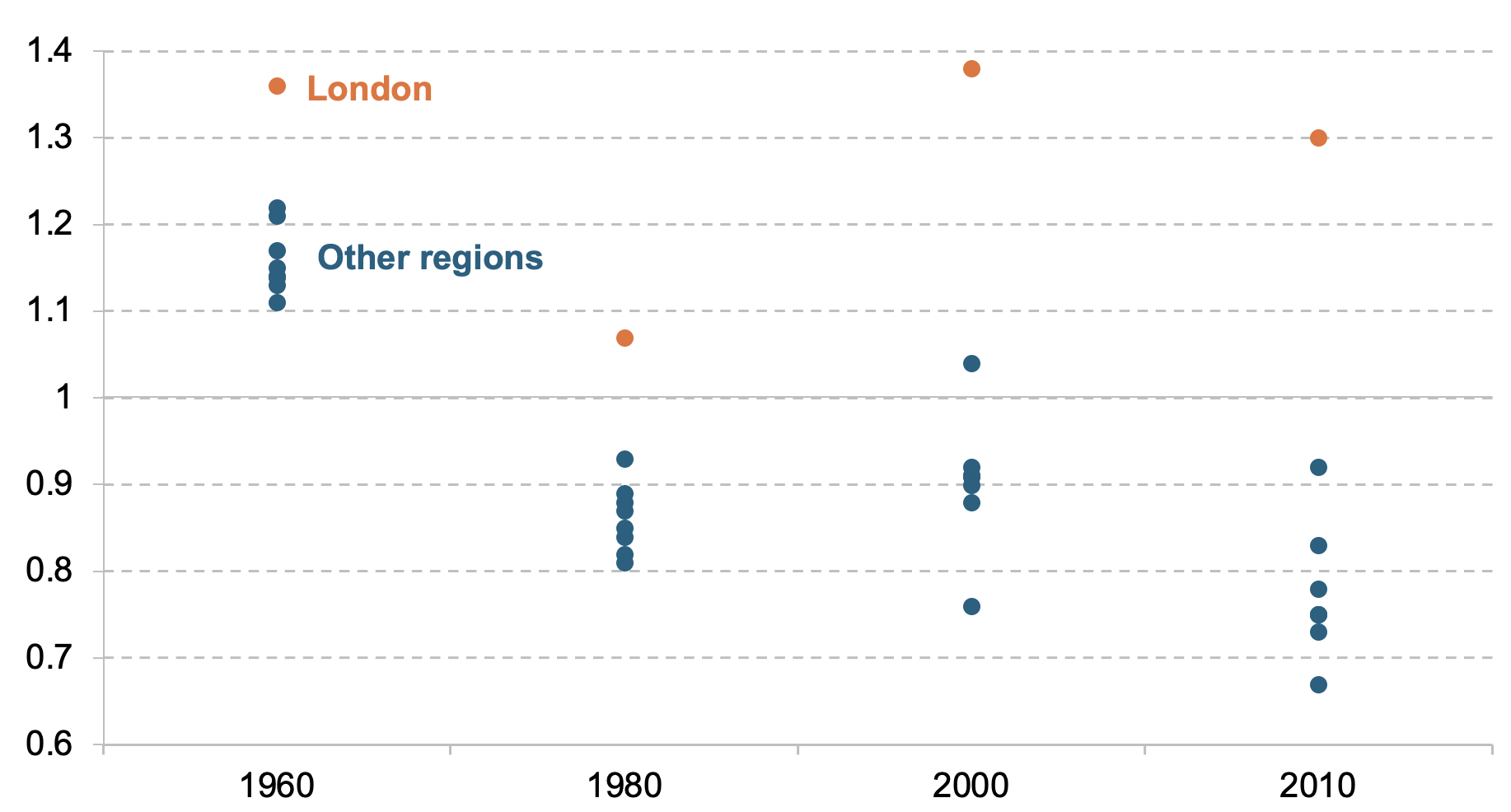
A second set of discussions is needed in the area of place-based policies and regional productivity. Geographically, the UK has developed an unusually extreme regional divide. High skill jobs cluster in London and the South East, benefiting from powerful agglomeration effects. But a country the size of the UK should have at least two or three other successfully agglomerated areas to attain its full productive potential. As Figure 1 shows, in terms of GDP per worker, the UK regions have steadily fallen further behind not just London but also the EU average.
Figure 1 UK regional GDP per worker relative to European mean, 1960-2010
Source: Allen (2024).
‘Educational flight’ can drain talent from poorer regions, but housing costs restrict mobility, especially for young people without family wealth. Thus, the consequences of the UK’s economic geography are harmful to both social mobility and productivity. When disadvantage across multiple dimensions of inequality come together, the market is unable to overcome the negative agglomeration.
No single policy intervention is likely to work. What is needed is a new industrial strategy that addresses the structural roots of regional inequalities – improving regional economic ecosystems, developing and retaining the right skills, nurturing local innovation, attracting productive firms beyond London, and reforming housing and transport infrastructures.
Place-based policies that attract innovative firms and support skill complementarities are therefore central to addressing inequality. Simply connecting places to London and the South East more efficiently, encouraging productivity and innovation in these successful regions and dealing with left-behind areas through redistribution is insufficient. Productivity in the regions beyond London needs to be supported by regional and interregional infrastructures, but this is hindered because UK governance is unusually centralised. Insufficient devolution hinders local capacity to promote growth.
Wealth and housing
Third, there is no escaping the increased importance of wealth and housing. Arguments for and against new wealth taxes should not distract from other broader issues. Existing taxes that are based on property values are poorly designed and out of date. Inheritance taxes could also play more of a role; in a public finance sense, they effectively insure new generations from inequalities arising from ‘accidents of birth’ – that is, being born into rich versus poor families.
Even the role of planning regulations in driving house prices and housing market dynamics would be in scope for the debate here. But regional housing markets, regional labour markets and educational and social mobility are all interconnected. None of these three areas of policy debate can happen in isolation.
A renewed social consensus
More generally, however, and well beyond these three specific areas, addressing inequality requires more than policy tinkering: it demands a renewed social consensus on inclusive growth, opportunity, fairness and shared responsibility. For our democracies to respond to the challenges that we mention, we surely need to have our politics engage with citizens’ concerns and that could mean strengthening voice.
How to do this is not easy. Radical solutions (by UK standards) of greater decentralisation of power regionally and moving towards proportional representation are things that should arguably be part of this conversation, although they are not a silver bullet when one starts to think through the detail. But only by integrating distributional concerns into political and economic decision-making and rebuilding broad democratic coalitions can governments address the inequalities that threaten social cohesion and long-term prosperity.
References
Adam, S, J Cribb, I Delestre, C Farquharson, H Miller, T Waters and X Xu (2026), Public policy and inequalities: Lessons for policymakers from the IFS Deaton Review, IFS.
Allen, R (2024), “Technical change, globalization, and the labour market: British and American Experience since 1620”, Oxford Open Economics 3 (supplement_1): i178-i211.
Benson, R, B Duffy, R Hesketh and K Hewlett (2024), “Attitudes to inequalities“, Oxford Open Economics 3(Supplement_1): i39-i63.
Johnson, P, J Banks, R Blundell, T Besley, A Deaton, R Joyce and D Satz (2026), Challenging Inequalities: How we got stuck and where we go next, Princeton University Press.
Deaton, D et al. (eds) (2024), Dimensions of Inequality: The IFS Deaton Review, Oxford Open Economics 3 (supplement_1).
Rau, E G and S Stokes (2024), ‘Income inequality and the erosion of democracy in the twenty-first century’, PNAS 122(1), e2422543121.
Appendix
The IFS Deaton Review of Inequalities was run by the Institute for Fiscal Studies (IFS) over the period 2019-25. Chaired by economics Nobel laureate Sir Angus Deaton and funded by the Nuffield Foundation, the Review brought together a multidisciplinary panel of leading scholars – from economics, philosophy, sociology, epidemiology, public health and demography – seeking to understand the causes, consequences and moral relevance of inequalities.
Given the scale and complexity of the challenge, the panel commissioned 144 authors to produce 74 scholarly papers, published in Oxford Open Economics in 2024 (Deaton et al. 2024) and freely available online. These evidence papers and commentaries provide a valuable resource to all those seeking to understand specific aspects or dimensions of inequality.
In the second phase of the review, a subset of the panel co-authored a volume synthesising the overarching themes that emerged from the full panel’s deliberations and discussions, providing an integrated framework for understanding inequality across domains. Following the Review, an IFS briefing paper sets out some reactions and recommendations with specific relevance to issues in the UK debate (Adam et al. 2026).