
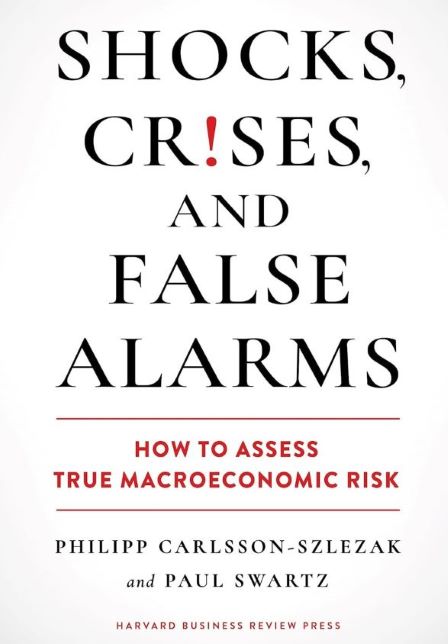

Shocks, Crises, and False Alarms: How to Assess True Macroeconomic Risk. 2024. Philipp Carlsson-Szlezak and Paul Swartz. Harvard Business Review Press.
Good macroeconomic predictions and risk assessments are not easy to make, so maybe the problem should be reframed not as an effort in prediction but as a process of learning to develop better macro judgment.
Macroeconomic investment research is generally focused on the short run and tied to market behavior. It can be classified into three approaches to analysis: a quant school that links data to precise forecasts, a narrative school that talks through stories to provide macro awareness, and a hybrid school with narrative surrounded by supporting data. With clear evidence that most macro forecasts are problematic, these approaches can be unsatisfying. Shocks, Crises, and False Alarms presents a new way of thinking about and framing macro risks that is refreshing.
Co-authors Philipp Carlsson-Szlezak and Paul Swartz, respectively global chief economist and senior economist at Boston Consulting Group, are not at all part of the quant numbers school, so anyone looking for a better way to make precise forecasts will be disappointed. Similarly, the authors do not fall into the pure narrative or hybrid schools, which focus on current stories or historical comparisons.
Carlsson-Szlezak and Swartz attempt instead to develop for the general management audience a useful framework that gives readers a clear focus on what is meaningful for identifying critical macro shocks. For investment professionals, reading how consulting economists frame these questions provides an alternative perspective to recalibrate macro thinking. This contrasts with Wall Street economists, who are driven by the latest macro data announcement shocks on the stock and bond markets.
Carlsson-Szlezak and Swartz reframe good macro analysis as a process for developing better judgment about the economic environment and not specific forecasts. Get the big picture and direction right, and you have likely solved the problem. The authors’ key focus on navigating shocks and crises is based on understanding the economic operating system and three foundations:
1. Employ judgment and do not focus on a specific forecasting school or model framework.
2. Think of macro awareness as a debate, not a question to be definitively answered through specific output. To assess true macro risk, the reader must be aware that no master model exists because no single framework or model can explain the varied phenomena that managers face. A healthy skepticism regarding theory is necessary, along with a willingness to practice economic eclecticism and focus on the broad picture and trends.
3. Macro risk assessments should not be focused on the usual doom-mongering. There are, of course, critical concerns and risks, but there is also a resilience in modern economies that is often missed by focusing only on downside risk.
After setting this initial framework, the authors assess risks in three core areas: the real economy, the financial setting, and the global environment.
The real economic discussion can be broken into three parts: an assessment of the business cycle, the drivers of long-term growth, and issues associated with technology and productivity. Fundamentally, no real symmetry exists in the business cycle. A fast and steep economic decline will tell us nothing about the recovery. Managers should therefore look at the specifics of demand and what may drive the cyclical moves on the supply side, without trying to force their conclusions into a cyclical framework.
Thinking about long-term growth can be conceived as a move back to basics. Growth is driven and constrained by the key inputs of labor and capital, along with productivity. Whether the discussion centers on the United States or any emerging market country, a basic labor/capital growth model is a logical and useful starting point. Finally, a focus on technology and its impact is critical for any meaningful growth discussion. A shock from technology, the impact of productivity changes, and the consequences from labor and capital growth can be both promising and perilous for an economy, so following these dynamics is a useful exercise if you want to predict the future.
The financial economy must be viewed within a framework of policy stimulus that assesses both the willingness and the ability of policymakers to act. Capabilities must match policy desires. Carlsson-Szlezak and Swartz argue that viewing the macro environment only as a doom-monger will result in missed opportunities. Nevertheless, there are current financial risks that will weigh on the likelihood of future crises. Inflation is not easy to solve because the cure may not be viewed as an acceptable risk–reward tradeoff. The risk from the overhang of high debt is not going away because there is no desire to address the problem. A stimulated macro environment through fiscal and monetary policy is likely to create market bubbles — which can have both a positive and a negative economic impact.
The third core area of focus, the global economy, cannot be divorced from the analysis of a specific country. Trends in different economies tend to converge, yet they can also diverge and become more disjointed. The large convergence bubble across the globe may have ended, so we must accept a more disjointed world in the future. Trade will be affected by specific policies that are more mercantilist, so any view forward must account for disjointed behavior. Although the dollar’s possible demise has been the subject of an ongoing debate, its global dominance is unlikely to change, so global connectedness will endure.
The investment professional’s response to macro risks is often to avoid them and not even try to make a macro forecast or else fall into the trap of following doomsayers. A significant portion of risk and return is associated, however, with the macro environment, and the biggest investment opportunities arise from large macro shocks and crises. Simply avoiding upside and downside risk predictions will critically affect long-term returns, so there is value in employing macro judgment as a preparation for the future.
My own quantitative orientation, combined with top-down thinking in a global macro investing environment, generated a negative bias on my part toward the authors’ approach, Still, I found significant areas of agreement and derived some useful insights from their eclectic judgmental method.
Carlsson-Szlezak and Swartz attempt to add fresh thinking on framing macro shocks that may often prove to be false alarms. Generating a simple framework without falling into negative all-or-nothing thinking counterbalances the standard approach of many macro analysts. Similarly, the eclecticism embedded within the authors’ core framework minimizes the excessive optimism of some macro market boosters. Any general reader will obtain some key fresh insights with this work, and CFA charterholders will be offered an alternative to the conventional Wall Street approach to macro discussions.