

Business Insights
  • Home
  • Crypto
  • Finance Expert
  • Business
  • Invest News
  • Investing
  • Trading
  • Forex
  • Videos
  • Economy
  • Tech
  • Contact

Archives

  • May 2026
  • April 2026
  • March 2026
  • February 2026
  • January 2026
  • December 2025
  • November 2025
  • October 2025
  • September 2025
  • August 2025
  • July 2025
  • June 2025
  • May 2025
  • April 2025
  • March 2025
  • February 2025
  • January 2025
  • December 2024
  • November 2024
  • October 2024
  • September 2024
  • August 2024
  • July 2024
  • June 2024
  • May 2024
  • April 2024
  • March 2024
  • February 2024
  • August 2023
  • January 2023
  • December 2021
  • July 2021
  • November 2019
  • October 2019
  • September 2019
  • August 2019
  • July 2019
  • June 2019
  • May 2019
  • April 2019
  • March 2019
  • February 2019
  • January 2019

Categories

  • Business
  • Crypto
  • Economy
  • Finance Expert
  • Forex
  • Invest News
  • Investing
  • Tech
  • Trading
  • Uncategorized
  • Videos
Apply Loan
Money Visa
Advertise Us
Money Visa
  • Home
  • Crypto
  • Finance Expert
  • Business
  • Invest News
  • Investing
  • Trading
  • Forex
  • Videos
  • Economy
  • Tech
  • Contact
Book Review: Plunder - CFA Institute Enterprising Investor
  • Invest News

Book Review: Plunder – CFA Institute Enterprising Investor

  • August 12, 2025
  • Roubens Andy King
Total
0
Shares
0
0
0
Total
0
Shares
Share 0
Tweet 0
Pin it 0

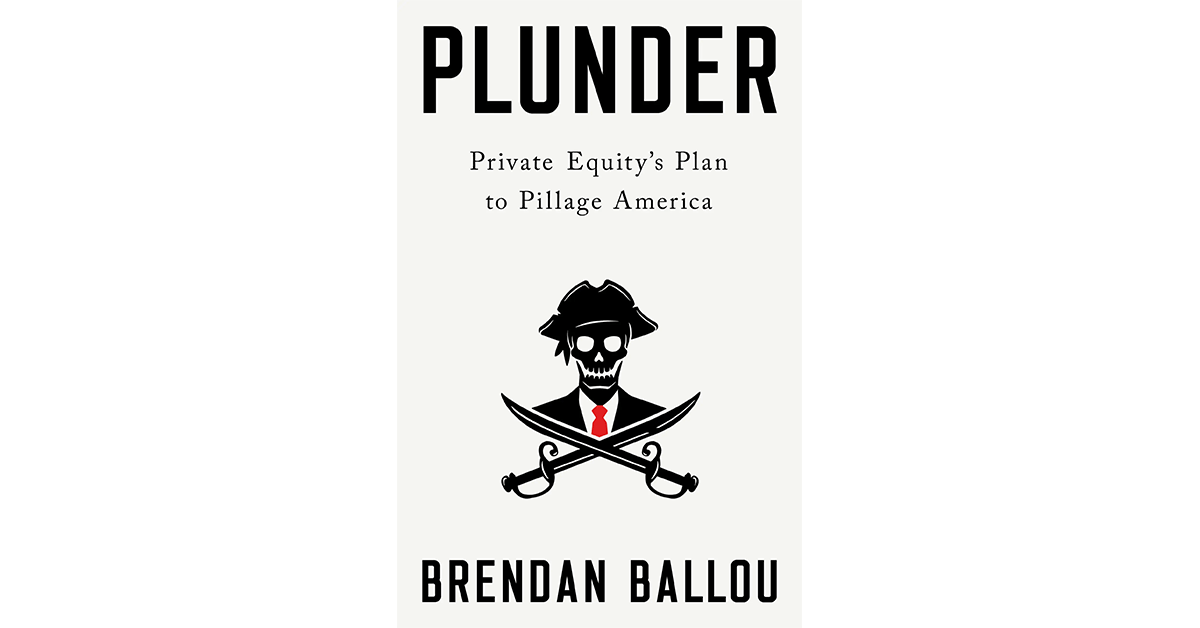
Plunder: Private Equity’s Plan to Pillage America. 2023. Brendan Ballou. PublicAffairs.


People stop in their tracks when they see the cover of the book I’m reading — Plunder — with its frightening depiction of skull and crossbones. “What are you reading? It must not be happy subject matter!”

Private equity investing is not everyday talk among friends — but considering its size and growth among investment choices and its possible impacts on the broader economy, it should be everyday conversation among investment professionals.

Author Brendan Ballou presents a meta-analysis of the worst of private equity investment practices, thus compelling investors to take a deeper look into their illiquid private equity commitments. With experience as a federal prosecutor and special counsel for private equity at the US Department of Justice, Ballou presents a comprehensive study that will influence decision makers’ analytical and ethical approach to the asset class. It will shake you up. It also serves as a call to action to monitor specific and repetitive activities of private equity that benefit the operators and no one else.

Like me, you may have a substantially different personal history with private equity investing than the author. More than 30 years ago, corporate executives and investors were seeking systematic ways to improve operating and financial efficiency. The concept of kaizen was sweeping Corporate America, even though it originated in Japan. It specifically dealt with the “continuous improvement” of a business through the elimination of waste. Just-in-time (JIT) inventory management became a buzzword in corporate earnings calls. This sort of tough medicine was the cure for what ailed US business. Consider the plundering by such “pirates” as “Chainsaw Al” — Albert J. Dunlap, infamous corporate raider and author of Mean Business: How I Save Bad Companies and Make Good Companies Great. We read of him almost every day when he was active in his business dealings, which seemed so mean to existing employees, suppliers, and customers. Still, it was widely thought that such practices were needed.

The present reality and possible future of private equity investing in the United States are Ballou’s focus. He presents industry-specific examples of private equity at its worst, prompting readers to evaluate their own experiences with it, both personal and professional. As he delves into the heavily affected industries— specifically housing, nursing homes, prisons, retailers, for-profit education, and health care — the persistent “tools of the trade” of typical private equity operation emerge: leasebacks, dividend recapitalizations, strategic bankruptcies, tax avoidance, roll-ups, and murky corporate structures.

Yet, Ballou also acknowledges the possible benefits of private equity investment, such as providing access to funding (or access at a lower cost), expert management by industry specialists, efficient global sourcing, operational and financial improvements, and even improved corporate and employee relations. Customers may benefit from greater consistency in product, faster access, and better pricing. Private equity firms can potentially profit from economies of scale and professional management at all levels, but in the cases presented in Plunder, their way of doing business results in disastrous conditions for employees and clients and the death of once viable, cash-rich companies.

Banner for CFA Institute Private Market Certficiate Pitchbook Banner

The carried interest loophole is probably the most prized tax benefit of private equity; it affects a substantial portion of the money made in the business. The typical fee of 2% of assets under management is taxed as ordinary income, while the private equity firm’s 20% share of profits earned above a specified threshold is taxed at the lower capital gains tax rate. Talk of ending this tax advantage has been floating around Congress for at least 20 years. Notwithstanding Dodd–Frank regulations and the 2019 attempted passage of the “Stop Wall Street Looting Act,” the plunder continues. The author notes that private equity is a potent force in congressional matters; these firms have donated more than $896 million on a bipartisan basis to candidates and members since 1990. Additionally, private equity could pose systemic risk to the economy, particularly because of its expansion into insurance, retirement funds, and private credit.

The author’s wish list of solutions to private equity abuses seems like a litany of impossible dreams to me, especially considering talk among some in Congress of achieving permanent spending cuts by reducing or eliminating certain departments that oversee business. Nevertheless, to constrain private equity firms’ abuses in specific industries and prevent private equity’s worst excesses, substantive actions could be taken through the Department of Justice, Department of Health and Human Services, the Securities and Exchange Commission, and most notably, the Internal Revenue Service and the Treasury Department. Some of Ballou’s suggested solutions are more realistic and practical than others. I commend the author for releasing this exceptionally well researched exposé of the industry. His extensive notes expand the book’s content and impact. Plunder has made me question the merits of private equity, an investment I originally considered to have a high level of investment integrity and a positive influence on corporate governance.

If you liked this post, don’t forget to subscribe to the Enterprising Investor.


All posts are the opinion of the author(s). As such, they should not be construed as investment advice, nor do the opinions expressed necessarily reflect the views of CFA Institute or the author’s employer.


Professional Learning for CFA Institute Members

CFA Institute members are empowered to self-determine and self-report professional learning (PL) credits earned, including content on Enterprising Investor. Members can record credits easily using their online PL tracker.

Total
0
Shares
Share 0
Tweet 0
Pin it 0
Roubens Andy King

Previous Article
Carlisle (CSL) Stock Trades Up, Here Is Why
  • Investing

Carlisle (CSL) Stock Trades Up, Here Is Why

  • August 12, 2025
  • Roubens Andy King
Read More
Next Article
What Are Wall Street Analysts’ Target Price for EQT Corporation Stock?
  • Business

What Are Wall Street Analysts’ Target Price for EQT Corporation Stock?

  • August 12, 2025
  • Roubens Andy King
Read More
You May Also Like
He Built a Following on Racist Livestreams. Now His Fans Are Funding His Release After a Courthouse Shooting
Read More
  • Invest News

He Built a Following on Racist Livestreams. Now His Fans Are Funding His Release After a Courthouse Shooting

  • Roubens Andy King
  • May 15, 2026
Alex Murdaugh Was Convicted of Killing His Wife and Son. Now the Verdict Has Been Thrown Out Because of a Fame-Chasing Clerk
Read More
  • Invest News

Alex Murdaugh Was Convicted of Killing His Wife and Son. Now the Verdict Has Been Thrown Out Because of a Fame-Chasing Clerk

  • Roubens Andy King
  • May 13, 2026
15 Overheard Conversations That Altered History
Read More
  • Invest News

15 Overheard Conversations That Altered History

  • Roubens Andy King
  • May 7, 2026
What Is Dollar Cost Averaging?
Read More
  • Invest News

What Is Dollar Cost Averaging?

  • Roubens Andy King
  • May 7, 2026
Trump Brands CNN and New York Times Disloyal as Iran Tensions Deepen
Read More
  • Invest News

Trump Brands CNN and New York Times Disloyal as Iran Tensions Deepen

  • Roubens Andy King
  • May 1, 2026
How to Start a Cake Shed Bakery in the UK: Legal Rules, Costs and Food Hygiene Checklist.
Read More
  • Invest News

How to Start a Cake Shed Bakery in the UK: Legal Rules, Costs and Food Hygiene Checklist.

  • Roubens Andy King
  • April 28, 2026
Jimmy Kimmel Targets Trump Backers He Compares to Zombies in Sharp Takedown
Read More
  • Invest News

Jimmy Kimmel Targets Trump Backers He Compares to Zombies in Sharp Takedown

  • Roubens Andy King
  • April 21, 2026
Can This App Help You Pay Off Debt Faster?
Read More
  • Invest News

Can This App Help You Pay Off Debt Faster?

  • Roubens Andy King
  • April 20, 2026

Recent Posts

  • Navigating energy vulnerability, resilient trade and limited fiscal capacity
  • The Financial Conspiracy Most People Still Don’t See – Robert Kiyosaki
  • The Only 3 ETFs I’d Invest In As A Beginner
  • Federal Reserve Board – Federal Reserve Board announces it does not object to the conversion of United Texas Bank, of Dallas, Texas, from a bank supervised by the Federal Reserve to a national bank supervised by the Office of the Comptroller of the Currency
  • Federal Reserve Board – Federal Reserve Board names Jerome H. Powell as chair pro tempore; Powell will serve as chair pro tempore until Kevin M. Warsh is sworn in as the new chair
Featured Posts
  • Navigating energy vulnerability, resilient trade and limited fiscal capacity 1
    Navigating energy vulnerability, resilient trade and limited fiscal capacity
    • May 16, 2026
  • The Financial Conspiracy Most People Still Don’t See – Robert Kiyosaki 2
    The Financial Conspiracy Most People Still Don’t See – Robert Kiyosaki
    • May 16, 2026
  • The Only 3 ETFs I’d Invest In As A Beginner 3
    The Only 3 ETFs I’d Invest In As A Beginner
    • May 15, 2026
  • Federal Reserve Board – Federal Reserve Board announces it does not object to the conversion of United Texas Bank, of Dallas, Texas, from a bank supervised by the Federal Reserve to a national bank supervised by the Office of the Comptroller of the Currency 4
    Federal Reserve Board – Federal Reserve Board announces it does not object to the conversion of United Texas Bank, of Dallas, Texas, from a bank supervised by the Federal Reserve to a national bank supervised by the Office of the Comptroller of the Currency
    • May 15, 2026
  • Federal Reserve Board – Federal Reserve Board names Jerome H. Powell as chair pro tempore; Powell will serve as chair pro tempore until Kevin M. Warsh is sworn in as the new chair 5
    Federal Reserve Board – Federal Reserve Board names Jerome H. Powell as chair pro tempore; Powell will serve as chair pro tempore until Kevin M. Warsh is sworn in as the new chair
    • May 15, 2026
Recent Posts
  • Federal Reserve Board – Federal Reserve Board announces approval of application by the Stephen M. Calk 2025 Trust
    Federal Reserve Board – Federal Reserve Board announces approval of application by the Stephen M. Calk 2025 Trust
    • May 15, 2026
  • He Built a Following on Racist Livestreams. Now His Fans Are Funding His Release After a Courthouse Shooting
    He Built a Following on Racist Livestreams. Now His Fans Are Funding His Release After a Courthouse Shooting
    • May 15, 2026
  • Federal Reserve Board – Federal Reserve Board announces termination of enforcement actions with UBS Group AG, Credit Suisse AG, Credit Suisse Holdings (USA), Inc., and Credit Suisse AG, New York Branch
    Federal Reserve Board – Federal Reserve Board announces termination of enforcement actions with UBS Group AG, Credit Suisse AG, Credit Suisse Holdings (USA), Inc., and Credit Suisse AG, New York Branch
    • May 15, 2026
Categories
  • Business (2,057)
  • Crypto (2,023)
  • Economy (278)
  • Finance Expert (1,687)
  • Forex (2,016)
  • Invest News (2,471)
  • Investing (2,040)
  • Tech (2,056)
  • Trading (2,024)
  • Uncategorized (2)
  • Videos (1,063)

Subscribe

Subscribe now to our newsletter

Money Visa
  • Privacy Policy
  • DMCA
  • Terms of Use
Money & Invest Advices

Input your search keywords and press Enter.