


Public pension funds allocate on average 30% of their assets to expensive alternative investments and as a result have underperformed passive index benchmarks by 1.2% per year since the Global Financial Crisis of 2008 (GFC). Large endowments, which allocate twice as much on average to alternatives, underperformed passive index benchmarks by 2.2% per year since the GFC.
These unfortunate results typically get little attention because the overseers of public pension funds and endowments often use performance benchmarks of their own devising that give an unduly favorable impression of performance. They should use passively investable benchmarks that reflect the funds’ average market exposures and risks over time. Their “custom” benchmarks are complex, opaque combinations of indexes, often nebulous and invariably subjective in their design, that lower the bar by 1.4 to 1.7 percentage points per year compared to simple, sound index benchmarks.[1]
In this post, I examine institutional investment performance from a different perspective. My focus is on whether institutions are meeting their investment goals. For public pension funds, I compare industrywide returns with the average actuarial earnings assumption prevailing since the GFC. For endowments, I compare the return earned by NACUBO’s large-fund cohort to a common goal for colleges and universities. That goal is to enjoy a typical rate of spending from the endowment, increasing over time at the rate of price inflation. In both cases, I seek to determine whether institutions have met their earnings objectives, rather than how well they have performed relative to market benchmarks.[2]
Public pension plans generate public liabilities. Actuaries for the plans estimate the value of those liabilities and prescribe an amount of annual contribution that would eventually lead to funding the liabilities. Their work includes identifying an earnings rate on invested funds that makes the pension funding math work over the long run. Public pension trustees often state that their top investment priority is to achieve the actuarial earnings assumption. Doing this affords them peace of mind that they are doing their part to see that pension liabilities do not go unmet. The Center for Retirement Research at Boston College reports the average actuarial earnings assumption of large pension plans. That figure averages 7.4% per year between fiscal years 2008 and 2023.
Colleges and universities typically seek to spend a sustainable percentage of their endowment fund in support of the institutional program. Spending percentages vary among schools and over time, recently averaging 4.5% of endowment value among large endowments, according to NACUBO. The cost of conducting higher education has risen faster than consumer prices historically. Accordingly, a separate measure of price inflation, the Higher Education Price Index (HEPI), is typically used to estimate cost increases for colleges and universities. Taken together, a target spending rate plus inflation (as measured by HEPI) is often used as an indication of the endowment earnings requirement. “HEPI + 4.5%” has amounted to 7.0% per year since fiscal year 2008.
Investment Policy Choices
Investment overseers have an important choice to make when establishing investment policy. They can use index funds (at next to no cost) in proportions compatible with their risk tolerance and taste for international diversification. Alternatively, they can use active managers — including for alternative assets — deemed to be exceptionally skillful in the hope of garnering a greater return than available through passive investment.
If it chooses index funds, the institution relies on theory and evidence regarding the merit of active and places its trust in the capital markets to generate sufficient returns to meet financial requirements. If it chooses active management, the institution bets that markets are meaningfully inefficient, and that the institution would be among the minority of active investors that can exploit presumed market inefficiency. And most try to do so with inefficient, clumsy, diversification: many institutions use 100 or more active managers jumbled together. Active versus passive is the most important investment policy choice institutions face in determining how to meet their financial requirements. In recent decades, institutions have opted overwhelmingly for active management, with particular emphasis on private-market assets.

How well has the active strategy served institutions during the 15 years since the GFC? As with most studies of this type, the results are sensitive to the period selected. I believe the post-GFC era offers a fair representation of circumstances having a bearing on the evaluation of investment strategy.[3]
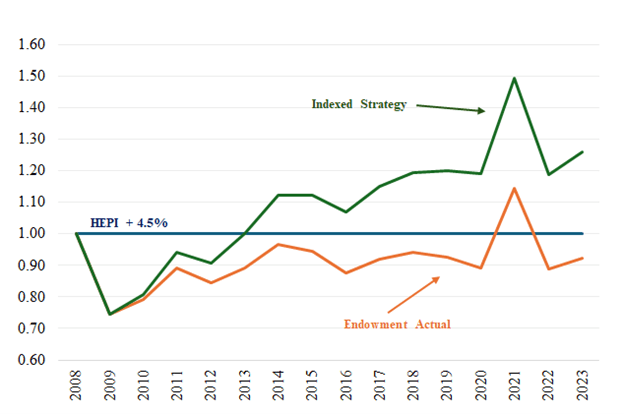
Exhibit 1 analyzes rates of return for public pension funds and large school endowments from fiscal year 2008 to fiscal year 2023. The return objective in the case of public pension funds is the actuarial earnings assumption described above. For the endowments, it is HEPI + 4.5%. The “actual return” for public pensions is that of an equal-weighted composite of 54 large funds. The “actual return” for the endowments is that of the NACUBO large fund cohort composite. In both cases, the indexed strategy is a combination of indexes with the same market exposures and risks as their respective composites — a kind of best-fitting, hybrid market index.[4]
Both types of institutions failed to meet their institutional investment objectives since the GFC: public funds fell short by 1.3 percentage points per year, and endowments fell short by 0.6 of a percentage point. The indexed strategy, however, essentially met the public plan requirement and handily outpaced that of the endowments.
Exhibit 1. Actual Returns and Indexed Strategy vs. Objectives2008–2023.
| Public | Endowment | |
| Return Objective | 7.4% | 7.0% |
| Actual Return | 6.1 | 6.4 |
| Indexed Strategy Return | 7.3 | 8.7 |
Exhibits 2 and 3 illustrate the results graphically. The investment objective in both cases is represented by the horizontal line with the constant value of 1.00. The other lines represent cumulative earnings for the active and passive strategies relative to the objective. For both types of institutions, the low-cost indexed strategies generated sufficient earnings to meet the objective. In neither case, however, did the actual active strategies do so. Their high cost of investing proved to be too great a drain.
Exhibit 2. Public Funds: Investment Returns vs. Actuarial Earnings Assumption.
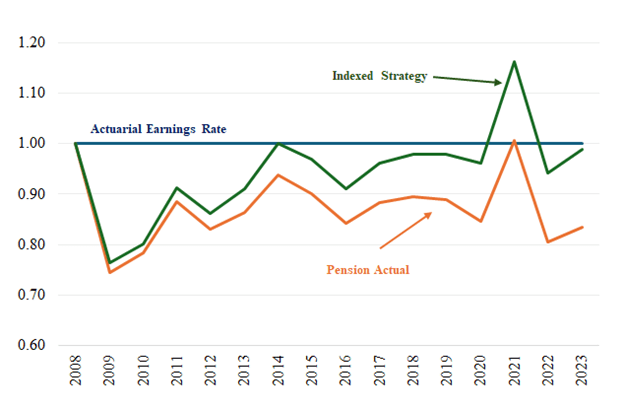
Exhibit 3. Large Endowments: Investment Returns vs. HEPI + 4.5%.
Final Words
Institutional investors’ goals are going unmet. What to do? Tennis great Bill Tilden had a solution: “Never change a winning game; always change a losing one.” Institutions have doggedly pursued active management, wasting precious resources in the process. It’s time they let the market work for them, rather than trying to beat it through brute force. To do so, overseers must focus on meeting their earnings objectives, rather than how well they have performed relative to market benchmarks.
REFERENCES
Aubry, J.P. 2022. “Public Pension Investment Update: Have Alternatives Helped or Hurt?” (Issue Brief.) Center for Retirement Research, Boston College.
Ennis, R.M. 2022. “Are Endowment Managers Better Than the Rest?” The Journal of Investing, 31 (6) 7-12.
———. 2023. “Lies, Damn Lies and Benchmarks: An Injunction for Trustees.”
The Journal of Investing, 32 (4) 6-16.
Hammond, D. 2020. “A Better Approach to Systematic Outperformance? 58 Years of Endowment Performance.” The Journal of Investing, 29 (5) 6-30.
Sharpe, W. F. 1988. “Determining a Fund’s Effective Asset Mix.” Investment Management Review (September/October): 16–29.
——— . 1992. “Asset Allocation: Management Style and Performance Measurement.” Journal of Portfolio Management Winter: 7-19.
[1] See Ennis (2022, 2023).
[2] See Hammond (2020) and Aubry (2022) for similar types of studies.
[3] Much has changed since the early days of alternative investing. Prior to 2008 there was no accounting requirement to mark private assets to market. We find evidence that this circumstance likely contributed to positive momentum in returns of institutional investors between 2000 and 2008. In the early 2000s, private-asset markets were much smaller and less well developed than they are now; they are much more efficient and liquid today. Buyout valuations have nearly doubled from the early days. Hedge fund assets grew tenfold between 2000 and 2007, dramatically increasing competition for profitable trades in that arena. Interest rates are now a real hurdle for leveraged private-market investors. Through it all, however, costs have remained stubbornly high. In our judgment, we are not likely to witness a recurrence of the extraordinary performance of alternative investments that we observed in the late 1990s and early 2000s.
[4] See Sharpe (1988, 1992).