
There is little doubt that the international order is at a point of rupture (Gensler et al. 2025, Obstfeld 2025, Papakonstantinou and Pisani 2024). The dramatic developments unfolding globally, spanning wars, geopolitical shifts, and trade disruptions, have caught Europe – both the EU and its member states – off balance. Where the current evolution will eventually settle is as yet uncertain. It is already clear, however, this upheaval has dismantled the external governance and institutional framework that underpinned the EU’s policy agenda, institutional design, and economic development, leaving what we have termed Europe’s ‘reduced responsibility model’ (RRM) entirely dysfunctional.
The Florence Report (Buti et al. 2026) – the flagship initiative of the EMU Lab at the Robert Schuman Centre for Advanced Studies at the European University Institute – explores how Europe can navigate this fundamentally changed world order. It discusses the roots and dimensions of fragmentation and examines how these developments constrain policy space for action at both the national and the EU governance levels. Pursuing a pragmatic way forward, the report re-examines established governance frameworks to articulate a coherent policy agenda to get over the RRM towards a more independent and secure Europe.
The end of the reduced responsibility model
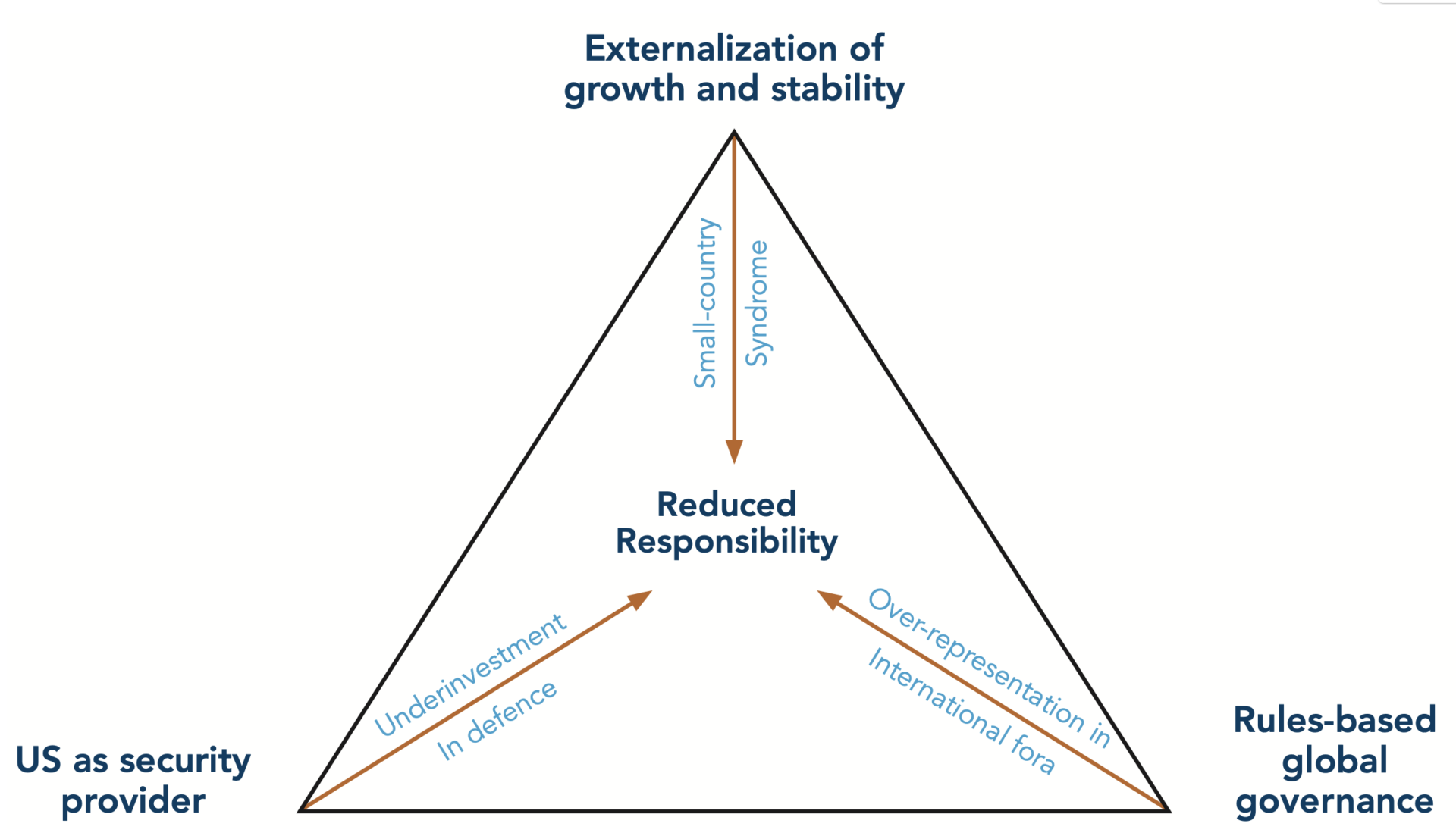
For decades, the EU operated under a ‘reduced responsibility model’ – member states could under-invest in common defence by relying on US protection, count on the vast American market to pursue export-led growth strategies, and anchor financial stability to US-led hegemonic governance of international law and trade institutions. To be clear, European integration was first and foremost led by strong internal political drivers, but the international context at the time allowed member states to progress with the Union project by bypassing ‘full responsibility’ in key areas. United Europe’s remarkable achievements all suffered from the same ‘hold-back’ diagnosis. Europe embraced the Single Market project, but never completed a common strategy to secure the efficiency and resilience of own infrastructure, telecommunication, or energy networks. It launched the euro, pretending that the unmatched independence of the ECB, the Stability and Growth Pact, and the no bail-out clause would guarantee a resilient financial and macroeconomic framework to deliver on the promise of shared prosperity.
Figure 1 Europe’s reduced responsibility model
Fractured by open geopolitical rivalry and strategic competition, the global environment is no longer conducive to the EU’s reduced responsibility model. Neutral commons such as energy, finance, and climate have been explicitly weaponised, turning public goods into public bads. What the EU counted on as pillars of cooperation and stability are now being used against it.
Although we are still in uncharted waters, it is already evident the breakdown of the status quo is structural: the external conditions that sustained Europe’s development have largely disappeared and are unlikely to materialise again in the same constellation that allowed the RRM to flourish in the first place. Beneath its apparent and surprising resilience, the global economy faces a high risk of collapse, triggered either by war or by financial shocks, originating with overextended private credit or a potential AI bubble burst.
The current situation is truly exceptional: the collapse of the RRM is a silent crisis eroding the very fundamentals that Europe long based its progress upon. These dynamics are not easily discerned and the EU’s conventional crisis-management model based on ad hoc reactive measures will not suffice in handling them. Instead, the Union must embrace a different approach in kind: the wholesale and accelerated implementation of a shared and cohesive strategy to stabilise its very foundations.
Four priors
There are four core convictions guiding the analysis in the Florence Report. First, while boosting growth and competitiveness is essential, that is not an end in itself. Rather, it is a means to sustaining Europe’s social model in the face of ageing, climate change, and geopolitical pressures, and therefore requires broad political consensus from inception to implementation. Second, we believe that the European social model should be understood not as a constraint on economic dynamism, but as a source of stability and a potential enabler of innovation. Properly designed social policies can reconcile labour market flexibility with social sustainability. We reject the defeatist narrative of a weak Europe and argue instead that the EU’s foundations – democratic values, rule of law, and regulated markets – constitute a distinct and underappreciated form of power that positions Europe as a global leader in sustaining the rules-based international order that is essential for the survival and functioning of modern democracies. Finally, despite the political limits to federalisation, the EU can still capture the benefits from economies of scale through targeted joint action on common projects. Delivering tangible gains for citizens through shared action may, in turn, reshape political preferences and create virtuous feedback effects that gradually ease domestic and EU-level constraints.
A three-pronged policy agenda
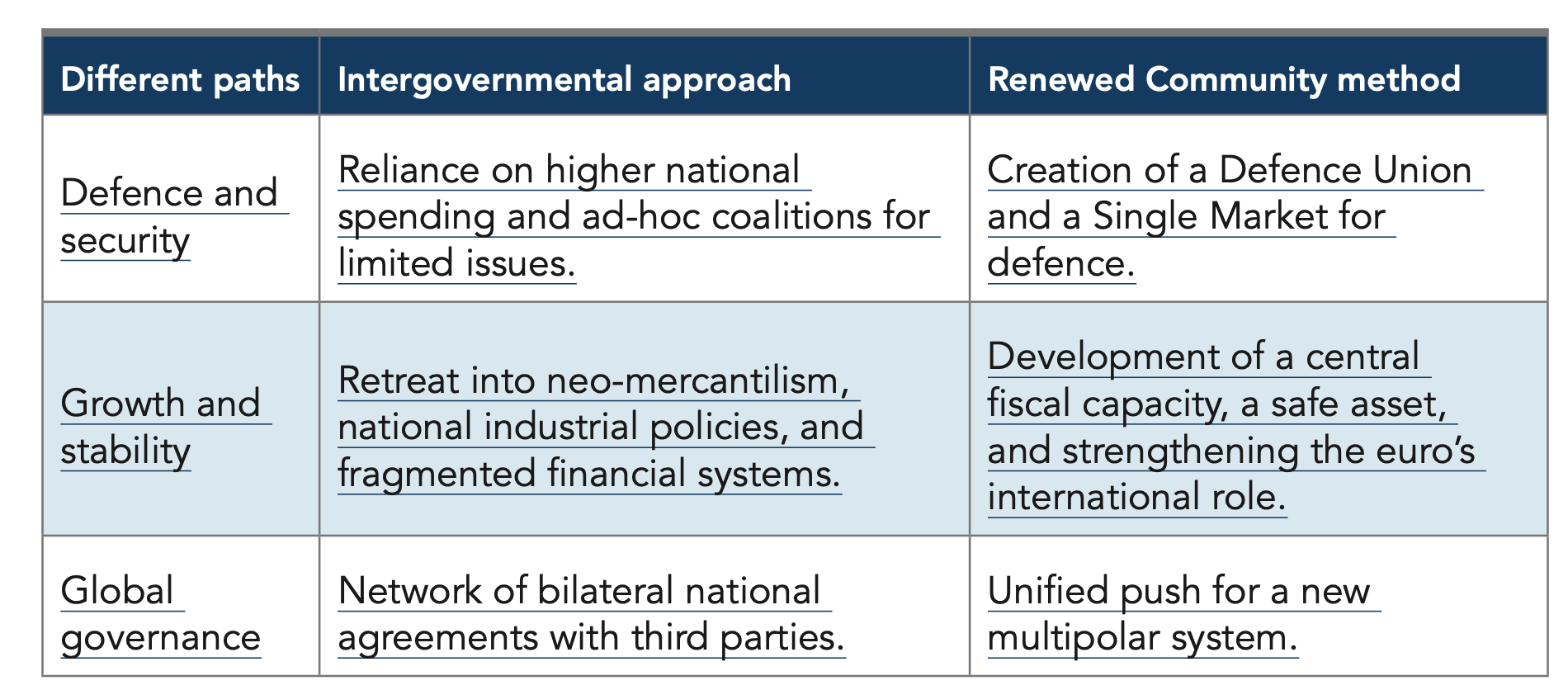
Delivering a new model for European independence and security involves a fundamental shift in perspective: the Union is not as a constraint on national policy space, but a creator of it. By trading a degree of formal sovereignty for collective security and prosperity – especially in areas such as climate transition, common defence, and large-scale digital infrastructure – member states can secure goods that no single nation can provide effectively on its own and gain a level of global relevance that is otherwise beyond individual reach. This approach also underpins the successful implementation of the Florence Report’s three-pronged policy agenda: strengthening multilateralism through multipolar global alliances in line with European values, creating a genuine Savings and Investment Union on boost competitiveness and innovation, and reorienting the EU budget towards the provision of European public goods.
In light of recent experience and existing legal constraints, further progress on this shared endeavour will likely emerge from initiatives driven by shifting coalitions of willing member states. The central task is to structure these efforts to enable broader participation over time and avoid devolving into an EU à la carte – a collection fragmented projects that weaken the EU’s institutional unity. The fundamental challenge to delivering on this course of action is not a lack of inherent power, but the need to overcome self-defeatism and what can be described as a ‘fragmentation trap’ – a short-termism in policy behaviour driven by national political narratives which frame shared sovereignty as a zero-sum game even if further integration would demonstrably raise welfare across all member states. That is why overcoming the now dysfunctional RRM requires the creation of an institutional setting attuned to remedying these biases. Most crucially on the path ahead, the EU must confront the fundamental issues plaguing its productivity. But rather than simply playing catch-up with the US or China, Europe should exploit its dynamic comparative advantage by boosting its own technological trajectories combining innovation with efficiency, equity, and sustainability.
Table 1 Response to the crisis of the reduced responsibility model
A New European Social Contract
The collapse of the external conditions underpinning Europe’s reduced responsibility model has exposed structural weaknesses, eroded policy space, and amplified divergence amongst member states. Fragmentation – both internal and external – now constrains Europe’s ability to take much-needed action causing a direct threat to European prosperity. Overcoming this dynamic will depend on re-establishing a political and institutional own capacity for collective action, anchored in a renewed European social contract. Central to this vision is the concept of ‘insurance-based solidarity’ championed by the late Jurgen Habermas: because no member state can reliably predict its future exposure to shocks, all have an interest in arrangements that allow risks and costs to be shared over time. This ‘veil of ignorance’ reinforces the case for collective mechanisms that go beyond narrow national calculations. Solidarity then becomes forward-looking: it is justified not by permanent transfers, but by the expectation that all may at different times benefit from common support. By extension, the New European Social Contract is not just an economic arrangement, but a political project of mutual recognition and responsibility. Mutual trust is the ‘intertemporal glue’ of this arrangement, allowing countries to sustain cooperation over time by recognising that the benefits of this shared insurance may not be immediate, but will materialise across different moments and circumstances.
There is also a fundamental political asset that should not be overlooked in this regard: public support for European integration and a stronger EU remains robust, even in traditionally sceptical countries. Capitalising on this approval could help ease political constraints and address the Union’s current challenges; failing to do so risks eroding it.
By embracing foresight and insurance-based solidarity, the Union can demonstrate to its citizens and the world that it is both ready and capable of taking its destiny into its own hands. The Florence Report provides the intellectual case for a New European Social Contract, asserting that a Union that is stronger than the sum of its parts is the only viable option for navigating a world where old alliances and certainties have vanished. Turning away from the full responsibility that comes with building a stable multipolar world, realising the Saving and Investment Union, and stepping up the supply of European public goods is not an option anymore. The external and internal dimensions of a stronger Europe are inextricably linked in a single whole.
References
Buti, M, G Corsetti and A. Peychev (eds) (2026), Reconfiguring Europe in a Fractured Global Economy, The 2026 EMU-Lab Florence Report, European University Institute.
Obstfeld M (2025), “The international monetary and financial system: a fork in the road, Andrew Crockett Memorial Lecture, Bank of International Settlement's Annual General Meeting, Basel, 29 June.
Papaconstantinou, G and J Pisani-Ferry (2024), New world new rules : global cooperation in a world of geopolitical rivalries, Agenda Publishing.