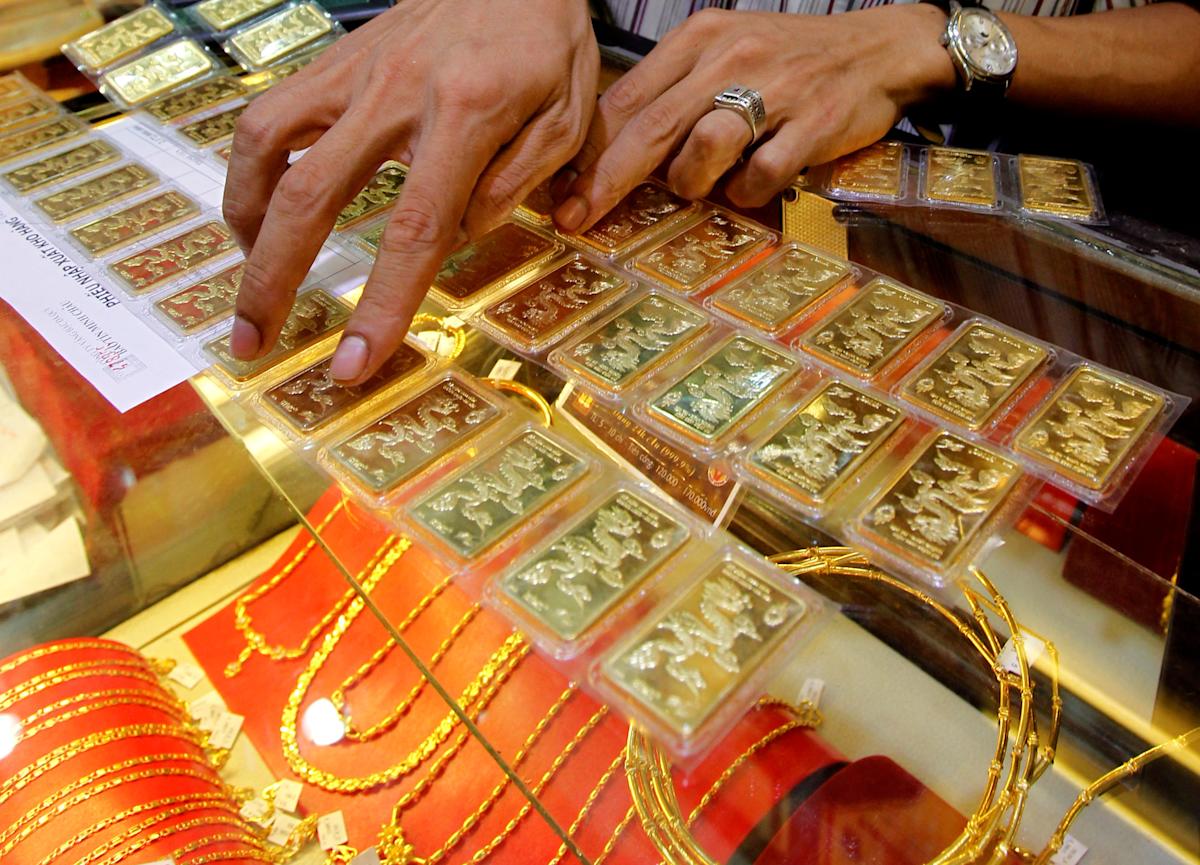

Gold prices (GC=F) hovered around the $3,400 mark on Tuesday morning, their highest level in more than a month as uncertainty over US tariffs and interest rates kept haven demand strong.
Gold futures were down 0.3% to $3,397.70.30 per ounce, at the time of writing, while spot gold rose 0.6% to $3,385.63 per ounce.
The rally in the precious metal came amid reports that the European Union was preparing retaliatory tariff measures in response to US president Donald Trump’s plans to impose fresh tariffs on European goods. Washington is reportedly eyeing levies of at least 15% on certain imports from the bloc.
Investor focus is also turning toward next week’s Federal Reserve meeting, with markets widely expecting the central bank to leave interest rates unchanged. However, the outlook remains clouded by political pressure, as Trump has continued to call for immediate rate cuts to support the economy.
Read more: FTSE 100 LIVE: London stocks tread water as UK borrowing jumps above £20bn
“The precious metals complex has been the clear beneficiary of the technical breakdown in the USD index (DXY), with the intraday relationship between gold and the DXY becoming notably tight,” said Chris Weston, head of Research at Pepperstone.
“Client volumes on gold have picked up over the past 24-36 hours, with XAU/USD holding the top spot as the most traded market. The upbeat flows through the market have seen spot gold emphatically breakout of the of $3,370 to $3,300 trading range it has held since early July, with front-month gold futures settling firmly above $3,400 and holding the big figure through Asia.”
Oil prices declined in early European trading on Tuesday as investors assessed limited near-term disruption to global supply from European sanctions on Russia, while mounting fears of a transatlantic trade dispute also weighed on sentiment.
Brent crude futures (BZ=F) slipped 0.6% to trade at $68.81 per barrel, at the time of writing, while West Texas Intermediate futures retreated 0.5% to $66.88 a barrel.
Market attention has turned to a possible trade rift between the US and the European Union, amid reports that Washington is seeking to impose tariffs of at least 15% on EU imports. Brussels is said to be preparing retaliatory measures in response.
Uncertainty over US trade policy is also casting a shadow over consumer confidence and broader economic prospects for the second half of the year. The International Energy Agency, in its July report, forecast global oil demand to rise by just 700,000 barrels per day in 2025, its slowest pace of growth since 2009.