
Unlock the Editor’s Digest for free
Roula Khalaf, Editor of the FT, selects her favourite stories in this weekly newsletter.
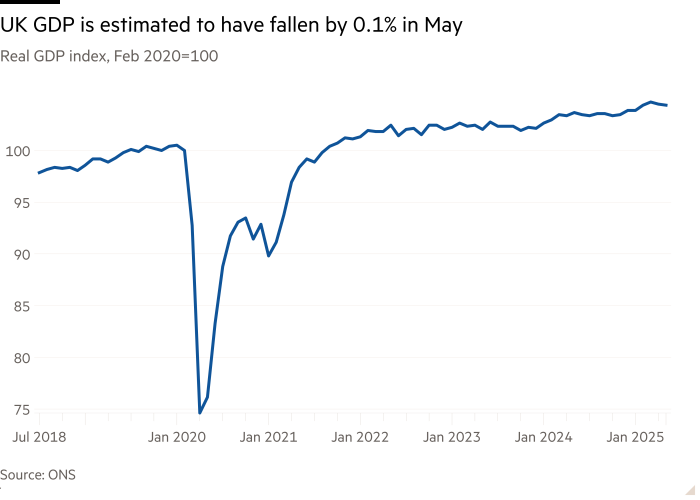
The UK economy unexpectedly contracted 0.1 per cent in May, the second monthly decline in a row, in a sign that strong growth earlier in the year has dissipated while the Labour government’s fiscal problems intensify.
Friday’s figure from the Office for National Statistics followed a contraction of 0.3 per cent in April and was well below the 0.1 per cent growth forecast by economists polled by Reuters.
The pound fell 0.3 per cent against the dollar to $1.35 following the data release.
The two-month dip in output comes after increases in taxes on business by chancellor Rachel Reeves, who still faces a fiscal hole some economists estimate at more than £20bn, and amid uncertainty about the global economic impact of US President Donald Trump’s tariff plans.
“This presents a challenge to the chancellor,” said Professor Joe Nellis, economic adviser at accountancy and advisory firm MHA. “Her fiscal headroom remains limited by high levels of public borrowing and debt and her spending plans are heavily reliant on kick-starting the economy.”
May’s fall in GDP, driven by declines in the oil and gas sector, manufacturing, construction and retail, contrasted with rapid growth of 0.7 per cent in the first three months of the year, when a surge in exports and a robust services sector performance placed the UK among the G7’s top performers.
Paul Dales, economist at the consultancy Capital Economics, said he expected “fairly subdued” growth this year “due to the lingering drags from a weakening global economy and the rises in domestic taxes for UK businesses”.
The gloomy figures will cast a pall over a cabinet “away day” convened by Prime Minister Sir Keir Starmer on Friday, which will try to map a path through the worsening fiscal outlook towards the autumn Budget.
Ministers are likely to assess the damage caused to the public finances by recent government retreats over welfare reform and winter fuel payments, which have blown a hole of more than £6bn in its fiscal plans.
Business leaders are warning Reeves against further weakening growth by trying to close that gap by hitting business and the City of London with higher taxes. Ben Jones, CBI lead economist, called on her to instead “offer a commitment to work alongside firms to dismantle barriers to growth”.
The chancellor described May’s GDP figure as “disappointing”, adding she was “determined to kick-start economic growth”.
But the Bank of England has warned that underlying growth remains weak, adding that economic activity in the first quarter was boosted by one-off factors, such as frontloading activities ahead of US tariffs and changes to stamp duty.
Suren Thiru, economics director at the Institute of Chartered Accountants in England and Wales, said: “These downbeat figures undoubtedly increase anxiety over the health of the UK economy.”
He added that an August rate cut from the BoE, which held borrowing costs at 4.25 per cent last month, “currently looks inevitable”.
Shadow chancellor Sir Mel Stride said: “Thanks to Labour’s reckless choices the economy actually shrank in May. This will pile even further pressure for tax rises in the autumn. Labour’s costly U-turns, on winter fuel and welfare, have created a ticking tax time bomb.”
Following the data release, the market continued to price in two quarter-point interest rate cuts by the end of the year.
ONS director of economic statistics Liz McKeown said May’s contraction had been largely caused by sectors such as “oil and gas extraction, car manufacturing and the often-erratic pharmaceutical industry” and only “partially offset by growth in services”.
The month-on-month rise in GDP for March was revised up to 0.4 per cent from the previous estimate of 0.2 per cent. For the three months to May, the UK economy grew 0.5 per cent compared with the previous three months.