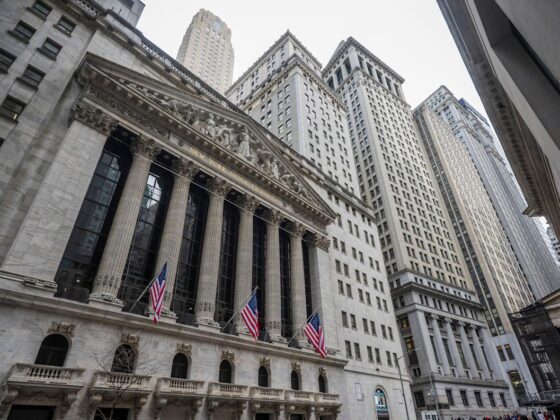


U.S. stock markets closed at record highs on Friday following the Fed rate cut last week and indications for further easing of policies. Some progress in U.S.-China trade talks also boosted investors’ sentiment. All three major stock indexes ended in positive territory on the day. For the week as a whole, these indexes finished in positive territory.
The Dow Jones Industrial Average (DJI) rose 0.4% or 172.85 points to close at 46,315.27, marking a new closing high for the index. Notably, 14 components of the 30-stock index ended in positive territory, 15 finished in negative territory and one remained unchanged. At the intraday high, the blue-chip index recorded a new all-time high of 46,396.47.
The tech-heavy Nasdaq Composite finished at 22,631.48, rising 0.7% or 160.75 points driven by the strong performance of technology bigwigs. At the intraday high, the tech-laden index recorded a new all-time high of 22,645.11.
The major gainer of the tech-laden index was AppLovin Corp. APP. The stock price of this AI-powered technology services giant surged 4.5%. AppLovin currently sports a Zacks Rank #1 (Strong Buy). You can see the complete list of today’s Zacks #1 Rank stocks here.
The S&P 500 advanced 0.5% to finish at 6,664.36. This marked the benchmark’s new closing high. Out of the 11 broad sectors of the broad-market index, six ended in positive territory, while five were in negative territory. The Technology Select Sector SPDR (XLK) gained 1% while the Energy Select Sector SPDR (XLE) fell 1.3%.
The fear gauge, the CBOE Volatility Index (VIX) was down 1.6% to 15.45. A total of 27.78 billion shares were traded on Friday, higher than the last 20-session average of 17.41 billion. Friday’s trading volume was the highest since early April. Decliners outnumbered advancers on the NYSE by a 1.43-to-1 ratio. On the Nasdaq, a 1.42-to-1 ratio favored declining issues.
On Sept. 17, the Fed in its FOMC meeting decided on a much-hyped 25-basis-point cut in the benchmark lending rate to reduce it to the range of 4-4.25%. This is the first interest rate cut of 2025. The decision was almost unilateral as 11 out of 12 Fed voting members favored a cut of a quarter percentage basis point in the Fed fund rate, while just a lone member dissented with a half a percentage point cut.
However, the Fed’s dot-plot has shown two more rate cuts of 25 basis points each this year and one rate cut of 25 basis points in both 2026 and 2027. A low-interest-rate regime will be beneficial for stock investing as it reduces the discount rate thereby increasing the net present value of equity investment. High-growth sectors such as technology, consumer discretionary and cryptocurrency will benefit the most.