


In today’s investment landscape, the debate between active and passive management often misses a critical point: they aren’t mutually exclusive. Incorporating passive funds into actively managed portfolios can enhance diversification, reduce risk, and optimize returns.
By leveraging a hybrid, “team of funds” approach, investors can capitalize on the strengths of both strategies, creating portfolios that achieve financial goals more efficiently. This post explores how passive investments complement active strategies, driving better results for clients and portfolios alike.
Robust Portfolio Construction With a Team of Funds Approach
A robust portfolio construction process should be customized to the client’s asset allocation and target excess return. It should also maximize alpha diversification across the portfolio.
This approach provides these benefits:
- Minimizing tracking error by aligning the portfolio’s long-term effective exposures to its benchmark
- Equalizing each fund’s contribution to portfolio alpha and tracking error
- Capitalizing on the relationship between the portfolio’s active return and market return.
Here is a case study that illustrates this approach. It tests results using all active funds versus using a combination of active and passive funds.
I chose four asset allocation strategies across global equity and bonds to represent a set of client risk tolerances. I excluded real assets and illiquid investments in favor of publicly available funds that represent the core of most investment portfolios.
Portfolio parameters:
- Strategies range from 50-50 to 80-20 mixes of equity and bonds
- Alpha targets range from a minimum 50 basis points (bps) to a maximum of 175 bps in 25 bps increments.
This produced a set of 24 teams of funds.
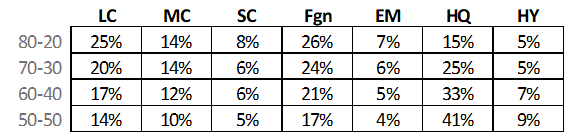
I maintained diversification and style characteristics across strategies, with global, developed equity balanced between value and growth styles. This produced a total of 11 minor asset segments.
Table 1: Diversification across asset strategies.
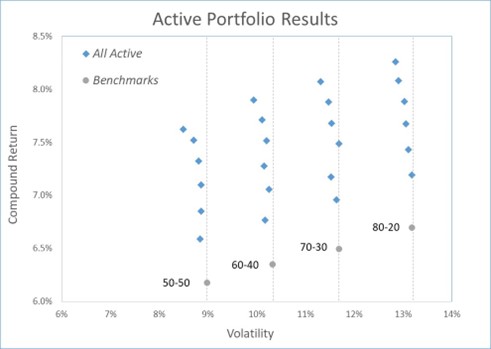
All-Active Fund Results
The all-active performance results over a 12-year period are grouped by investment strategy. The hybrid, team of funds approach delivered enhanced returns with lower volatility than their benchmarks.
This result was driven by two factors. First, alpha diversification removed most individual fund tracking error. Second, the slightly negative correlation of each portfolio’s excess return to the portfolio’s total return causes a portion of its tracking error to be subtracted from its volatility, given this relationship:
Contribution to Volatility = Weight * Volatility * Correlation with Portfolio Return
Chart 1: Team of Funds vs. Benchmarks.
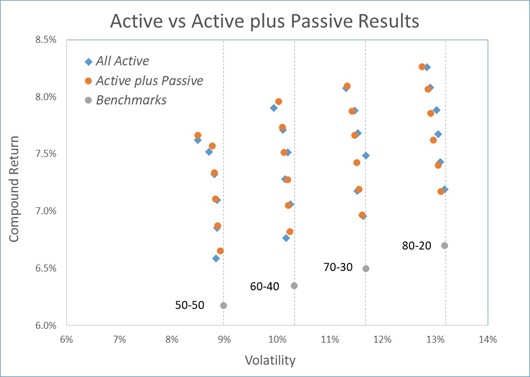
I repeated this approach, this time allowing passive funds into the mix. Each portfolio was free to hold any funds on our platform and an unlimited allocation of passive funds. The goal was to earn the target excess return while minimizing volatility risk.
The surprising result — across all strategies and alpha targets — is that portfolios that held substantial exposure to passive investments replicated the returns of the portfolios that held all active funds.
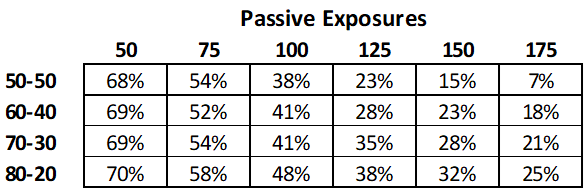
This result corrects the prevailing wisdom that passive funds dilute excess return. The passive-active hybrid portfolios had an average of 40% passive exposure and a range of about 10% to 65%, depending on the strategy and the alpha target.
Chart 2: All-Active Portfolios vs Hybrid Portfolios.
Passive Exposures Across Strategies and Alpha Targets
Passive funds allow us to be more selective in our use of active investments, choosing only the best of the best. They eliminate asset allocation constraints that limit efficiency in the selection of active funds. This drives greater “alpha diversification” and lowers active risk.
Table 2: Passive Exposures.
Key insight: Including passive funds drives a more efficient selection of active funds.
Effect of Passive Investments on Active Risk
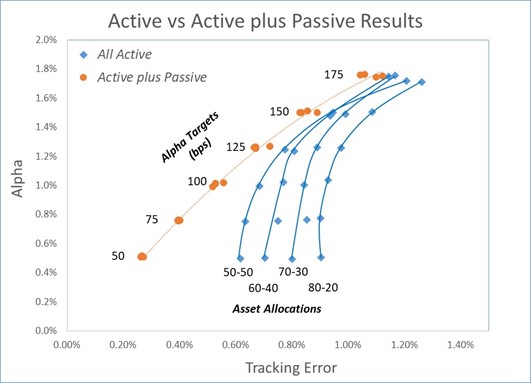
Chart 3 compares the relationship between alpha and tracking error for all-active and hybrid portfolios. Tracking error increases modestly with total volatility in the all-active portfolios, until reaching an inflection point, when risk begins increases rapidly.
The hybrid portfolios are dramatically more efficient. Active risk across the strategies is nearly identical, with differences only at the highest alpha targets. The return-to-risk line is nearly linear.
Chart 3: Active results for All-Active and Hybrid Portfolios.
Benefits of Lowering Active Risk
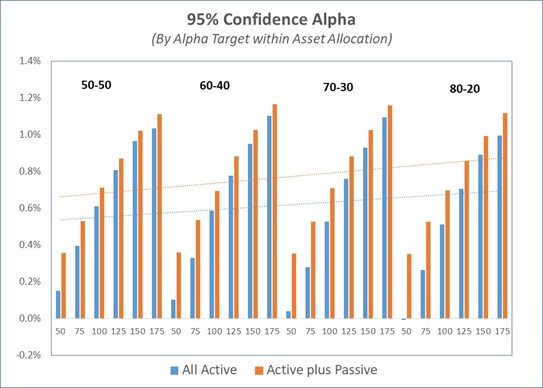
Alpha diversification, the selective use of passive investments, and an unconstrained active fund team create a combination of factors that produce superior active results. These benefits are consistent across the strategies, with lower active risk increasing high-confidence minimum alpha in the hybrid portfolios.
Chart 4 illustrates the 95% confidence level alpha across all portfolios. The trend lines for the all-active and the hybrid strategies summarize the improvement that passive funds contribute. On average, this is between 15 bps and 20 bps of excess return.
Chart 4: High-Confidence alpha for All-Active and Hybrid Portfolios.
Evaluating Hybrid Portfolio Performance
I selected the 60-40 strategy with 100 bps target alpha to illustrate my hybrid performance evaluation approach.
My decision-based approach focuses on an active component plus a passive component, in a hierarchical framework:
- Active vs. passive allocation
- Major asset segments
- Minor asset segments
- Funds
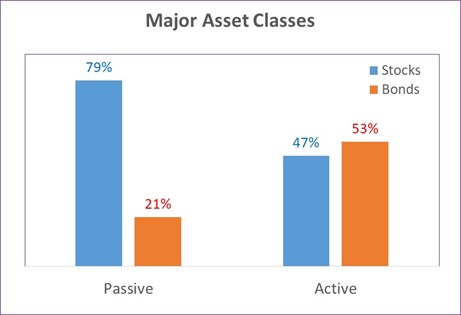
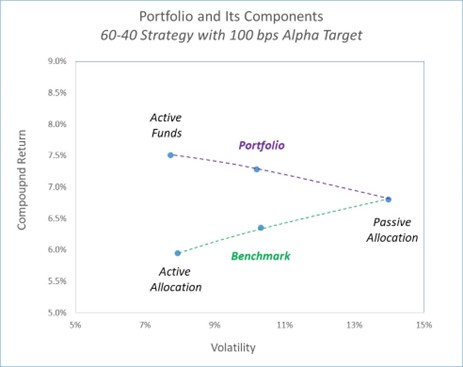
My passive allocation is close to an 80-20 mix of stocks and bonds, while the active allocation is a nearly-even mix. This creates substantially different long-term allocation performance effects.
Chart 5: Hybrid Portfolio Allocation to Asset Classes Within Passive and Active Components.
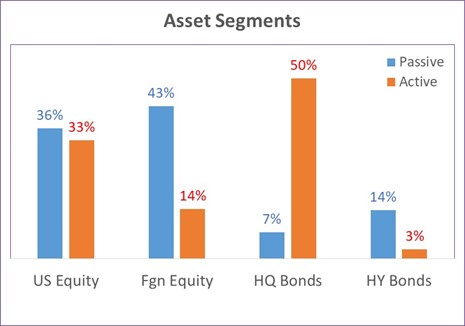
The active and passive components also differ in their allocations within equity and bonds. This is primarily driven by the alpha opportunities found in the active funds. It is also influenced by alpha diversification across the active funds we include.
Chart 6: Allocation to Major Asset Segments within Passive and Active Components.
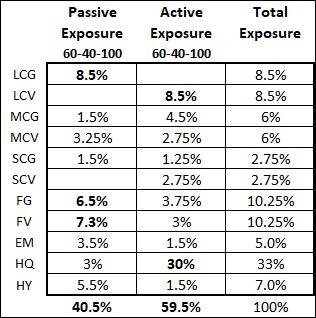
My most detailed passive and active allocations (at the style level) fully explain my allocation to more than 40% of the portfolio’s assets to passive investments. The total exposure in each asset segment matches the benchmark allocation.
Table 3: Style-Level Allocations Across Passive and Active Components.
Key Drivers of Hybrid Portfolio Return
Chart 7 illustrates total return and volatility for each performance component. Relative to the benchmark return, the active allocation detracted from excess return while the passive allocation contributed to excess return.
Chart 7: Return and Risk for Hybrid Portfolio Performance Components.
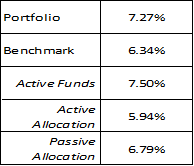
The selection effect is evaluated by comparing the active funds return to the active allocation. The typical approach compares active funds to the total benchmark. That understates the true selection benefit that we achieved by removing the asset allocation constraint from the fund selection process.
Table 4: Hybrid Portfolio Performance Factors.
Risk-Adjusted Contribution to Return Analysis
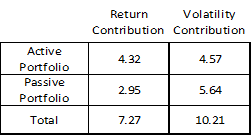
I begin with the contributions to total return and volatility risk, comparing the traditional attribution approach (Table 5) with my active-passive approach (Table 6). These analyses are “two sides of the same coin.”
Table 5: Traditional Contribution to Return Analysis.
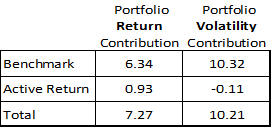
Active return contributed 93 bps of excess returns while subtracting 11 bps of volatility, since the excess return stream is negatively correlated with the portfolio’s total return.
Table 6: Hybrid Approach Contribution to Total Return Analysis.
Hybrid Portfolio Performance Attribution
My task is to explain 93 bps of excess return and 52 bps of tracking error.
The hybrid portfolio’s Information Ratio (IR) of 1.79 is substantially higher than the 1.21 IR earned by its all-active counterpart. This quantifies the efficiencies that passive funds delivered to the portfolio from superior fund selection and lower active risk. These results are illustrated in Table 7.
Table 7: Hybrid Performance Attribution Results.
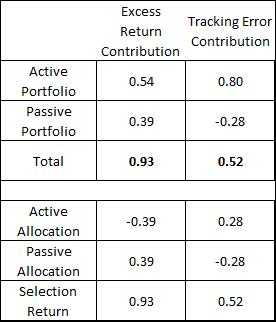
The 93 bps of excess return includes 39 bps contributed by the passive component’s aggressive asset allocation. This passive allocation also subtracted 28 bps of tracking error. These results demonstrate the significant positive contributions of the passive funds in the portfolio.
The second part of Table 7 provides a more traditional attribution analysis, with allocation and selection contributions to excess return and tracking error. The active and passive allocation contributions offset each other, since their combined exposures equal the benchmark exposures. This leaves the excess return attributable to active fund effects, i.e., selection.
Digging Deeper into Tracking Error Attribution
Minimizing tracking error is key to increasing efficiency. The factors driving tracking error risk are weighting, individual tracking error, and the correlation of excess return to portfolio total excess return. Table 8 provides a complete attribution analysis of the portfolio’s 52 bps of tracking error.
Table 8: Drivers of Hybrid Portfolio Tracking Error.
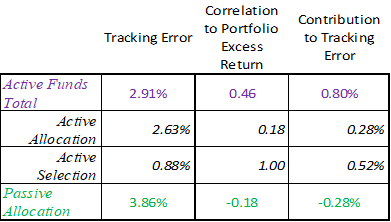
The passive portfolio allocation reflects tracking error of 386 bps, with a negative correlation to portfolio excess return. This produces a reduction in active risk of 28 basis points:
Weight (40.5%) * Risk (3.86%) * Correlation (-0.18) = -0.28%
The active funds produced 80 bps of tracking error, while the passive allocation reduced this by 28 bps, resulting in portfolio tracking error of only 52 bps.

Key Takeaways
The team of funds approach to portfolio construction is the cornerstone of active efficiency. By introducing passive funds into the mix, I produced a set of portfolios with equal return and volatility to the all-active set, but with substantially better active efficiency. Several insights explain these benefits:
- Passive funds remove asset allocation constraints that limit the fund selection process.
- Alpha-drag from passive funds is more than offset by superior active excess returns.
- Passive exposure lowers active costs.
- Active risk declines significantly, with more consistent active results across the strategies.