


Introduction
Switch on Bloomberg TV or CNBC at any time of the day and there is a good possibility the host will be explaining the daily ups and downs of the stock market as a function of the latest economic news. Unemployment is down, stocks are up. Inflation is up, stocks are down. And so on. The underlying assumption is that the stock market represents the economy. Yet most economic data is released on a quarterly basis, and on many days there isn’t any significant news. So, what do stocks trade on on those days?
And what about when the stock market gets carried away? After all, too much investor enthusiasm led to technology bubbles in 2000 and 2021, for example. While economic growth was strong during those times, in hindsight it hardly justified such sky-high returns and valuations. So, how much does the economy matter to the stock market? It may be that sometimes it matters very much and at others time much less. Let’s explore.
US GDP Growth vs. Stock Market Returns
The US economy is driven primarily by consumers whose spending accounts for 70% of GDP. The remaining 30% is split almost equally among private investment and government spending. Net exports are close to zero; the United States imports slightly more goods and services than it exports.
This composition is hardly analogous to the US stock market, where technology, health care, and financials are among the top three industrial sectors. Naturally, many companies sell directly to the consumer, but more tend to focus on businesses and international markets. For example, Apple, the public company with the largest market capitalization, generates close to 70% of its sales abroad. So, does the US stock market really represent the larger economy?
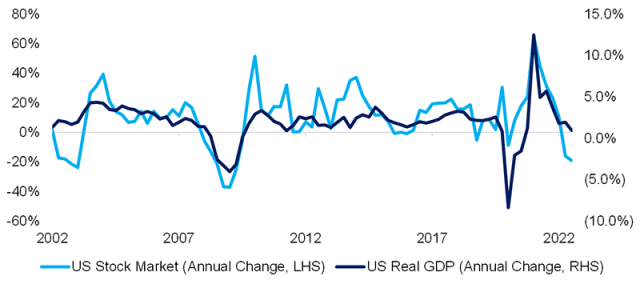
Well, the annual change in real US GDP and the S&P 500 shows broadly the same trends over the last 20 years. When the economy crashed in 2008, so did the stock market. When the economy recovered from the global pandemic in 2021, so did the S&P 500.
US Real GDP Growth vs. US Stock Market Returns, Since 2002
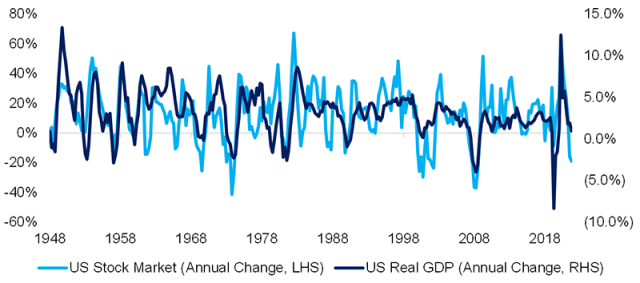
But if we extend the lookback as far as the available quarterly real US GDP data will take us, then the relationship between US GDP and the S&P 500 becomes less clear. Between 1948 and 1962, they tracked each other closely, but not so much in the period thereafter: The US economy expanded rapidly, despite several stock market crashes, until the oil crisis in 1970. In later time frames, however, both GDP growth and S&P 500 returns again moved synchronously.
US Real GDP Growth vs. US Stock Market Returns, Since 1948
Correlation between US Economy and US Stock Market
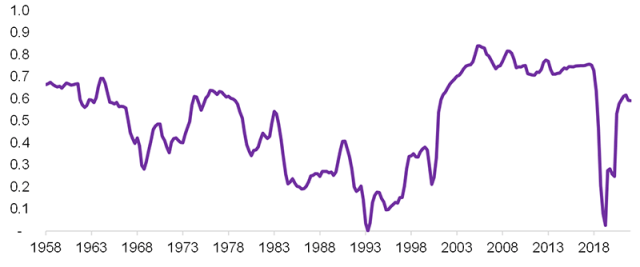
To quantify the relationship between the US economy and the stock market, we calculated rolling 10-year correlations. Between 1958 and 1993, the correlation declined to zero from 0.7. It increased to 0.8 thereafter. The correlation decoupled again during the COVID-19 crisis in 2020, when the economy tanked, but the S&P 500 finished the year on a bull run thanks to massive fiscal and monetary stimulus.
US Real GDP Growth vs. US Stock Market Returns: 10-Year Rolling Correlations, Since 1958
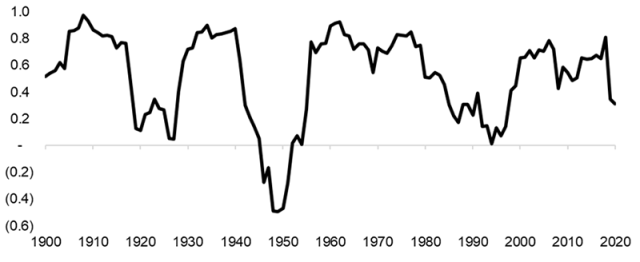
We extended our analysis back to 1900 using annual data from MacroHistory Lab. Since the stock market is forward-looking and tends to anticipate economic news flows, we instituted a one year lag. So for 2000, we compared that year’s GDP numbers with the performance of the S&P 500 in 1999.
Again, the US economy and stock market showed high correlation throughout most of this period. Correlations only fell off considerably four times: during the Great Depression, World War II, the 1990s, and the global pandemic. All of which suggests the S&P 500 was a good proxy for the US economy for much of the last 120 years.
US Real GDP Growth vs. US Stock Market Returns: 10-Year Rolling Correlations, Since 1900
International Evidence
But thus far our analysis is confined to the United States. Does GDP growth and stock market performance show similar correlations in other parts of the world?
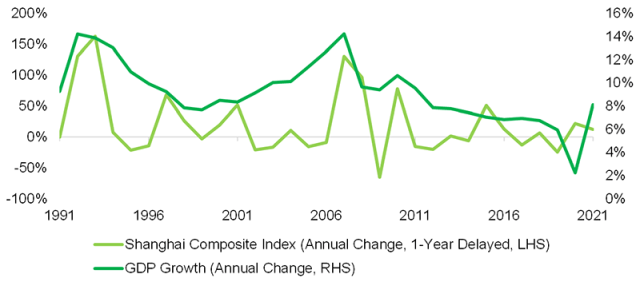
The evidence from Asia Pacific tells a different story. China’s economy expanded at fairly regular and impressive rates from 1991 to 2019. The Shanghai Composite Index’s performance, however, was much less consistent. It has had some exceptional years, with gains in excess of 100%, as well as some dismal ones, with declines of more than 50%.

What explains this divergence? Perhaps the Shanghai Composite, which only launched in 1991, has not yet reached the point where it reflects China’s modern and dynamic market-based economy. Historically, the Shanghai Composite has listed many state-owned enterprises (SOEs), which have different governance structures, for example. China’s retail investment market has also been bubble-prone, so much so that Chinese regulators have imposed a 10% daily limit on stock price movements.
China GDP Growth vs. Shanghai Composite Index
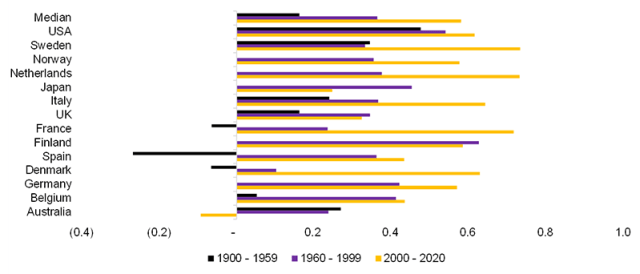
Other industrialized markets show different relationships depending on the country and timeframe under analysis. After calculating the 10-year rolling correlations for 14 developed markets from 1900 to 1959, 1960 to 1999, and 2000 to 2020 we found the median correlations between real GDP growth and stock market returns increased to 0.6 from 0.2. We attribute this to decades of relative peace combined with a trend towards more capitalistic economies with larger and more diversified stock markets.
Not all countries experienced the same trajectory, however: The Belgian GDP growth-to-stock-market-returns correlation changed little during the 1960–1999 and 2000–2020 periods, and the correlation in Australia has gone negative over the last 20 years with steady GDP growth combined with an up-and-down stock market.
Real GDP Growth vs. Stock Market Returns: 10-Year Rolling Correlations
Further Thoughts
Given the lack of long-term data, our analysis is confined to developed markets, but we expect the correlations would likely be lower in emerging markets since their stock markets tend to be more decoupled from their economies and often dominated by retail investors.
But even if economies and stock markets are highly correlated, it does not necessarily follow that high-growth countries make for good investments. The low volatility factor demonstrates that low-risk stocks outperform their high-risk counterparts, at least on a risk-adjusted basis, and the excess returns from growth stocks are essentially zero. The same likely applies on a country-by-country basis.
For more insights from Nicolas Rabener and the Finominal team, sign up for their research reports.
If you liked this post, don’t forget to subscribe to Enterprising Investor.
All posts are the opinion of the author. As such, they should not be construed as investment advice, nor do the opinions expressed necessarily reflect the views of CFA Institute or the author’s employer.
Image credit: ©Getty Images / DusanBartolovic
Professional Learning for CFA Institute Members
CFA Institute members are empowered to self-determine and self-report professional learning (PL) credits earned, including content on Enterprising Investor. Members can record credits easily using their online PL tracker.