


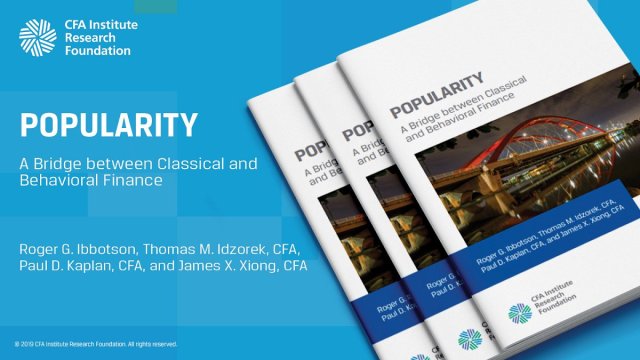
Thomas M. Idzorek, CFA, is the author of “Personalized Multiple Account Portfolio Optimization,” for the Financial Analysts Journal, and co-author of Popularity: A Bridge between Classical and Behavioral Finance, from the CFA Institute Research Foundation.
Like many topics that inspire passion and thoughtful debate, environmental, social, and governance (ESG) investing is complex and multifaceted. Unfortunately, at least in the United States, ESG investing has become politicized, which makes nuanced perspective and analysis more and more difficult.
If only there were an economic theory we could leverage to rise above the binary, politicized landscape, that would help us understand the different impacts of ESG analysis on risk and expected return and how such considerations should or should not influence portfolio construction for different investors.
Fortunately, we have such a theory — the popularity asset pricing model (PAPM)!
While most finance and investment professionals know about the capital asset pricing model (CAPM) as well as Harry Markowitz’s mean–variance optimization, PAPM knowledge is much more limited.
In the CAPM, every investor formulates their investment problem in Markowitz’s mean–variance framework. By assumption, markets are perfectly efficient and all investors “agree” on the risk and expected returns of all assets. Thus, everyone arrives at the same efficient frontier and the same Sharpe-maximizing market portfolio, which is then levered or unleveraged based on risk tolerance. Mean–variance optimization becomes unnecessary, and investors have no other “tastes” beyond their risk tolerance, which leads to different levels of leverage.
Empirically, there are numerous anomalies in which realized long-term average returns differ from the expected returns from the CAPM. Eugene Fama and Kenneth French, in particular, have proposed various hidden risk factors to explain departures from the CAPM. Their paper “Disagreement, Tastes, and Asset Prices,” marks a shift in their perspective. They describe “disagreement” and “tastes” as the two missing ingredients from the CAPM that affect asset prices. Disagreement is the notion that people have different capital market expectations, and tastes are the investor’s individual preferences beyond risk tolerance for various attributes and characteristics.
The PAPM incorporates both ingredients in a generalized equilibrium asset pricing model. Each investor solves a mean–variance optimization problem based on their capital market expectations, which include an additional term that captures how much utility the investor derives from a portfolio that tilts toward their preferred characteristics and away from those they dislike. At the same time, that term allows for any magnitude of like and dislike. For example, an investor may be somewhat fond of green energy but hate handguns. If enough investors have a strong positive or negative feeling about a characteristic, it impacts asset prices. Over long periods and in line with the PAPM, many CAPM anomalies indicate that a return premium may accrue to the shunned characteristic.
Under PAPM, individual investors may all have unique views on how ESG characteristics or sub-ESG characteristics influence expected risk and return. They may also have different tastes as to what characteristics they want reflected in their portfolio. Likewise, they may view almost any given characteristic from a pecuniary and nonpecuniary perspective.
For example, genetically modified organisms (GMOs) evoke a range of views from investors. From a pecuniary perspective, some may believe that demand and price for GMOs will increase or decrease and, as a result, future returns will be better or worse than the market.
From a nonpecuniary perspective, some investors may prefer investing in companies that produce GMOs because they believe it will help feed humanity and end world hunger. Others may want to avoid such companies because they fear GMOs could threaten biodiversity.
Such views and preferences may or may not be mutually exclusive and at times may defy expectations. One investor may believe that demand and prices for GMO products will fall but still think that fighting world hunger is a worthy cause. Another investor may expect price and demand to rise but feel that it is a small price to pay to prevent GMOs from potentially harming the environment.
Investors are complex. As practitioners, we should seek out foundational theories and models that reflect reality and that have fewer and less restrictive assumptions. ESG true believers may think that ESG investing can save the world and improve a portfolio’s expected risk and return. ESG skeptics, on the other hand, may feel that taking ESG considerations into account in investing decisions should be illegal. Both perspectives are flawed. The expectation that selecting only investments with high ESG scores will lead to superior returns is just as wrongheaded as restricting the use of pecuniary ESG information in investment analysis and portfolio construction.

After all, investors who ignore pecuniary ESG considerations operate at an informational disadvantage and are likely to underperform. So, too, are those who only invest in securities with good ESG scores for nonpecuniary reasons or who avoid such securities for nonpecuniary reasons. On the other hand, investors who consider pecuniary ESG factors and ignore nonpecuniary ones are likely to overperform.
Investors who apply pecuniary ESG considerations and have nonpecuniary tastes are likely to underperform, yet from a PAPM perspective, they should own personalized, utility-maximizing portfolios! For those without tastes or strong pecuniary views, that “personalized” portfolio will often be a passive, low-cost portfolio.
Therefore, individual investors and those that serve them should build personalized portfolios that reflect their views and preferences to the degree that they have them.
As for institutional portfolios, those who manage public pension plans or other large portfolios that serve diverse groups of people should not limit the investment universe based on their personal preferences. This is especially true when those whom the portfolio serves have no other choice. To the degree that any pecuniary factor, ESG, or otherwise, may influence risk and return, stewards of public capital should consider all applicable information and should not be restricted from using applicable pecuniary ESG information. This could include seeking to take advantage of the impact of tastes by purchasing unpopular assets and avoiding overly popular ones.
The PAPM moves us beyond broad strokes and divisive rhetoric by explaining how disagreement and tastes influence personalized portfolio construction and ultimately equilibrium asset prices. It allows for a world of different views and preferences and provides a practical framework anchored in a theory to navigate that world.
When it comes to ESG investing, we have to agree that we don’t all agree.

Further Reading on the PAPM
Idzorek, Thomas M., and Paul D. Kaplan. “Forming ESG-Oriented Portfolios: A Popularity Approach.” Journal of Investing.
Idzorek, Thomas M., and Paul D. Kaplan. Lifetime Financial Advice: A Personalized Optimal Multilevel Approach (Forthcoming). CFA Institute Research Foundation.
Idzorek, Thomas M., Paul D. Kaplan, and Roger G. Ibbotson. “The CAPM, APT, and PAPM.” Social Sciences Research Network (SSRN).
Idzorek, Thomas M., Paul D. Kaplan, and Roger G. Ibbotson. “The Popularity Asset Pricing Model.” Social Sciences Research Network (SSRN).
Zhao, Albert, Thomas M. Idzorek, CFA, and James X. Xiong. “ESG Role in Equity Performance in Private Market, Primary Market and Secondary Market.” Social Sciences Research Network (SSRN).
For more from Thomas M. Idzorek, CFA, check out “Personalized Multiple Account Portfolio Optimization,” from the Financial Analysts Journal, and Popularity: A Bridge Between Classical and Behavioral Finance, from the CFA Institute Research Foundation.
If you liked this post, don’t forget to subscribe to Enterprising Investor and the CFA Institute Research and Policy Center.
All posts are the opinion of the author(s). As such, they should not be construed as investment advice, nor do the opinions expressed necessarily reflect the views of CFA Institute or the author’s employer.
Image credit: ©Getty Images / Witthaya Prasongsin
Professional Learning for CFA Institute Members
CFA Institute members are empowered to self-determine and self-report professional learning (PL) credits earned, including content on Enterprising Investor. Members can record credits easily using their online PL tracker.