


Our primer on commercial real estate (CRE) investing explored the core components of real estate investing decisions. But what about CRE investing in the current environment? How has the post-pandemic world of renewed geopolitical tensions, resurgent inflation, and rising interest rate pressures reshaped how real estate capital markets operate? How has hawkish monetary policy impacted CRE over the past year? Where is the CRE sector headed, and how can investors respond?
Here we explore the historical data as well as various theories and perspectives on CRE’s “new normal.” Above all, we consider what strategies may emerge for investors.
The era of “free money” is over, at least for now. The COVID-19 pandemic and the subsequent fiscal and monetary stimulus efforts brought it to a close, if inadvertently, in late 2021 when US Core Consumer Price Index (CPI) growth — CPI excluding food and energy prices — exceeded 3% per annum for the first time in nearly three decades.
Lockdowns and travel restrictions drove the work-from-home (WFH) phenomenon and helped US families stockpile more than $2.6 trillion in excess liquid savings. With overstuffed consumer balance sheets and a slow return to normalcy, discretionary spending increased throughout 2021 and inflation began to rise. Unemployment plunged from its peak-COVID high of 14.7% in April 2020, which paired with global supply chain issues, among other factors, pushed Core CPI above 6.0% — levels last seen in the stagflation era of the late 1970s and early 1980s.
To control inflation, central banks mainly deploy contractionary monetary policy: They raise interest rates. With inflation soaring in 2021 and 2022, the US Federal Reserve hiked rates at the fastest pace in generations.
With interest rates much higher than last year, investors have a new perspective on cap rates for CRE, which generally are at a spread, or premium, to underlying interest or risk-free rates. Moreover, interest rates are a key driver for any leverage associated with a (direct) real estate investment. As such, these pressures will mean reduced deal flow for CRE in the near term and, likely, moderated return potential across most CRE sectors.
But that does not mean there will not be excess value in pockets of CRE. The potential cresting of interest rates and the crisis in the mid-size and regional banking sector — which may get worse before it gets better — have remade the CRE opportunity landscape.

The Current State of US Interest Rates and Monetary Policy
The Federal Open Market Committee (FOMC) raised benchmark interest rates by an aggregate 500 basis points (bps) between March 2022 and 3 May 2023, and rates seem to have a (temporary) reprieve of further increases over the summer. The Fed confirmed as much at its June meeting, holding firm on the rate and signaling its intent to remain cautious and deliberate over the coming months but indicating that further rate hikes could be in the cards before the end of the year if inflation persists.
If the most aggressive phase of monetary tightening is behind us, rates may stabilize in the near future. April’s data showed 10 straight months of declining inflation, with the annualized CPI increase falling below 5% for the first time in two years, to 4.4% in May. Core inflation is slowing, at 5.3% year-over-year in May, vs. 5.5% in April and 5.6% year-over-year in March. The surprising June CPI release solidified these trends: CPI reached 3.0% year-over-year and Core inflation 4.8%; both results were lower than the median estimates. All this suggests that Fed hawkishness may be easing.
This is welcome news for real estate markets. As interest rates soared in the second half of 2022 and early 2023, cap rates expanded for the first time in years. In the first quarter of 2023 alone, US residential (apartment) and strip center retail nominal cap rates expanded 15 bps, according to Green Street data. Nominal cap rates for office, perhaps the most challenged sector at present, grew by 115 bps. Amid rising interest rates, asset values declined in most CRE sectors — by an aggregate 15% since property prices peaked around March 2022.
Rising interest rates affect real estate valuations through cap rate expansion. This, in turn, influences the profitability of an investment — negatively for liquidating investors and potentially positively for acquiring investors. On a go-forward basis, however, lower asset values are not necessarily bad news for real estate operators. With cap rates higher than they were a year ago, there is once again room for “cap rate compression.” That is, expanding cap rates reflect an adjustment in the pricing of risk in real estate markets: Investors now have more opportunities to acquire assets at appealing rates and engineer compelling total returns by exiting at a calmer, more favorable moment in the market at compressed cap rates.
Monetary tightening has also created uncertainty in capital markets, which has compromised transaction volume. Buyers and sellers do not know where the bottom of the market is or what the terminal interest rate is and so cannot come together on a price. This is especially true among real estate operators. If rates stabilize, transaction volumes should increase. Institutional investors are waiting on the sidelines with ample capital to deploy. At the institutional level, private equity real estate (PERE) funds held a record $400 billion in “dry powder” as of Q3 2022.
In a higher interest rate environment, distressed opportunities should develop. Operators who transacted in the lower-rate regime now face steeper costs of capital due to floating-rate debt, maturing loans that they cannot refinance at anticipated levels given shifts in cap rates/valuation, or untenable interest rate derivative costs. Even with quality assets in quality markets, these operators may have to sell or default on loans.

Turmoil in Mid-Sized Banking
Several high-profile regional and mid-sized banks have failed in 2023. Silicon Valley Bank (SVB) and Signature Bank both collapsed within days of one another and, respectively, constituted the second and third largest bank failures in US history. A distressed Credit Suisse was acquired by UBS in close cooperation with Swiss regulators, and regulators seized First Republic and sold most of it off to JPMorgan Chase.
Bank lending standards have tightened to near-2008 levels. Why is this bad for real estate markets? Because most of these banks and their direct peers have historically lent to regionally focused, middle-market real estate firms, and as they deleverage, liquidity has dried up for middle-market real estate operators.
Contractionary monetary policy throughout 2022 had already generated volatility in the unsecured bond and commercial mortgage-backed securities (CMBS) markets. This pushed institutional capital out of the credit markets and CRE borrowers towards bank-provided financing. US banks issued a net ~$350 billion in CRE loans in 2022, according to Green Street — roughly equal to the cumulative loan growth from 2017 to 2019. The recent middle-market banking crisis, combined with reduced transaction volumes, drove negative bank loan growth in March and April 2023. This should continue to constrain refinancing options and contribute to forced asset sales and defaults.
Mid-sized and regional banks now account for more CRE lending activity: Their share has grown from 17% in 2017 to 27% in 2022, as CMBS and government lending pulled back. Indeed, HSBC, PacWest, and other US banks are selling parts of their loan portfolios at a loss to reduce their CRE exposure.
Despite the pullback in transaction volume, a significant “wall of maturities” and the resulting “funding gap” should produce a strong opportunity set. Almost $1.5 trillion of US CRE debt will mature by year-end 2025, according to Morgan Stanley. Property valuation forecasts for office, retail, and other hard-hit sectors anticipate declines of up to 40% from peak to trough, which heightens the risk of defaults.

Some high-profile defaults have occurred this year. Brookfield incurred a ~$750 million default on two office towers in downtown Los Angeles, and the PIMCO-managed Columbia Property Trust defaulted on $1.7 billion of debt backed by a portfolio of US office assets. In Europe, Blackstone defaulted on a €531 million CMBS backed by a portfolio of Finnish offices and retail.
Various US institutional office owners have sold assets at deep discounts in recent weeks and months, driving an increase in market activity. Their European counterparts have not fared much better. CRE values may fall by as much as 40% due to debt market turmoil, according to projections. Compounding the problem, to refinance assets and satisfy lending metrics, landlords must provide about 50% more equity.
From a capital stack perspective, the valuations of certain assets may decrease to the point of default, while the reduced valuations of other assets may create a funding gap wherein the anticipated refinancing proceeds are not enough to repay an existing or maturing facility. This scenario is far removed from the ample refinancing liquidity of recent years when ultra-low rates could provide a return-enhancing distribution to equity.
A recent CenterSquare report illustrates the hypothetical financing gap for a multifamily property, even as it factors in strong rent growth in the sector. We explore what this looks like for a middle-market investment. A multifamily property valued at a 5% cap rate in 2021 and financed with a 4.00% loan at a 65% loan-to-value (LTV) would have yielded a 1.9x debt-service-coverage-ratio (DSCR), relative to a typical lender-required 1.2x DSCR. Even if the property delivered strong rental growth, with 8% net operating income (NOI) growth by 2023, reduced value from cap rate expansion to 6%, and paired with a refinance at an 8.00% rate in line with today’s prevailing rates would still reduce its value and yield a DSCR of 1.0x. This essentially breaks even and falls short of most lender’s minimum thresholds. One way to meet a 1.2x DSCR threshold would be to resize the loan to 65% LTV based on the new (reduced) value. This would generate a shortfall — of $2.6 million relative to the in-place financing, in the example — and subsequently, the opportunity for a mezzanine or bridge lender to provide capital behind the new senior loan. Such “funding gaps” represent an opening for non-bank lenders, given the tightening of bank balance sheets.
EquityMultiple: Financing Gap Example
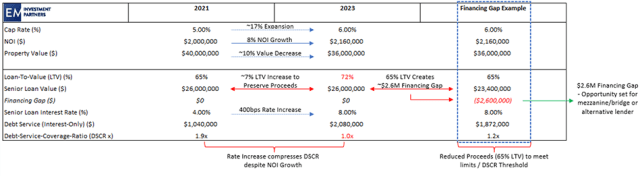
Source: EquityMultiple; based on/replicates precedent analysis by CenterSquare in “Real Estate Debt: The Time Is Now,” the Q1 2023 report by Michael Boxer.
Looking Forward: Beyond the Challenges
So, where does this leave real estate investors? Despite the challenging transactional environment, depressed CRE valuations, and an increasingly harder path to sourcing positive leverage at adequate levels, economic fundamentals remain strong with many potential catalysts for commercial real estate investing success. The following themes stand out:
- Distressed Asset Opportunities across Sectors: These will span direct equity investments, at a compelling acquisition basis, and debt investments –refinancing, transitional mezzanine/bridge lending, etc.
- Sectoral Shake-Ups and Demand Dislocation: Knowledge workers are leaving the big cities for the exurbs, suburbs, and Tier II metros.
- Innovation: As the remote economy matures, technology, consumption, and real estate will evolve. AI and clean energy incentives will create new demands on the built environment across geographies.
Taken together, these factors could help create a chasm between the demand for capital among real estate operators and the actual supply of capital. In the wake of the global financial crisis (GFC) and Dodd–Frank and other legislation, a credit crunch developed. Designed to stimulate traditional sources of start-up capital, the Jumpstart Our Business Startups (JOBS) Act shook up real estate markets. By enabling real estate crowdfunding, the JOBS Act opened up private real estate markets to individual investors and introduced new capital channels for real estate operators.
So today, as traditional lenders pull back, alternative capital providers may fill the gap. Accredited direct investment platforms that now offer access to alternative investments, including real estate, can help solve the credit crunch and capitalize on the current need in the market.

Many real estate firms, ours among them, offer a full range of investment opportunities across the capital stack. These include bridge financing and debt solutions for real estate firms as well as relatively short-duration, fixed-income products for individual investors. Writ large, real estate investing fintech platforms have had 10 years to mature and grow, and alternative, non-bank financing sources could prove crucial in the months and years ahead in helping middle-market real estate operators seize new opportunities.
In our next installment, we will consider the potential value the principal US CRE sectors may offer investors.
If you liked this post, don’t forget to subscribe to Enterprising Investor.
All posts are the opinion of the author. As such, they should not be construed as investment advice, nor do the opinions expressed necessarily reflect the views of CFA Institute or the author’s employer.
Image credit: ©Getty Images / onurdongel
Professional Learning for CFA Institute Members
CFA Institute members are empowered to self-determine and self-report professional learning (PL) credits earned, including content on Enterprising Investor. Members can record credits easily using their online PL tracker.