
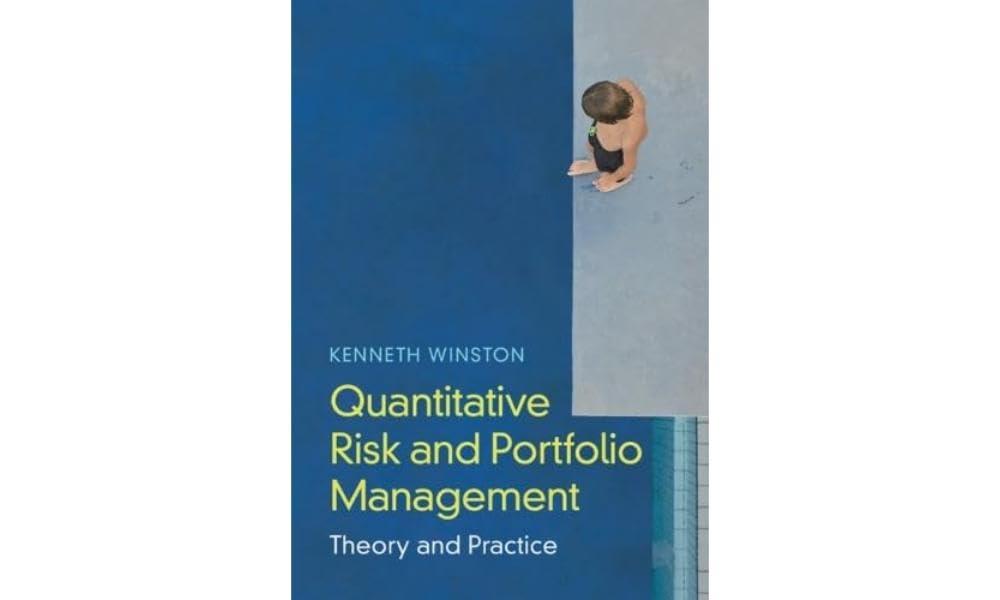

Quantitative Risk and Portfolio Management: Theory and Practice. 2024. Kenneth J. Winston. Cambridge University Press.
The field of textbooks on quantitative risk and portfolio management is crowded, yet there is a problem matching the right book with the appropriate audience. Like Goldilocks, there is a search for a book that is neither too technical nor too simple to reach a broad audience and have the most significant reader impact. The perfect quant text should be a mix of explaining concepts clearly with the right level of intuition and enough practicality, combined with mathematical rigor, so the reader can know how to employ the right tools to solve a portfolio problem.
Although textbooks are not often reviewed for CFA readers, it is useful to highlight a book that fills a unique gap between the CFA curriculum and the growing demand to find model-driven investment management solutions.
Quantitative Risk and Portfolio Management: Theory and Practice achieves that critical balance by providing an apt mix of intuition and applied math. Author Ken Winston, the author of Quantitative Risk and Portfolio Management, has had a distinguished career moving between industry and academic positions. He is well-placed to provide readers with the necessary tools to be an effective quant or a professional who needs to digest the output from quants.
Winston’s book fills a niche between theory and practice; nevertheless, it is not the ideal text for every CFA charterholder. It places greater emphasis on the math and programming of solutions than most practical portfolio management books.
Programming is currently a “hidden curriculum” item in investment risk and portfolio management education that goes beyond theory and research. Brad De Long, the University of California Berkeley economic historian, has conjectured that programming skills are like the fine chancery hand of medieval university graduates. Programming goes beyond the classic liberal arts or business education, showing your distinction as an educated man. In today’s world, it is not enough to say you know portfolio or risk management; you must be able to “do” it. Winston closely links quant concepts with Python programming to make the hidden curriculum of quant finance transparent and accessible. You will not become a quant programmer from studying this book, but Quantitative Risk and Portfolio Management enables you to more easily bridge the link between theory and critical quantitative analysis through programming.
Quantitative Risk and Portfolio Management integrates Python code snippets throughout the text so that the reader can learn a concept and the foundational math and then see how Python code can be integrated to build a model with output. While this is not a financial cookbook, the close integration of code distinguishes it from others.
That makes the book useful for sitting on the shelf as a reference for analysts and portfolio managers. For example, the reader can learn about fixed-income yield curves and then see how the code can generate output for different models. If you want to build a simple model, creating the basic code is not a trivial exercise. Exposure to Winston’s code snippets allows the reader to move more quickly from a risk and portfolio management learner to a doer.

The book is divided into twelve chapters that cover all the basics of quantitative risk and portfolio management. The emphasis for many of these chapters, however, is significantly different from what many readers may expect. Winston often focuses on concepts not covered in more traditional or advanced texts by building on core math foundations. For example, there is a chapter on how to generate convex optimizations following the discussion on the efficient frontier. If you are going to run an optimization, this is critical knowledge, yet it is the first time I have seen an extensive review of optimization techniques in a finance text.
At times, the chapter order may seem odd to some readers. For example, optimization and distributional properties come after equity modeling. However, this sequencing is not problematic and does not take away from the book.
Winston begins with the basic concepts of risk, uncertainty, and decision-making, which are central issues facing any investor. Before discussing individual markets, the book focuses on risk metrics based on no-arbitrage models and presents the often-overlooked Ross Recovery Theorem. Quantitative Risk and Portfolio Management then focuses on valuation measurements for equity and bond markets.
The author takes a unique presentation approach to discuss these core markets, which is a critical difference between this book and its competitors. For fixed income, he starts with classic discounting of cash flows but then layers in greater degrees of complexity so that readers can learn how more complex models are developed and extend their earlier thinking. I have not seen this done as effectively in any other portfolio management book, even ones that focus solely on fixed income.
The same technique is used with the equity markets section. From a simple presentation of Markowitz’s efficient frontier, Winston adds complexities to show how the problem of uncertain expected returns is addressed to improve model results. He also effectively presents the complexities of factor models and the arbitrage pricing theorem. Again, this is not generally the approach presented in other texts.

Quantitative Risk and Portfolio Management presents a focused chapter on distribution theory and a section on simulations, scenarios, and stress testing. These are important risk concepts, especially when the problem of risk management is placed in the context of controlling for uncertainty.
The book then explains time-varying volatility measurement through current modeling techniques, the extraction of volatility from options, and the measurement of relationships across assets based on correlation relationships. While it is neither a math book nor one on econometrics, Quantitative Risk and Portfolio Management strikes a nice balance between the core concepts on measuring volatility and covariance with more advanced issues concerning risk forecasting.
The book ends with a chapter on credit modeling and one on hedging, and in both cases follows Winston’s approach of layering in greater modeling complexity. Given his clear discussion of the difference between risk and uncertainty, I wish the author had emphasized this important distinction in his chapters. Knowing what is objectively measurable and what is subjective is a critical lesson for any risk or portfolio manager.
The presentations of quant risk and portfolio management concepts in this book are well thought through, starting with simple concepts and then adding complexity along with code to help the reader understand how to employ data to implement the methodology.
If you are looking for a traditional survey book that touches on the key concepts of risk and portfolio management, you may be disappointed with this more idiosyncratic work.
If, on the other hand, you want to be a doer because your job requires you not just to talk about risk concepts but to implement tools and you want strong foundational math without reading a cookbook, this is an excellent text. There is no question that a junior quant analyst will find this book insightful, but just as important, the portfolio manager who wants to understand the output from quants will find it useful. Acceptance of new ideas and models will occur only if the quantitative tool builder and the output user can effectively talk with each other. Quantitative Risk and Portfolio Management: Theory and Practicewill help both parties with that conversation.