
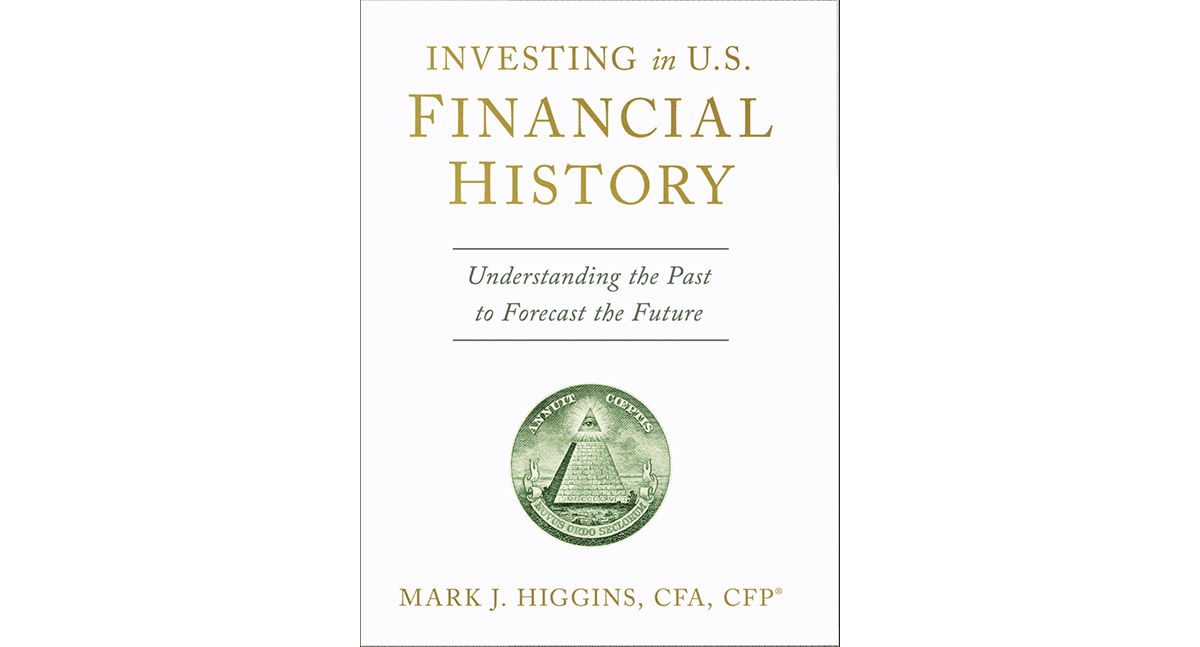

Investing in U.S. Financial History: Understanding the Past to Forecast the Future. 2024. Mark J. Higgins, CFA, CFP. Greenleaf Book Group Press.
Chronicling the United States’ entire financial history from the 18th century onward is a highly ambitious but essential undertaking. The most recent such effort, prior to the book under review, was Jerry W. Markham’s multi-volume Financial History of the United States series. Other century-spanning histories appeared much earlier and consequently do not capitalize on the experience and scholarship of the last several decades. These include Paul Studenski and Herman Edward Krooss’s Financial History of the United States and Margaret Good Myers’s A Financial History of the United States.
In taking on this formidable task, Mark J. Higgins, CFA, CFP, strives not only to tick off key events dating back to Alexander Hamilton’s time but to demonstrate that learning from them has helped decision makers address new crises as they have arisen. For instance, he maintains that fresh memories of the Panic of 1907 preconditioned government officials and Wall Street leaders to respond swiftly and aggressively to the first sign of panic that followed the 1914 outbreak of World War I. In that instance, the appropriate response turned out to be shutting down the New York Stock Exchange, a step specifically avoided by J. Pierpont Morgan seven years earlier. Clearly, historical precedents require some interpretation, but as Higgins writes, “By applying lessons from the Great Depression over the last ninety years, U.S. fiscal and monetary authorities have avoided a repetition of the catastrophe.”
The author sets the record straight on some popular misconceptions about financial history. For instance, he rightly says that the 29 October 1929 stock market crash did not trigger the Great Depression. According to the National Bureau of Economic Research, the economic contraction began in September 1929. The crash was a less important contributor to the severity and duration of the downturn than monetary and fiscal policy errors.
Even well-informed practitioners stand to gain new insights from Higgins’s painstaking research. For example, it will be news to many of them that today’s closed-end funds represent a revival of a product that, on average, suffered a staggering 98% loss of value between July 1929 and June 1932.
On a different topic, just a couple of years ago, a Barron’s headline read, “The Culprits of the 1987 Market Crash Remain a Mystery,” but Higgins lists six specific causes of the Dow Jones Industrial Average’s record 22.61% plunge on 19 October 1987. He also debunks the notion, propagated by the real estate profession prior to the 2008 bust, that property prices could not possibly fall on a nationwide basis because it had never happened before. Higgins cites precedents that accompanied economic depressions of the 1820s and 1840s.

The author’s heroic, 585-page work is all the more impressive by virtue of his background. Higgins is not an academic historian but, rather, an institutional investment consultant. His practitioner-oriented book includes a section on the origin of the securities analyst profession and a tribute to the CFA charter. This orientation makes Higgins’s treatment particularly useful to investors and money managers. He has applied to his day job the knowledge he amassed through his voracious reading of financial history during the course of writing the book. By his account, his clients have benefited in the form of lower fees and improved performance.
The book’s title, Investing in U.S. Financial History, crystalizes Higgins’s notion that studying the past can be much more than a pleasurable intellectual exercise. Still, the book contains hints of an attraction to history for its own sake in such digressions as a more than 25-page discussion of the leadup to World War II, followed by more than 14 pages on the war itself. That is surely more detail on the strategies and battles than extracting the relevant financial lessons requires.
Bond specialists will question Higgins’s assertion that because of their complexity, structured mortgage products of the early 2000s “were well beyond the competency of ratings analysts — or any human being whatsoever in many cases.” Famously, Goldman Sachs had no difficulty identifying, on behalf of a major client who wanted to sell short, mortgage pools that were exceptionally susceptible to defaults. Credit ratings of mortgage-backed securities (MBSs) that proved to be far too lenient were instead a function of a rating agency conflict of interest — that is, the issuer-pay model, which was more successfully controlled in the corporate asset class. In corporates, unlike the MBS market at the time, investors demanded that issues be rated by both leading agencies. That prevented issuers from dangling the prospect of fees to play one agency off against the other. Another difference was that no single corporate issuer represented a large enough percentage of the agencies’ revenues to tempt them to sacrifice their reputations by putting a thumb on the scale to help the issuer lower its borrowing cost. In MBSs, by contrast, a few investment banks dominated deal origination and disbursement of rating fees.

Some readers may scratch their heads when they see a graph that accompanies Higgins’s discussion of Moore’s law. Intel cofounder Gordon Moore predicted in 1965 that the number of transistors per chip — and, therefore, the chip’s power — would double roughly every two years. Intended to illustrate the accuracy of his prediction, the graph shows the number of transistors per CPU declining in 1965, 1967, 1969, and 1970. In a future edition, the author could clear up possible confusion by expanding on his statement that the graph “uses data from Fairchild Semiconductor and Intel Corporation to show the average number of transistors on silicon chips produced from 1960 to 1971.” Older-model, less densely packed semiconductors do not cease to be produced as soon as engineers achieve a new high in transistors per chip. The mix of older and newer chips that the companies manufacture varies from year to year, so the average density per chip may fall in a given year, even though the density of the most advanced chip can only rise or hold steady.
These minor criticisms should not deter investment professionals from procuring the benefits of diligently studying Investing in U.S. Financial History. By now, it is true that John Templeton’s dictum “The four most dangerous words in investing are ‘This time it’s different’” has become a cliché. It has attained that status, however, because it contains much wisdom. Certainly, one should be prepared for the possibility of an unprecedented event, but smart investors will set a high bar for making it their base case. Higgins’s epic book offers invaluable context for forecasting the direction of the economy and the market.*
If you liked this post, don’t forget to subscribe to Enterprising Investor and the CFA Institute Research and Policy Center.
* The reviewer thanks Jesse Ausubel, Peter Barzdines, David Burg, Emanuel Derman, Michael Edelman, John Pantanelli, Felix Suarez, and Richard Sylla for their insights. Any errors or omissions are the reviewer’s responsibility.
All posts are the opinion of the author. As such, they should not be construed as investment advice, nor do the opinions expressed necessarily reflect the views of CFA Institute or the author’s employer.
Professional Learning for CFA Institute Members
CFA Institute members are empowered to self-determine and self-report professional learning (PL) credits earned, including content on Enterprising Investor. Members can record credits easily using their online PL tracker.