


“I think, therefore I am.”
—René Descartes
Investing isn’t a test of who’s right; it’s a test of who updates best. In that scenario, success doesn’t go to those with perfect predictions, it goes to those who adapt their views as the world changes. In markets shaped by noise, bias, and incomplete information, the edge belongs not to the boldest but to the most calibrated.
In a world of uncertainty and shifting narratives, this post proposes a new mental model for investing: Bayesian edge investing (BEI) — a dynamic framework that replaces static rationality with probabilistic reasoning, belief-calibrated confidence, and adaptive diversification. This approach is an extension of Bayesian thinking — the practice of updating one’s beliefs as new evidence emerges. For investors, this means treating ideas not as fixed predictions but as evolving hypotheses — adjusting confidence levels over time as new, informative data become available.
Unlike modern portfolio theory (MPT), which assumes equilibrium and perfect foresight, BEI is built for a world in flux, one that demands constant recalibration rather than static optimization.
A confession: Much of what I’ve explored in this post remains a work in progress in my own investment practice.
Judgment Over Analysis
Financial models are teachable. Judgment is not. Most frameworks today are centered on mean-variance optimization, assuming investors are rational, and markets are efficient. But the reality is messier: markets are often irrational, and investor beliefs evolve.
At its core, investing is a game of decisions under uncertainty, not just numbers on a spreadsheet. To consistently outperform, investors must confront irrationality, navigate evolving truths, and react with rational conviction — a much harder task.
That means shifting from deterministic models to belief-weighted, evidence-updated frameworks that recognize markets as adaptive systems, not static puzzles.
Calibrated, Not Certain
In investing, being rational isn’t about being certain. It’s about being calibrated. It’s about recognizing irrationality and then responding with discipline, not emotion. But here’s the paradox: both irrationality and rationality are elusive and often indistinguishable in real time. What appears obvious in hindsight is rarely clear in the moment, and this ambiguity fuels the very boom-bust cycles investors try to avoid.
BEI reframes rationality as the ability to construct a probability-weighted map of future outcomes and to continuously update beliefs as new information emerges. It is:
- Bayesian, because beliefs evolve with evidence.
- Edge-seeking, because alpha lies in misalignments between an investor’s belief and the market’s.
Rationality in this framework means acting when your updated model of reality diverges materially from prevailing prices.
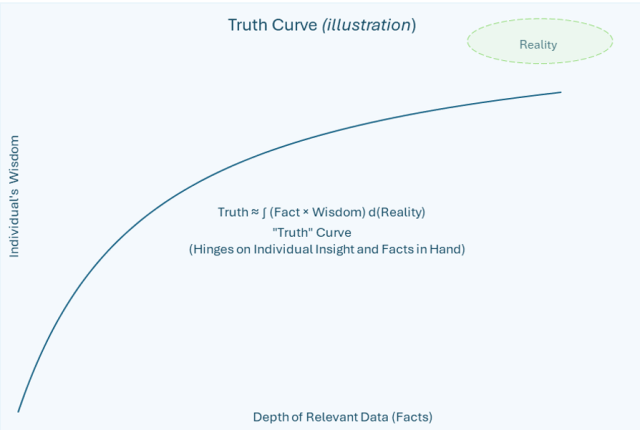
A Mental Model: Truth ≈ ∫ (Fact × Wisdom) d(Reality)
“Truth” based on facts and wisdom leads to “Reality.”
“Facts” are objective but “Truth” is conditional. It emerges from how much information is available and how well you interpret it.
Let’s reframe how we perceive “Truth” in markets. It is a function of:
- Facts — objective data.
- Wisdom — Interpretive ability, including judgement and context.
Together, facts and wisdom determine how close our perception of truth aligns with reality. Like an asymptote, we approach reality but never fully capture it. The goal is to move further along the truth curve than other market participants.
Figure 1 illustrates this relationship. As both relevant data (facts) and interpretive wisdom increase, our understanding (truth) moves progressively closer to reality – asymptotically approaching it, but never fully capturing it in advance.
Figure 1.
This mental model reframes rationality as the pursuit of superior probabilistic judgment. Not certainty. It’s not about having the answer, but about having a more informed, better-calibrated answer than the market. In other words, aiming to be further along the truth curve (reality).
From Bias to Bayes
Cognitive biases like loss aversion, confirmation bias, and anchoring cloud decisions. To combat these biases, Bayesian thinking begins with a hypothesis and updates belief strength in proportion to the diagnostic power of new information.
Not every data point deserves equal weight. The disciplined investor must ask:
- How likely is this information under competing hypotheses?
- How much weight should it carry in updating my conviction?
This is dynamic conviction-building rationality in motion.
A Biotech Case Study
The principles of BEI come into sharper focus when applied to a real-life decision-making exercise. Imagine a mid-cap biotech firm developing a breakthrough therapy. You initially place the probability of success at 25%. Then the company announces positive and statistically significant Phase II trial results — a meaningful signal that warrants a reassessment of the initial belief.
Bayesian Update:
- P(Positive Result | Success) = 0.7
- P(Positive Result | Failure) = 0.3
- P(Success) = 0.25
- P(Failure) = 0.75
Bayesian Update:
P(Success | Positive Trial) = [P(Positive Trial | Success) × P(Success)] / {[P(Positive Trial | Success) × P(Success)] + [P(Positive Trial | Failure) × P(Failure)]}
= (0.7 × 0.25) / [(0.7 × 0.25) + (0.3 × 0.75)]
= 0.175 / 0.4 = 0.4375 → 43.75%
This increases confidence in the trial’s success from 25% to 43.75%.
Now embed this in a Weighted Evidence Framework:

A single data point can meaningfully shift conviction, position sizing, or risk exposure. The process is structured, repeatable, and insulated from emotion.
Interpretation: Understanding what the market implicitly believes can reveal powerful opportunities. In the example discussed, if the current price of $50 reflects only existing cash flows and an additional $30 of value is estimated with 57% confidence, the gap suggests a potential analytical edge — one that could justify a high-conviction position.
Turning Confidence into Allocation
Traditional diversification assumes perfect calibration and constant correlations. BEI proposes a different principle: allocate based on your edge.
This framework constructs portfolios based on two factors: an investor’s dynamically updated confidence level in a thesis and the investor’s assessment of market irrationality, or perceived mispricing. Unlike traditional models that theoretically push all investors toward a similar optimal portfolio, this approach generates a personalized investment universe, inherently discouraging “me-too” trades and aligning capital with an investor’s unique insight.
This framework positions ideas across two axes: conviction and the magnitude of mispricing:

Why this works:
- Depth over breadth — Focus capital where you have informational or analytical advantage.
- Adaptive structure — Portfolios shift as beliefs evolve.
- Behavioral shield — Confidence quantification helps counter overreaction, FOMO, and anchoring.
The Real Risk Isn’t Volatility — It’s Misjudging Reality
Volatility is not risk. Being wrong — and staying wrong — is. Especially when you fail to update your beliefs as new evidence emerges.
Risk = f(Belief Error × Position Size)
The BEI model addresses this risk by requiring investors to:
- Regularly reassess priors.
- Stress-test views with new evidence.
- Adjust conviction-based exposure.
Conclusion: The Edge Belongs to the Adaptive
Investing is not about certainty. It’s about clarity under uncertainty. The BEI framework offers a path toward clarity:
- Define a belief.
- Update it with evidence.
- Quantify your confidence.
- Align capital with conviction.
In doing so, it reframes rationality not as static precision, but as adaptive wisdom.
The BEI model may not offer the neat equations of MPT. But it provides a method to think clearly, act decisively, and build portfolios that thrive not despite uncertainty but because of it.