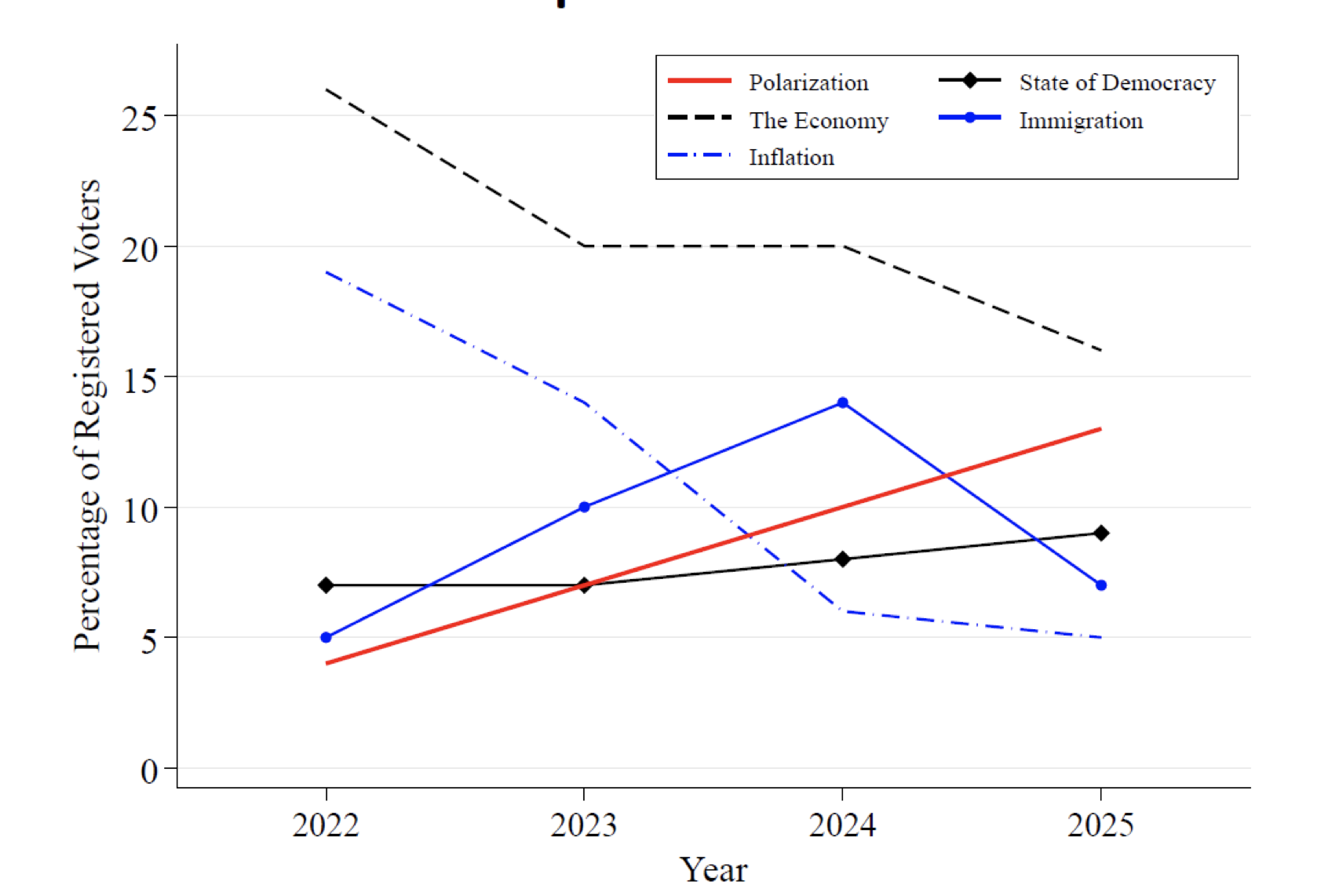

Voters in the US and other advanced democracies disagree sharply on many issues – not only on what policies to adopt, but also on basic facts, such as trends in inequality, the features of immigrants, the causes of climate change (eg. Alesina et al. 2023, Kahan 2015). Disagreement in turn fuels political conflict, which many see as undermining the functioning of democracy (Klein 2020, Graham and Svolik 2020, Levitsky and Ziblatt, 2018). Political polaristion is now seen by US voters as a major social problem, almost on a par with the economy (see Figure 1)
Figure 1 US voters’ opinion on the most important problem facing the country
Note: Responses to the question “What do you think is the MOST important problem facing the country today?”
Source: New York Times/Siena poll.
But where does polarisation come from? The standard explanation stresses distortions in exposure and processing of information. Some scholars point to echo chambers, where voters only encounter news that confirms their priors. Others emphasise motivated reasoning, where people under-weight evidence that contradicts their preferences. Both accounts view news – accurate or distorted – as the essential input.
In a recent paper (Gennaioli et al. 2026), we show that the forces behind polarisation may run deeper, with important implications. In a pre-registered online experiment with a large representative US sample of nearly 13,000 respondents, we show that increasing the salience of a social conflict – economic or cultural – without providing any news at all boosts disagreement on a range of political issues by 8% to 35%. Our treatments are minimal: we simply change the order of survey questions, asking some respondents to reflect on a social ‘enemy’ – for example, billionaires who evade taxes, or supporters of White Pride – before they state their beliefs on income inequality, immigration, redistribution, or abortion. There is no new information, no persuasion attempt, no partisan cue. And yet beliefs shift substantially and systematically.
Identity as a polarisation engine
Why does merely thinking about a social conflict change what people believe about verifiable facts? The answer lies in social identity. Building on the theoretical framework of Bonomi et al. (2021), we argue that people hold latent group memberships: economic (e.g. supporters of free markets versus supporters of government intervention) and cultural (e.g. religious versus secular). When a conflict between such groups is made salient, people begin to see the world through the lens of their activated ingroup. Their beliefs shift toward ingroup stereotypes: what distinguishes the ingroup from the outgroup, exaggerated relative to reality.
If this mechanism is real, then anyone who can make a group conflict salient can shift beliefs – without providing any information. Consider the rhetorical style of Donald Trump, who in rally after rally recites a litany of enemies: “the communists, Marxists, fascists, and the radical left thugs”. No policy proposal accompanies the list. No new facts are offered about what these groups have done. The audience is simply invited to contemplate who threatens them. This is structurally identical to what our experiment does: we ask respondents to select which group “they and people like them feel most threatened by” from a list of opposing groups. Based on this enemy choice, we classify respondents as progressive or conservative in the economic and cultural domains. Trump's speeches perform the same operation from a rally stage, that is, collapsing diverse progressive positions into a single threatening outgroup and activating a broad conservative-versus-progressive identity. What effects does this have? Our experiment allows us to answer this question in a controlled setting.
We document two effects:
- First, amplification: making a conflict salient widens the gap between the classified progressive and conservative groups standing in that conflict, across both factual and normative issues. When economic conflict is primed, economic progressives become measurably more progressive and economic conservatives become more conservative – not only on economic issues but also on cultural ones, because groups that disagree on economics tend to disagree on culture as well.
- Second, realignment: some people with ‘mixed’ profiles – economically progressive but culturally conservative, or vice versa – shift across the progressive-conservative divide when a different conflict becomes salient. Making economic conflict top of mind can partially undo culturally driven polarisation, and vice versa.
Crucially, polarisation is strongest on issues where opposing groups disagree most. This is the ‘kernel of truth’ logic: stereotypes exaggerate real group differences rather than inventing them from nothing. These effects are robust to controlling for partisanship and hold even among independent voters, confirming that the mechanism operates through social group identities, not through party cues.
Why politicians want to fan the flames
These findings have direct implications for political strategy. If merely making a conflict salient is enough to polarise beliefs, then politicians and propagandists need not lie or distort facts to divide voters. They can simply choose which conflict to highlight.
But why would politicians want to polarise voters? As shown by Glaeser et al. (2005) and Gennaioli and Tabellini (2025), if voters are asymmetrically exposed to party propaganda – right-wing voters attending more closely to conservative messages, and vice versa on the left – even opportunistic parties find it optimal to adopt divergent platforms and to polarise the electorate. Gennaioli and Tabellini (2025) formalise this logic within the framework of identity theory: a right-wing message that “immigrants are criminals” makes conservative voters more anti-immigrant but triggers a progressive backlash. On net, however, the party gains because its core voters respond more strongly to its propaganda. This creates a self-reinforcing spiral — more extreme voters push parties toward more divergent platforms, which incentivises more aggressive propaganda, which polarises voters further. Boeri et al. (2026a, 2026b) discuss how indeed political rhetoric becomes more polarised in the run-up to elections.
Culture wars
Politicians cannot highlight any conflict they choose – it must resonate with voters and trigger their latent identities. Cultural conflicts have grown increasingly salient in recent decades: US parties have shifted their advertising and rhetoric toward cultural issues over the past two decades, even as rising inequality made redistributive conflict seemingly more pressing. A likely reason is that globalisation and technology have hurt less educated, culturally conservative workers, widening the cultural divide with progressive groups.
The China trade shock provides a particularly striking example. Gennaioli and Tabellini (2025) show that in US commuting zones more exposed to import competition from China, Republican representatives adopted more conservative rhetoric, and conservative voters demanded less redistribution and became more hostile toward immigrants – even though a rational response to an adverse economic shock might be to demand more redistribution. The mechanism is an identity switch from class to cultural identity.
Politicians are not the only actors with incentives to raise the salience of social conflict. Noy and Rao (2025) document that cable news networks have increasingly focused on culture war content – not because it is most newsworthy, but because it generates the highest audience engagement. Media outlets that systematically prime cultural conflict activate identity-based polarisation even when their reporting is factually accurate. The problem is not misinformation but selection, that is, which conflicts are made salient. Editorial choices about what to cover may matter more than the accuracy of the coverage itself.
Social media has further amplified these dynamics. On the supply side, it allows parties to micro-target their core constituencies, strengthening incentives to diverge and polarize (Boeri et al. 2026a, 2026b). On the demand side, engagement-optimised algorithms promote content that triggers group conflict, keeping adversarial identities perpetually salient and making it easier for politicians to harden their base.
These dynamics carry an uncomfortable policy implication. The standard prescription against polarisation – fact-checking, more balanced media diets, greater media literacy – may be insufficient. When identity is activated, people over-weight group-based beliefs and under-weight issue-specific information; a well-placed fact-check can even backfire by reinforcing perceptions of outgroup bias. More promising interventions might instead target conflict salience directly. Our experiment offers a proof of concept: priming economic conflict partially reverses culturally driven polarisation among mixed types. Interventions that prime common identities – shared national projects, cross-cutting social ties, or external challenges – could de-escalate polarisation more effectively than adding more information to an already saturated media environment.
Conclusion
Political polarisation is not just a byproduct of misinformation, echo chambers, or partisan media. It can be manufactured – deliberately or as a side effect – by strategic choices about which social conflicts to make salient. Politicians, media outlets, and social media algorithms all have tools, and incentives, to raise the salience of divisive group conflicts. Understanding that the mere framing of ‘us versus them’ can shift beliefs on verifiable facts, even in the absence of any news, is essential for designing effective responses. The fight against polarisation must go beyond correcting falsehoods and address the deeper question of how societies choose to frame their disagreements. And future research ought to devote more effort to study how media and political actors choose what issues and conflicts to make salient.
References
Alesina, A, A Miano and S Stantcheva (2023), “Immigration and Redistribution,” The Review of Economic Studies 90(1): 1–39.
Boeri, T, N Nikiforova and G Tabellini (2026a), “When and Why Political Leaders Polarize Rhetoric: Evidence from Twitter/X”, VoxEU.org, 10 April.
Boeri, T, N Nikiforova and G Tabellini (2026b), “Do Elections Moderate or Polarize Political Rhetoric?”, CEPR Discussion Paper 21317.
Bonomi, G, N Gennaioli and G Tabellini (2021), “Identity, Beliefs, and Political Conflict”, The Quarterly Journal of Economics 136(4): 2371–2411.
Gennaioli, N, F Schwerter and G Tabellini (2026), “Us vs Them: Salient Conflict and Belief Polarization“, CEPR Discussion paper 21324.
Gennaioli, N and G Tabellini (2025), “Presidential Address: Identity Politics”, Econometrica 93(6): 1937–1967.
Glaeser, E L, G Ponzetto and J Shapiro (2005), “The Political Economy of Hatred,” The Quarterly Journal of Economics 120(1): 45–86.
Graham, M H and M W Svolik (2020), “Democracy in America? Partisanship, Polarization, and the Robustness of Support for Democracy in the United States,” American Political Science Review 114(2): 392–409.
Kahan, D M (2015), “Climate-Science Communication and the Measurement Problem,” Political Psychology 36: 1–43.
Klein, E (2020), Why We're Polarized, Simon and Schuster.
Levitsky, S and D Ziblatt (2018), How Democracies Die, Crown.
Noy, S and A Rao (2025), “The Business of the Culture War”, available at SSRN.