


Interest rates move markets worth trillions of dollars, influence politics, impact the value of currencies, and even affect our grocery bills. Central bank press conferences announcing rate decisions attract large audiences and make captivating headlines such as, “Rates Lift Off.” And pundits use jargon such as “soft landing” and “hard landing” to describe the expected consequences of central bank policy decisions. But in a perfect world, where exactly should we be landing?
Economists and practitioners alike have been wondering about this since the 19th Century, when Swedish economist Knut Wicksell came up with the idea of the natural rate of interest, also known as the neutral interest rate, the equilibrium rate, and r* (r-star). It is the rate at which monetary policy is not stimulating or restricting economic growth. It is important because central bankers use it to set monetary policy, primarily by raising, lowering, or maintaining interest rates.
The neutral rate is compatible with stable price levels and maximum employment. If current interest rates are higher than r*, the implication is that we are in a restrictive monetary environment in which inflation will tend to fall. Prevailing rates that are lower than r* imply that we are likely to experience higher inflation.
The idea of r* is extremely attractive. We have a rate that equates to all savings and investments in the economy while keeping output at its full potential without inflation. This is a place where we want to land the economy. No wonder so much research has been done in the area. The neutral rate can be considered the Holy Grail of central banking: the rate that promises low inflation without impacting employment. However, just like the Holy Grail itself, r* is remarkably difficult to find. It is elusive because it is not observable.
With Federal Reserve Chair Jerome Powell’s semiannual address to the Senate Banking Committee this week fresh in mind, it is an ideal time to consider the drivers of r*. It is important to remember that the Fed’s response to changing financial conditions has subsequent impacts on financial conditions.
The Forces that Drive R*
R* is widely believed to be determined by real forces that structurally affect the balance between savings and investment in an economy. This includes potential economic growth, demographics, risk aversion, and fiscal policy, among others. It is the rate that will prevail in an equilibrium once the effects of short-term perturbations have petered out.
All of this makes r* unobservable, and therefore analysts and economists must resort to models to derive an approximation of the rate. Each model has its pros and cons, and the resulting estimated rate is model dependent and never the true r*.
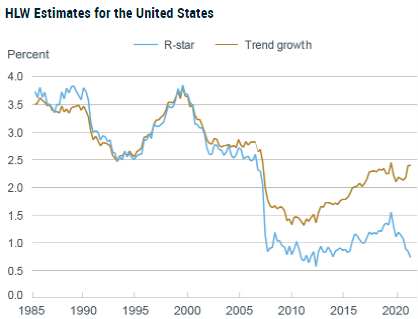
Central banks estimate the natural rate of interest regularly using differing models. The Federal Reserve Bank of New York, for example, uses the Laubach-Williams (LW) and Holston-Laubach-Williams (HLW) models. The latter is represented in Exhibit 1.
Exhibit 1.
Source: Federal Reserve Bank of New York.
Is Money Really Neutral?
Despite the challenges associated with relying on different models to derive r*, there has been a clear trend shared by each model: rates were in a secular decline for four decades. This decline resulted from structural forces driving rates ever lower. Factors like China’s rising savings rate and strong appetite for US securities, an ageing population pushing savings up and investments down, globalization, and low productivity growth played a role in reducing the neutral rate of interest.
But there is another, less-discussed driver of r*. That is monetary policy. Most of the macroeconomic research assumes that money is neutral with no impact over real variables and that r* is determined by real variables. Therefore, in theory, monetary policy is irrelevant in the search for r*. In practice, however, monetary policy is not irrelevant.
The importance of monetary policy is patent when we consider the decades-long effort by the major central banks to lower rates, in fact pushing interest rates well below r*. When this happens, several “evils” take hold of an economy, and these evils impact both real and nominal variables, explained Edward Chancellor in his book The Price of Time: The Real Story of Interest.
One evil is faulty investment assessment. Artificially low rates reduce the hurdle rate for evaluating projects and, therefore, capital is directed to sectors and projects with lower-than-normal expected returns.
Another is the “zombification” of the economy. When rates are low and debt financing is plentiful, companies that should have gone bankrupt continue to operate at ever higher levels of debt. This puts the Schumpeterian mechanism of creative destruction on hold, allowing non-viable companies to continue in existence.
Third is the lengthening of supply chains. Low rates promote unsustainable expansion of supply chains as manufacturers push their production process further into the future. This implies that when rates rise, globalization trends will reverse, as we are already starting to observe.
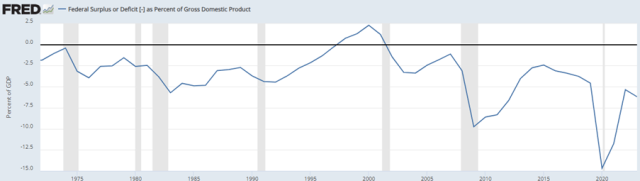
The fourth evil is fiscal imprudence. For politicians, it is tempting to spend money on popular policies to win elections. If interest rates are low and bond “vigilantes” are nowhere in sight, then the temptation is impossible to avoid. This is reflected in the ever-red US fiscal balance. The fact that the US deficit stands at 6% of GDP is a worrying trend for the United States.
Exhibit 2. Federal Surplus or Deficit as a Percent of GDP.
Source: Federal Reserve Bank of St. Louis.
Remaining consistently below r* will not only drive up inflation but will also create a host of other imbalances throughout the economy. These imbalances will need to be corrected at some point with considerable pain and impact over real variables.
The fact is that monetary policy has not been neutral, and central bankers have not been seeking the rate of equilibrium. Rather, they have pushed rates ever lower under the assumption that this is the way to achieve maximum employment, regardless of the imbalances accumulating throughout the economy.
Where Do We Go From Here?
To find the future trajectory of the neutral rate, we must project how the structural drivers of the economy will move. Some of them are clear, and some others may or may not materialize.
First, post pandemic inflation forced central banks to end the era of ultra cheap money. The market consensus is that we will not be returning to a near-zero interest rate environment in the short term.
Second, massive fiscal deficits are far from being corrected. The United States lacks any fiscal consolidation plan. Outside of the United States, we should expect further public spending supported by three main drivers: an ageing population, the green transition, and higher defense spending.
Third, financial globalisation will roll back because of higher rates and geopolitical fragmentation.
On the bright — or the investment side – it remains to be seen whether artificial intelligence (AI) or green technologies will live up to their promises and attract private investment.
Taken together, these factors point to a higher r* and thus an end of the secular decline in rates.
Will We Ever Find R*?
Estimating r* is a challenging task. Afterall, there is no single r* to estimate. In the European Union (EU), the natural rate is different than the perceived r* in member states Spain and Finland, for example, but currently the European Central Bank (ECB) sets a single rate that applies across the EU.
Research will produce more sophisticated models, but in an era defined by all-powerful central banks, r* may indeed be an artificial creation. Rates do not reflect individual private decisions, but bureaucratic ones.