

The financial landscape is showing signs of strain as bankruptcy filings surge, with businesses and consumers alike feeling the pressure of shifting economic conditions. Despite Federal Reserve rate cuts aimed at stabilizing the market, historical patterns suggest that monetary policy alone may not be enough to stem the tide. As cracks in the system become more apparent, understanding the drivers of the rise in bankruptcies is crucial for navigating the challenges ahead.
Statistics reported by the Administrative Office of the US Courts show a 16% surge in bankruptcy filings in the 12 months before June 30, 2024, with 486,613 new cases, up from 418,724 the previous year. Business filings saw an even sharper increase, rising by 40.3%. These figures indicate growing financial stress within the US economy, but the real storm may be just around the corner.
During the 2001 recession, the Federal Reserve’s aggressive rate cuts failed to prevent a sharp increase in corporate bankruptcies. Despite lower interest rates, the Option-Adjusted Spread (OAS) for high-yield bonds widened significantly, reflecting heightened risk aversion among investors, and increasing default risks for lower-rated companies.
Trend Analysis: Fed Rates and OAS Spread Compared to Bankruptcy Filings
Image Source: Fred Economic Data, St Louis: The American Bankruptcy Institute and Author Analysis
The Disconnect Between Monetary Easing and Market Conditions
As a result, the period saw a sharp spike in corporate bankruptcies as many businesses struggled to manage their debt burdens amid tightening credit conditions and deteriorating economic fundamentals. This disconnect between monetary easing and market realities ultimately led to a surge in bankruptcies as businesses struggled with tightening credit conditions.
A similar pattern emerged during the 2008 global financial crisis. For 218 days, the ICE BoFA US High Yield OAS Spread remained above 1000 basis points (bps), which signaled extreme market stress. This prolonged period of elevated spreads led to a significant increase in Chapter 7 liquidations as companies facing refinancing difficulties opted to liquidate their assets rather than restructure.
ICE BoFA US High Yield OAS Spread
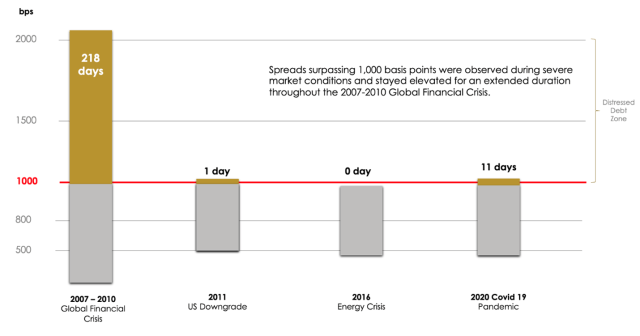
Image Source: Fed Economic Data, St Louis and Author Analysis
The sustained period of elevated OAS spreads in 2008 serves as a stark reminder of the crisis’s intensity and its profound impact on the economy, particularly on companies teetering on the edge of insolvency. The connection between the distressed debt environment, as indicated by the OAS and the wave of Chapter 7 liquidations, paints a grim picture of the financial landscape during one of the most challenging periods in modern economic history.
The Federal Reserve’s interest rate policies have frequently lagged the Taylor Rule’s recommendations. The Taylor Rule is a widely referenced guideline for setting rates based on economic conditions. Formulated by economist John Taylor, the rule suggests that interest rates should rise when inflation is above target, or the economy is operating above its potential. Conversely, interest rates should fall when inflation is below target or the economy is operating below its potential.

The Lag
The Fed’s rate adjustments lag for several reasons.
First, the Fed often adopts a cautious approach, preferring to wait for clear evidence of economic trends before making rate adjustments. This cautiousness can lead to delayed responses, particularly when inflation begins to rise, or economic conditions start to diverge from their potential.
Second, the Fed’s dual mandate of promoting maximum employment and stable prices sometimes leads to decisions that diverge from the Taylor Rule. For example, the Fed might prioritize supporting employment during economic slowdowns, even when the Taylor Rule suggests higher rates to combat rising inflation. This was evident during prolonged periods of low interest rates in the aftermath of the 2008 financial crisis. The Fed kept rates lower for longer than the Taylor Rule suggests to stimulate economic growth and reduce unemployment.
In addition, the Fed’s focus on financial market stability and the global economy can influence its rate decisions, sometimes causing it to maintain lower rates than the Taylor Rule prescribes. The rule’s goal is to avoid potential disruptions in financial markets or to mitigate global economic risks.
Historical Fed Funds Rate Prescriptions from Simple Policy Rules
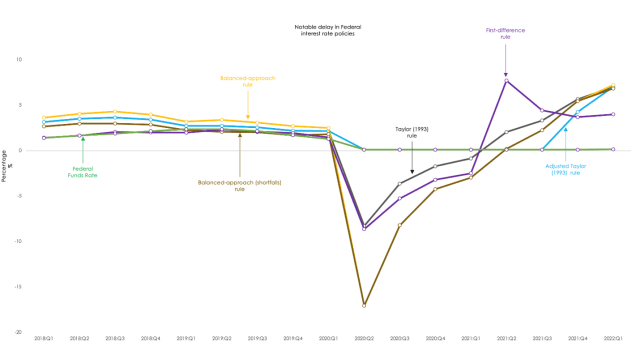
Image Source: Federal Reserve Board and Author Analysis
The consequence of this lag is that the Fed’s rate cuts or increases may arrive too late to prevent inflationary pressures or curb an overheating economy, as they did in the lead-up to previous recessions. Cautious timing for rate cuts may also delay needed economic stimulus, which prolongs economic downturns.
As the economy faces new challenges, this lag between the Fed’s actions and the Taylor Rule’s recommendations continues to raise concerns. Critics argue that a more-timely alignment with the Taylor Rule could lead to more effective monetary policy and reduce the risk of inflation or recession, ensuring a more stable economic environment. Balancing the strict guidelines of the Taylor Rule with the complexities of the real economy remains a significant challenge for policymakers.
As we approach Q4 2024, the economic landscape bears unsettling similarities to past recessions, particularly those of 2001 and 2008. With signs of a slowing economy, the Federal Reserve has cut the interest rate by 0.5% recently to prevent a deeper downturn. However, historical patterns suggest this strategy may not be enough to avert a broader financial storm.
Furthermore, easing monetary policy, which typically involves lowering interest rates, will likely shift investor behavior. As yields on US Treasuries decline, investors may seek higher returns in high-yield sovereign debt from other countries. This shift could result in significant capital outflows from US Treasuries and into alternative markets, putting downward pressure on the US dollar.
The current global environment, including the growing influence of the BRICS bloc, the expiration of Saudi Arabia’s petrodollar agreements, and ongoing regional conflicts, make the US economic outlook complex. The BRICS nations (Brazil, Russia, India, China, and South Africa) have been pushing to reduce reliance on the US dollar in global trade, and petrodollar petrodollar contracts are weakening. These trends could accelerate the dollar’s depreciation.
As demand for US Treasuries declines, the US dollar could face significant pressure, leading to depreciation. A weaker dollar, geopolitical tensions, and a shifting global economic order could place the US economy in a precarious position, making it increasingly difficult to maintain financial stability.
While Federal Reserve rate cuts may offer temporary relief, they are unlikely to address the underlying risks within the financial system. The specter of widening OAS spreads and rising bankruptcies in 2024 is a stark reminder that monetary policy alone cannot resolve deep-seated financial vulnerabilities. As we brace for what lies ahead, it’s essential to recognize the potential for a repeat of past crises and prepare accordingly.