


Business Insights
  • Home
  • Crypto
  • Finance Expert
  • Business
  • Invest News
  • Investing
  • Trading
  • Forex
  • Videos
  • Economy
  • Tech
  • Contact

Archives

  • May 2026
  • April 2026
  • March 2026
  • February 2026
  • January 2026
  • December 2025
  • November 2025
  • October 2025
  • September 2025
  • August 2025
  • July 2025
  • June 2025
  • May 2025
  • April 2025
  • March 2025
  • February 2025
  • January 2025
  • December 2024
  • November 2024
  • October 2024
  • September 2024
  • August 2024
  • July 2024
  • June 2024
  • May 2024
  • April 2024
  • March 2024
  • February 2024
  • August 2023
  • January 2023
  • December 2021
  • July 2021
  • November 2019
  • October 2019
  • September 2019
  • August 2019
  • July 2019
  • June 2019
  • May 2019
  • April 2019
  • March 2019
  • February 2019
  • January 2019

Categories

  • Business
  • Crypto
  • Economy
  • Finance Expert
  • Forex
  • Invest News
  • Investing
  • Tech
  • Trading
  • Uncategorized
  • Videos
Apply Loan
Money Visa
Advertise Us
Money Visa
  • Home
  • Crypto
  • Finance Expert
  • Business
  • Invest News
  • Investing
  • Trading
  • Forex
  • Videos
  • Economy
  • Tech
  • Contact
Beyond the Fed Model: Dissecting Equity Valuation Trends
  • Invest News

Beyond the Fed Model: Dissecting Equity Valuation Trends

  • July 1, 2025
  • Roubens Andy King
Total
0
Shares
0
0
0
Total
0
Shares
Share 0
Tweet 0
Pin it 0

With equity markets hitting record highs and the Fed Model signaling historically low valuation spreads, investors face a perplexing landscape. This post explores the intricacies of the equity risk premium, scrutinizes traditional valuation models, and introduces an updated framework to guide strategic decision-making in today’s volatile environment.

US stocks hit new record highs following Donald Trump’s re-election to the White House. Market risk appetite remains high, but equity valuations also appear elevated. The Fed Model, which measures the spread between the S&P 500 Index forward earning yield and the US Treasury 10-year yield, is currently at -0.1%, a level not seen since 2002 (See Exhibit 1).  

Does the negative Fed Model speak to the end of the equity risk premium? Should investors worry about current equity valuations? In this paper, we address these questions by evaluating the Fed Model through the lens of an intrinsic equity valuation model and disentangling the equity risk premium (ERP) from equity earnings yield.

Subscribe Button

The Fed Model

The FED model has become a very popular equity valuation indicator since Edward Yardeni introduced the model in 1998. The model, as defined in equation [1], compares the equity forward earnings yield with the risk-free 10-year Treasury nominal yield. A positive value indicates the stock market is under-valued, and vice versa. The valuation spread is seen as equivalent to the expected ERP.   

Fed Model = Earning yield – US Treasury 10 year nominal yield           [1]

The intuition is that stocks and bonds are competing assets; therefore, buying riskier stocks only makes sense when stocks can out-earn risk-free US treasuries. However, the Fed Model has continuously faced criticism from investors for lack of theoretical foundation.

Intrinsic Equity Valuation

The Gordon Growth Model (GGM) provides an estimate on a stock’s intrinsic value based on the assumptions of a constant earnings growth rate, cost of capital and dividend payout ratio (See equation [2]). By following the steps described in equations 3 to 5, we can arrive at a modified version of the Fed Model depicted in Equation 5. 
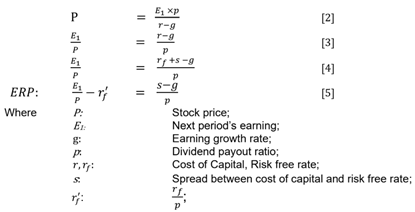
Compared to Yardeni’s model, the modified model no longer assumes the beta to the risk-free rate and the maturity of risk-free yields can vary. Meanwhile, the model indicates that the ERP is negatively correlated with earnings growth rates when fairly valued, i.e. higher earnings growth can lead to a narrower valuation spread. According to FactSet, S&P 500 companies are expected to see annual earnings growth of around 14% over the next two years, well above their historical growth trend.

Conversations with Frank Fabozzi Lori Heinel

An Empirical Framework

Many assumptions behind the GGM do not hold in the real world. For example, the growth rates vary over time; the yield curve is not flat; and so on. Without going through the extensive mathematical theory, we can adopt a generalized model as shown in equation 6 to describe the ERP as the forward equity earnings yield in excess of a linear exposure of the entire risk-free yield curve.

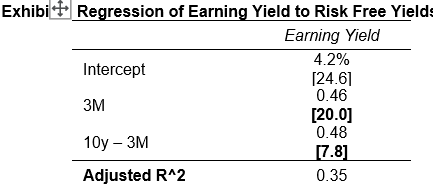
Long term beta exposures of the equity earnings yield to risk-free rate can be estimated by using linear regression techniques. In the spirit of model parsimony, I chose 3-month Treasury bill yield and yield slope (10 year minus 3 month) to approximate the entire yield curve. As shown in Exhibit 2, the beta coefficients of equity earnings yields to Treasury yields are statistically significant with t-stat > 7.0.  
The historical ERP can then be estimated by using Equation 7 below. Exhibit 3 shows the time series of historical ERP. The current model estimate (as of November 30, 2024) is 2.0%, which indicates a narrow but still positive ERP. 
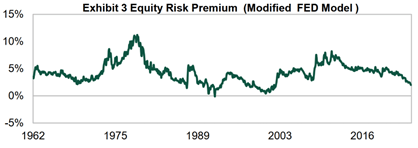
Source:  Bloomberg.  Global Asset Allocation Quant Research. Data from 1/1962 to 11/2024. Historical trends are not predicative of future results.

Signaling Effect

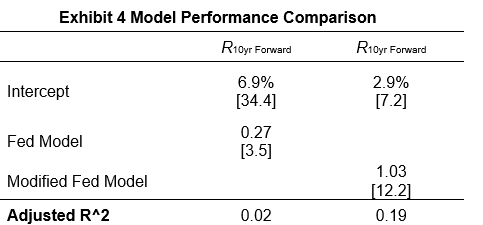
Is the Modified Fed Model a better valuation signal? To evaluate that, I built two linear models by using 10-year forward stock returns as independent variables and two equity risk premium time series as dependent variables, separately. Exhibit 4 below shows a summary of regression outputs.  The modified model has a better fitness than the original model with a higher R2 and t-stat of Beta coefficients. 
Valuation risk is running high thanks to a relentless market rally. The famous FED Model shows equity valuation has flipped into expensive territory. However, I believe higher-than-normal earnings growth is the main reason why the valuation spread has turned negative. Through a new valuation framework based on the intrinsic valuation model, I show that the current valuation level still provides room for positive stock returns in the near term at least.


References

Weigand, R. A., & Irons, R. (2008). Compression and expansion of the market P/E ratio: The Fed model explained. The Journal of Investing, 17(1), 55–64. https://doi.org/10.3905/joi.2008.701961

Yardeni, E., 1997. Fed’s stock market model finds overvaluation. Topical Study #38. US Equity Research, Deutsche Morgan Grenfell.

Yardeni, E., 1999. New, improved stock valuation model. Topical Study #44. US Equity Research, Deutsche Morgan Grenfell.



Total
0
Shares
Share 0
Tweet 0
Pin it 0
Roubens Andy King

Previous Article
3 Penny Stocks To Watch With Market Caps Over M
  • Investing

3 Penny Stocks To Watch With Market Caps Over $60M

  • July 1, 2025
  • Roubens Andy King
Read More
Next Article
Charter said Van Nuys vandalism should be considered ‘domestic terrorism’
  • Business

Charter said Van Nuys vandalism should be considered ‘domestic terrorism’

  • July 1, 2025
  • Roubens Andy King
Read More
You May Also Like
15 Overheard Conversations That Altered History
Read More
  • Invest News

15 Overheard Conversations That Altered History

  • Roubens Andy King
  • May 7, 2026
Trump Brands CNN and New York Times Disloyal as Iran Tensions Deepen
Read More
  • Invest News

Trump Brands CNN and New York Times Disloyal as Iran Tensions Deepen

  • Roubens Andy King
  • May 1, 2026
How to Start a Cake Shed Bakery in the UK: Legal Rules, Costs and Food Hygiene Checklist.
Read More
  • Invest News

How to Start a Cake Shed Bakery in the UK: Legal Rules, Costs and Food Hygiene Checklist.

  • Roubens Andy King
  • April 28, 2026
Jimmy Kimmel Targets Trump Backers He Compares to Zombies in Sharp Takedown
Read More
  • Invest News

Jimmy Kimmel Targets Trump Backers He Compares to Zombies in Sharp Takedown

  • Roubens Andy King
  • April 21, 2026
Can This App Help You Pay Off Debt Faster?
Read More
  • Invest News

Can This App Help You Pay Off Debt Faster?

  • Roubens Andy King
  • April 20, 2026
High-Yield Checking With Built-In Budgeting for Families
Read More
  • Invest News

High-Yield Checking With Built-In Budgeting for Families

  • Roubens Andy King
  • April 20, 2026
10 Frugal Swaps to Save Up to ,200 Per Month
Read More
  • Invest News

10 Frugal Swaps to Save Up to $1,200 Per Month

  • Roubens Andy King
  • April 20, 2026
Hidden Cash in Your Driveway, Unlock Cash from Scrapping Your Old Car
Read More
  • Invest News

Hidden Cash in Your Driveway, Unlock Cash from Scrapping Your Old Car

  • Roubens Andy King
  • April 17, 2026

Recent Posts

  • CFA Level I Crash Course | Session 1: Financial Statement Analysis – Day 1
  • 15 Overheard Conversations That Altered History
  • WHEN SHOULD YOU INVEST USING YOUR PERSONAL NAME? 👀
  • ScarYoup – Business (feat. B-Grâce, Blacky PM & Zepekinio)
  • Financial Times: Hegseth’s broker looked to make multimillion-dollar defense investment before war
Featured Posts
  • CFA Level I Crash Course | Session 1: Financial Statement Analysis – Day 1 1
    CFA Level I Crash Course | Session 1: Financial Statement Analysis – Day 1
    • May 7, 2026
  • 15 Overheard Conversations That Altered History 2
    15 Overheard Conversations That Altered History
    • May 7, 2026
  • WHEN SHOULD YOU INVEST USING YOUR PERSONAL NAME? 👀 3
    WHEN SHOULD YOU INVEST USING YOUR PERSONAL NAME? 👀
    • May 6, 2026
  • ScarYoup – Business (feat. B-Grâce, Blacky PM & Zepekinio) 4
    ScarYoup – Business (feat. B-Grâce, Blacky PM & Zepekinio)
    • May 5, 2026
  • Financial Times: Hegseth’s broker looked to make multimillion-dollar defense investment before war 5
    Financial Times: Hegseth’s broker looked to make multimillion-dollar defense investment before war
    • May 4, 2026
Recent Posts
  • Want To ‘Invest’ In OpenAI or SpaceX? What To Know About Tokenization
    Want To ‘Invest’ In OpenAI or SpaceX? What To Know About Tokenization
    • May 3, 2026
  • I Bought My Dream Car with Online Business | Full Story (2019–2025)
    I Bought My Dream Car with Online Business | Full Story (2019–2025)
    • May 2, 2026
  • Index Funds vs Mutual Funds vs Hedge Funds vs ETFs Explained!
    Index Funds vs Mutual Funds vs Hedge Funds vs ETFs Explained!
    • May 1, 2026
Categories
  • Business (2,057)
  • Crypto (2,023)
  • Economy (266)
  • Finance Expert (1,687)
  • Forex (2,016)
  • Invest News (2,468)
  • Investing (2,040)
  • Tech (2,056)
  • Trading (2,024)
  • Uncategorized (2)
  • Videos (1,054)

Subscribe

Subscribe now to our newsletter

Money Visa
  • Privacy Policy
  • DMCA
  • Terms of Use
Money & Invest Advices

Input your search keywords and press Enter.