
What exactly did El Salvador do?
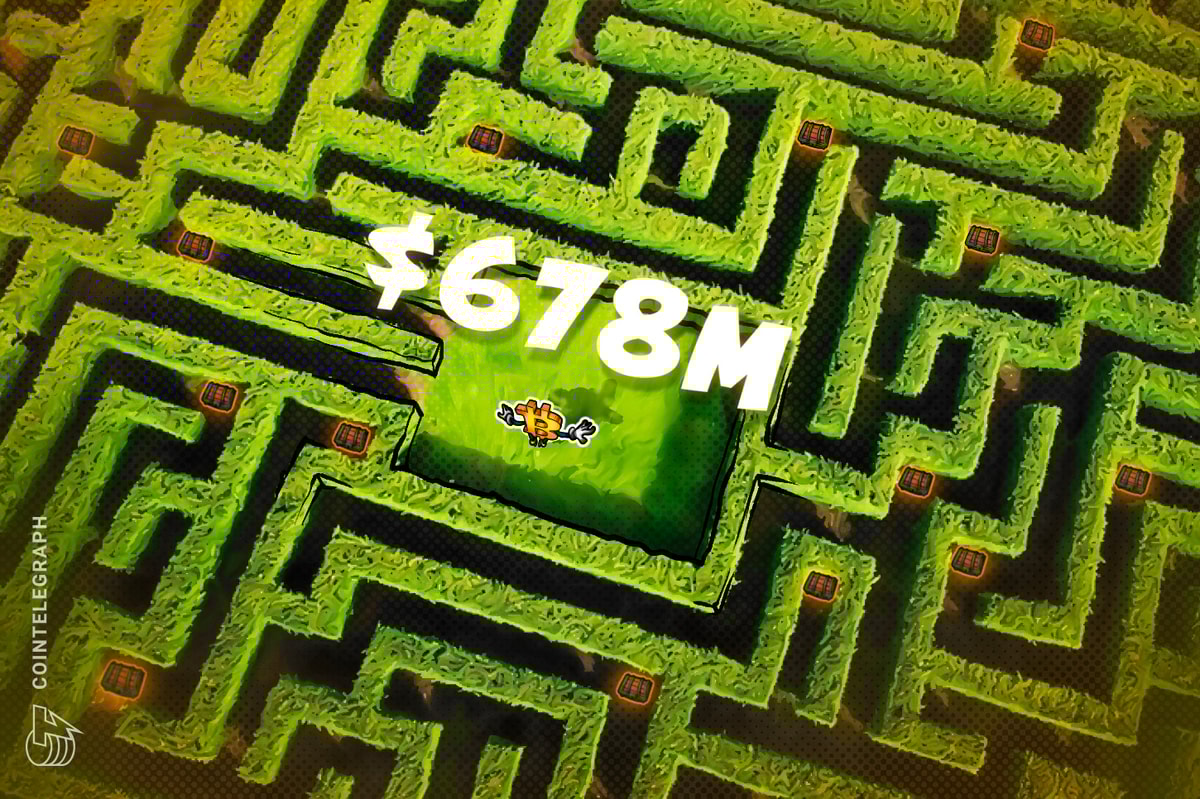
The government redistributed roughly 6,274 BTC (around $678 million at publication time) from one address into 14 fresh addresses, each capped at 500 BTC, as a precautionary security measure.
Until late August 2025, El Salvador’s national Bitcoin reserve sat in a single address. That’s a straightforward setup but a risky one: If a vulnerability is ever discovered, the entire stash could be exposed.
The National Bitcoin Office (ONBTC) announced that the holdings were split across 14 addresses. Each wallet holds up to 500 BTC, a “shard and spread” approach meant to limit losses if any single address were ever compromised. Onchain data confirmed the transfers, which were completed in one sweep.
By fragmenting the funds, El Salvador essentially created firebreaks: Even if one wallet is compromised, the loss is capped.
Did you know? El Salvador became the first country in the world to adopt Bitcoin as legal tender on Sept. 7, 2021, making it an official currency alongside the US dollar.
Why is quantum computing part of the conversation?
Bitcoin’s cryptography is solid today, but quantum computers may one day crack the math behind private keys.
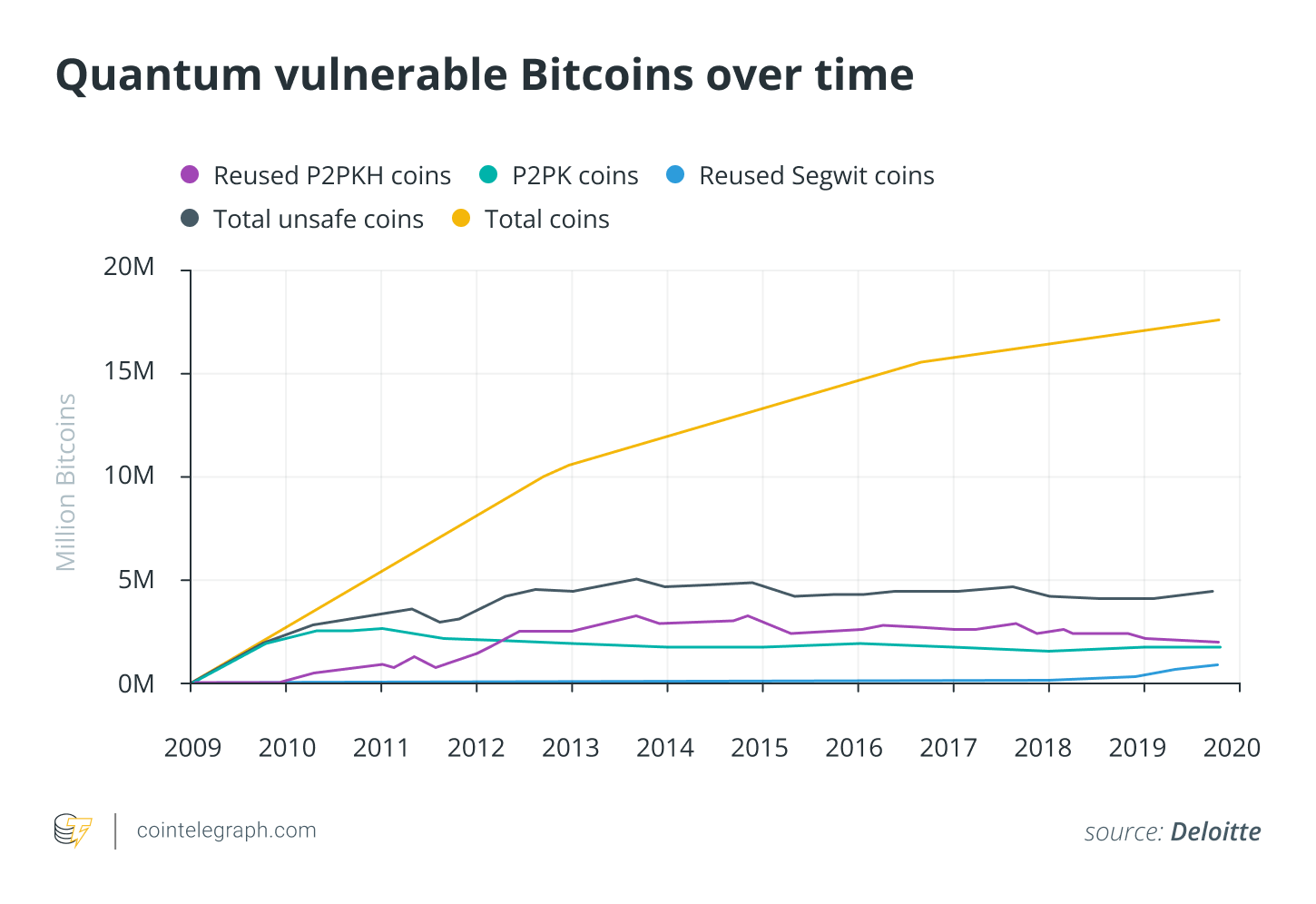
Bitcoin’s security rests on the Elliptic Curve Digital Signature Algorithm (ECDSA). When coins are spent from an address, that address’s public key becomes visible onchain.
In a far-future, post-quantum scenario, sufficiently powerful machines could reverse those public keys to their corresponding private keys, enabling theft from exposed addresses.
El Salvador’s ONBTC, the agency responsible for the country’s Bitcoin strategy, highlighted this exact risk. In its messaging, the ONBTC pointed to the vulnerability of exposed public keys and explained the logic of splitting funds across new, unused addresses.
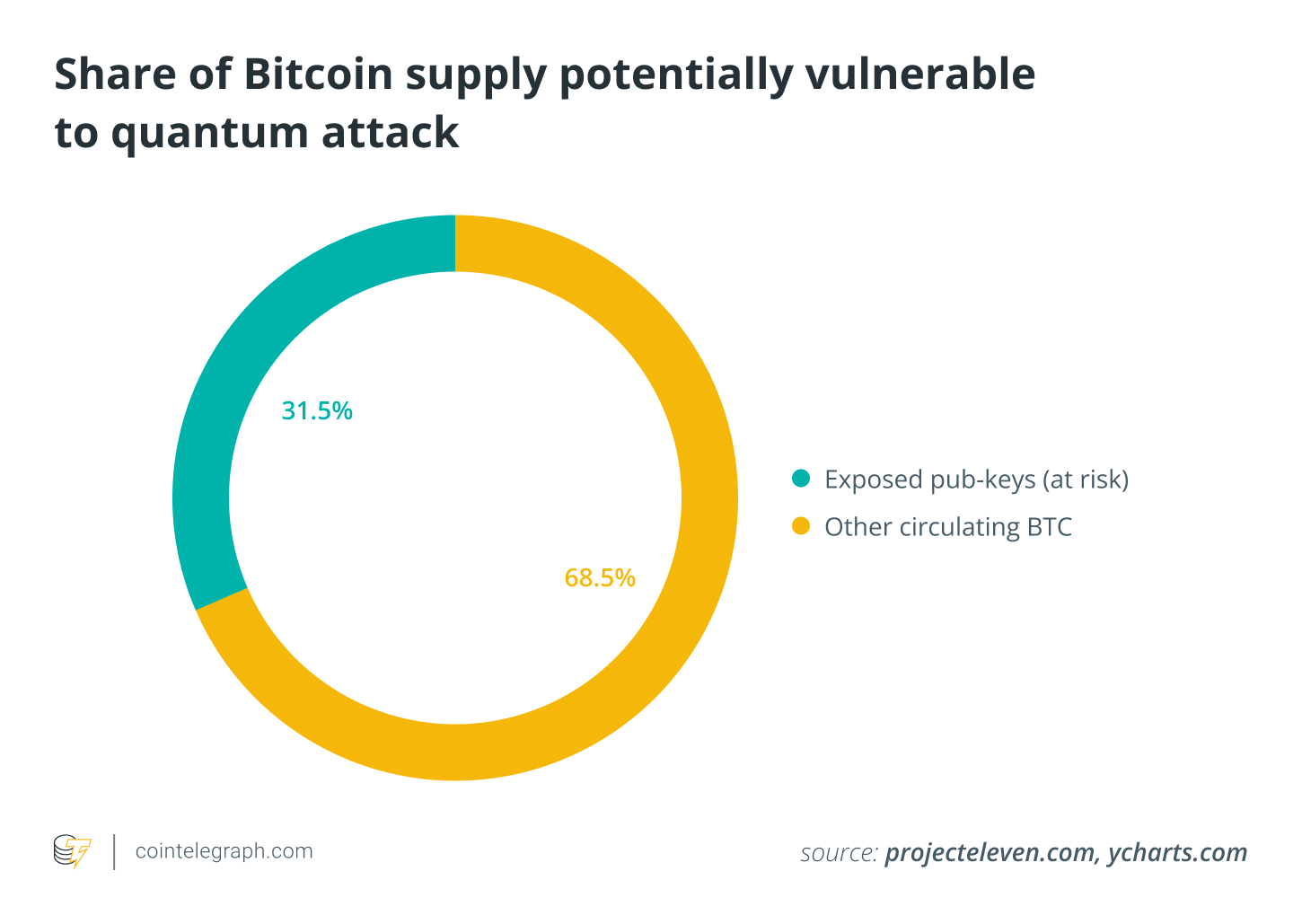
– Percentage of BTC at risk. Source: Project Eleven (Jan. 17, 2025) and YCharts (June 18, 2025)
Related: Bitcoin must upgrade or fall victim to quantum computing in 5 years
Is this an imminent threat?
Unlikely. Experts agree that quantum computers are nowhere near powerful enough today to break Bitcoin’s cryptography. Estimates push the risk decades into the future, if it ever materializes. And if it does, the Bitcoin network can upgrade its cryptographic standards.
As of 2025, no public quantum computer has demonstrated anything close to breaking 256-bit ECDSA at Bitcoin’s scale.
A quantum research company, Project Eleven estimated that more than 6 million BTC could be at risk if elliptic-curve keys were breakable. However, it also noted that no machine running Shor’s algorithm has cracked even a 3-bit toy key so far. In other words, the field is progressing, but the gulf to breaking Bitcoin is vast.
Industry voices have downplayed the immediacy. Strategy’s Michael Saylor dismissed the rhetoric around quantum threats, calling much of the alarm “hype,” adding that if the risk ever turns real, the Bitcoin network can meet it with software and hardware upgrades, much like other critical systems routinely do.
Did you know? The US National Institute of Standards and Technology (NIST) began standardizing post-quantum cryptography in 2022.
What does splitting wallets actually achieve?
Moving funds into unused addresses keeps public keys hidden, and splitting balances limits damage if one address is ever cracked.
Unused Bitcoin addresses don’t expose public keys. By moving the entire reserve into several new wallets, El Salvador ensured that none of its holdings currently reveal vulnerable data.
The 500-BTC cap per wallet is another layer of defense. If a quantum exploit ever arrives, no single breach would empty the national treasury. Think of it as locking treasure in multiple vaults instead of keeping it all in one chest.
Transparency wasn’t lost either: The ONBTC maintains a public dashboard showing the wallets, balancing security with accountability.
Why do this now if quantum computers aren’t ready?
El Salvador didn’t split its Bitcoin reserve because quantum computers are at the gates; it did so to show the world it can govern like a serious player. The move signals foresight, turns a threat into a narrative of responsibility and reassures skeptics that the country’s Bitcoin bet is more strategy than stunt.
President Nayib Bukele has built his political identity around Bitcoin ever since making it legal tender in 2021. That bold wager drew applause from crypto circles and sharp rebukes from heavyweight institutions like the International Monetary Fund (IMF).
By late 2024, El Salvador struck a staff-level deal with the fund, finalized in February 2025 as a 40-month, $1.4-billion Extended Fund Facility. The paperwork flagged Bitcoin risk again and again, and by mid-2025, the IMF had already wrapped its first program review and Article IV consultation.
Against that backdrop, El Salvador’s decision to harden custody — even against a quantum threat that may not materialize for decades — reads less like sci-fi paranoia and more like calculated statecraft.
By casting the upgrade as a hedge against the next era of cryptography, the government positions itself as a player not just reacting to the future but anticipating it, while still sparring with skeptics at home and abroad.
Did you know? Under IMF rules, Article IV consultations are mandatory annual check-ups of a country’s economy. El Salvador’s 2025 review specifically noted Bitcoin as a factor in financial stability assessments.
What do critics say?
Supporters call it a forward-looking blueprint; skeptics call the quantum angle theatrics, but most agree the underlying custody practices are sound.
Proponents argue that El Salvador has created a blueprint for sovereign Bitcoin custody that is fragmented, transparent and future-proof. For them, even if the quantum risk is far away, there’s no harm in getting ahead.
Skeptics counter that the move is more about headlines than real security. Since the quantum risk is negligible in the near term, they argue that the reshuffling doesn’t materially change El Salvador’s position.
Still, critics admit that the practice, splitting holdings and avoiding key reuse, is sound Bitcoin hygiene, even without the quantum angle.
Could this set a precedent for other nations and institutions?
Wallet-splitting may look eccentric, but it sets a clear playbook for sovereign Bitcoin custody that is auditable and ready for future cryptography. Even if quantum risks are distant, the move reframes Bitcoin as an asset class serious enough for institutional best practices.
Nation-state Bitcoin custody is still uncharted territory. El Salvador’s actions show how governments can balance transparency with security, demonstrating techniques that exchanges, custodians or even corporations might adopt.
For institutional investors holding billions in Bitcoin, the episode highlights best practices: never reuse addresses, fragment reserves and think about long-term threats.
Whether others follow El Salvador’s example depends on how seriously they take the quantum narrative. But the optics alone — appearing proactive, not reactive — may push others to adopt similar measures.
Was this necessary?
Maybe not, but it was smart. Splitting the reserve costs little, caps risk and signals that El Salvador treats its Bitcoin like a strategic treasury, not a headline stunt.
El Salvador’s move doesn’t imply a quantum attack is near. It implies a sovereign holder isn’t waiting to think about edge-case risks. By reducing potential worst-case losses, preserving transparency and showing readiness to evolve custody, the country is treating its Bitcoin like a strategic asset, not a stunt.
Whether the “quantum threat” arrives in decades or never, the operational upgrades are worth doing anyway. The price of being early is minor process work; however, the price of being late could be catastrophic. In that calculus, spreading $678 million over several vaults looks less like hype and more like responsible housekeeping.