Key takeaways
-
Blockchain growth in 2025 hinges on real usage and tech upgrades, not speculation or hype.
-
Active users, measured by wallet addresses, are the key metric.
-
DeFi, NFT ecosystems and stablecoin adoption are driving millions of new users.
-
Partnerships with major platforms and institutional inflows through Bitcoin ETFs are accelerating adoption.
-
Networks still face inflated metrics, scalability trade-offs, regulatory pressure and L1-L2 competition.
The blockchain industry is growing rapidly, with new networks emerging to compete with established leaders. But are these platforms truly gaining widespread use?
In 2025, blockchain growth has been driven by real user engagement and innovative technology, not just speculation. From foundational layer-1 blockchains to efficient layer-2 solutions, networks are vying to attract millions of users through low-cost transactions, seamless integrations with mainstream platforms and thriving decentralized finance (DeFi) and non-fungible token (NFT) ecosystems.
This article ranks the top 10 fastest-growing blockchains based on their active user growth.
Criteria for ranking
Our ranking of the top 10 fastest-growing blockchains of 2025 is based primarily on active user numbers. Each entry also highlights whether the network is a layer 1 (L1) or layer 2 (L2), the metrics supporting its rise, the main drivers behind its growth and the challenges it faces.
For the uninitiated, L1 blockchains provide foundational infrastructure with native consensus mechanisms, while L2 solutions are designed to enhance the scalability of L1 blockchains and reduce their costs. For instance, Ethereum is an L1 blockchain, while Polygon is an L2.
The term “active users” refers to a unique wallet address that completes a transaction.
Fully diluted valuation (FDV) is the theoretical total market value of a cryptocurrency, assuming all its tokens are in circulation at the current price. This metric offers a broader view of a project’s potential value. It also helps determine whether a token is overvalued or undervalued relative to its total potential supply.
Top 10 fastest-growing blockchains
1. Solana
Solana is a high-speed L1 blockchain with a proof-of-history (PoH) consensus mechanism, designed for scalable decentralized applications (DApps) and marketplaces.
-
Monthly active users: 57 million
-
FDV: $107.2 million
-
Token trading volume (30 days): $284.2 billion
-
Key drivers: Solana’s growth has been fueled by DeFi and NFTs, a surge in high-frequency trading of memecoins, the Firedancer validator client boosting reliability and increasing institutional adoption.
-
Challenges: Past network outages affect reliability. Other challenges include criticism regarding the degree of centralization and competition from L2 solutions.
Did you know? Solana’s proof-of-history lets it process thousands of transactions per second, powering DeFi, NFTs and even memecoin trading at lightning speed.
2. Near Protocol
Near Protocol is a layer-1 blockchain using a thresholded proof-of-stake (TPoS) consensus. It focuses on scalability, developer-friendly tools and integration of AI-native features for decentralized applications.
-
Active addresses (monthly): 51.2 million
-
FDV: $3.1 million
-
Token trading volume (30 days): $7.8 million
-
Key drivers: AI integration for user-owned agents and intents, low transaction fees with carbon neutrality, partnerships like with EigenLayer for fast finality and ecosystem expansions in DeFi and gaming.
-
Challenges: Competition from faster L1s and L2s, price volatility despite user growth and potential vulnerabilities in sharding complexity.
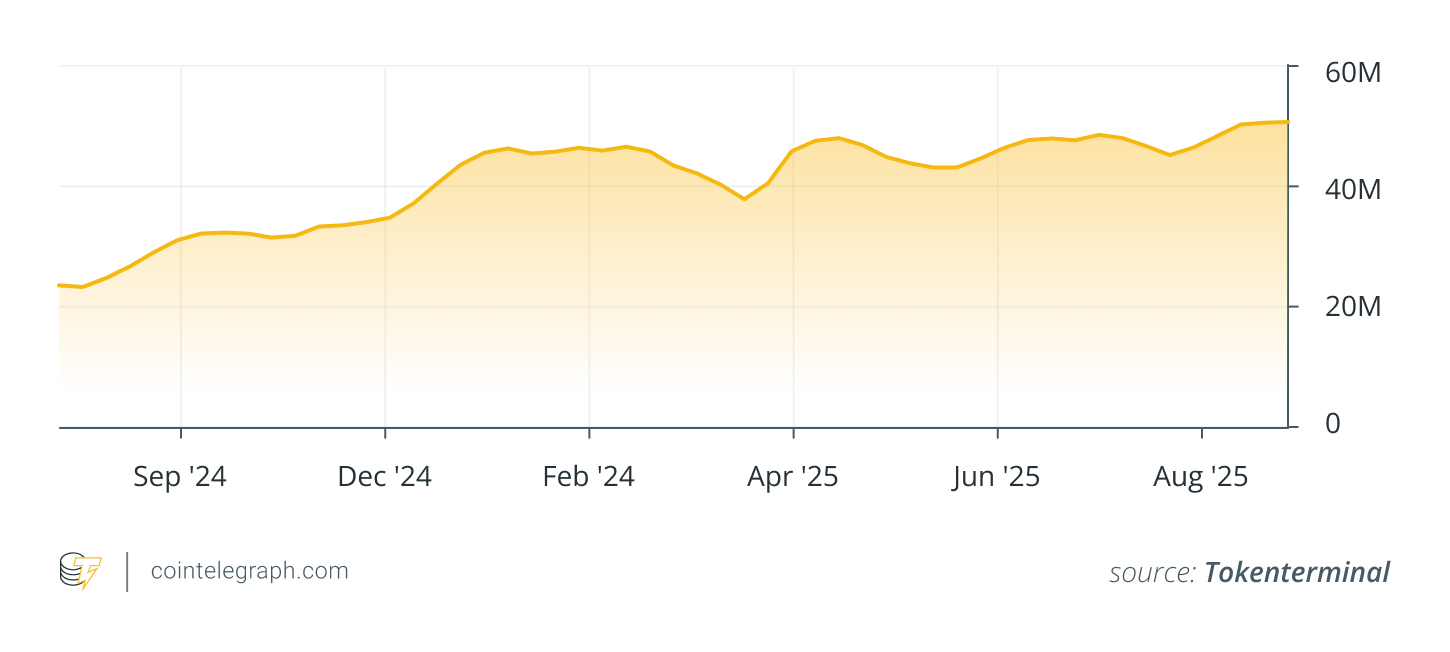
Did you know? Near Protocol boasts carbon neutrality with low fees. It has shown strong momentum despite competition from faster chains.
3. BNB Chain
BNB Chain is a Binance-backed L1 blockchain supporting DeFi, NFTs and DApps with Ethereum Virtual Machine (EVM) compatibility.
-
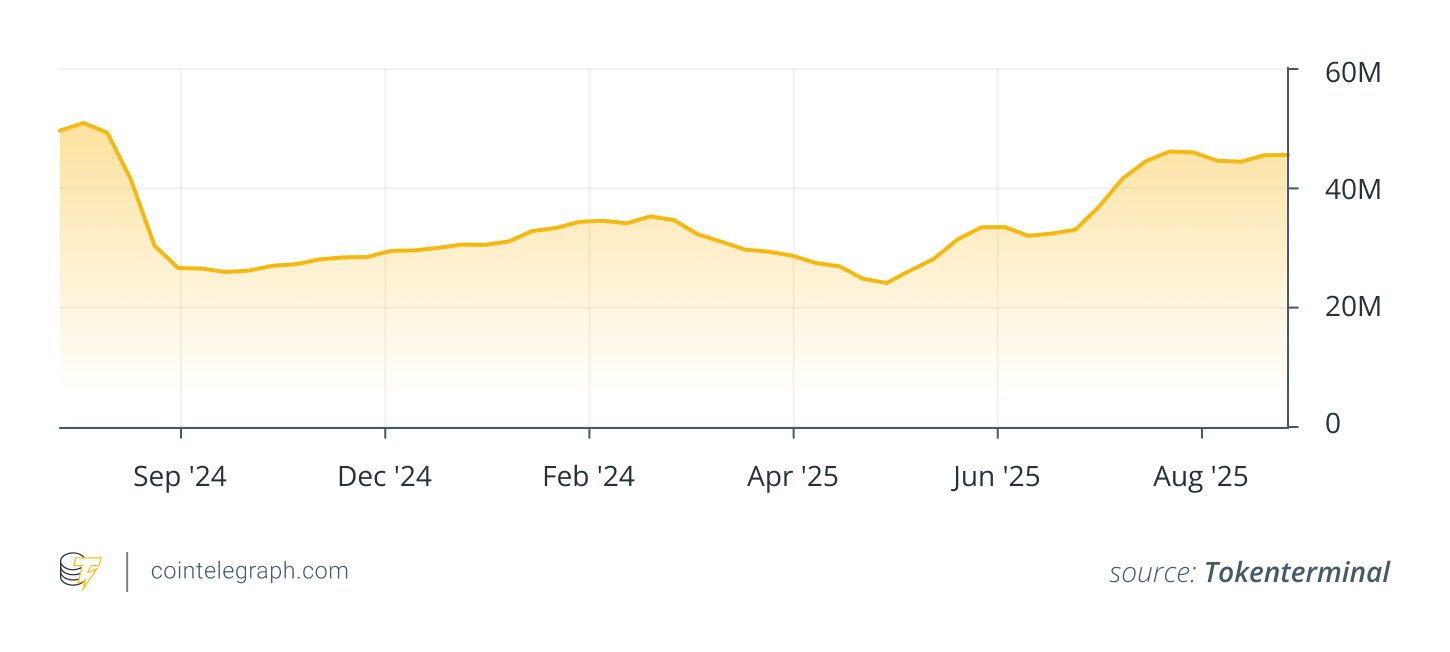
Active addresses (monthly): 46.4 million
-
FDV: $121.2 billion
-
Token trading volume (30 days): $56.1 billion
-
Key drivers: Reduced block time to 0.75 seconds, AI integrations for data ownership.
-
Challenges: Centralization concerns due to backing of Binance, regulatory scrutiny.
4. Base
Coinbase developed Base, an Ethereum L2 blockchain using optimistic rollups, focusing on low-cost DeFi, consumer apps and seamless integration.
-
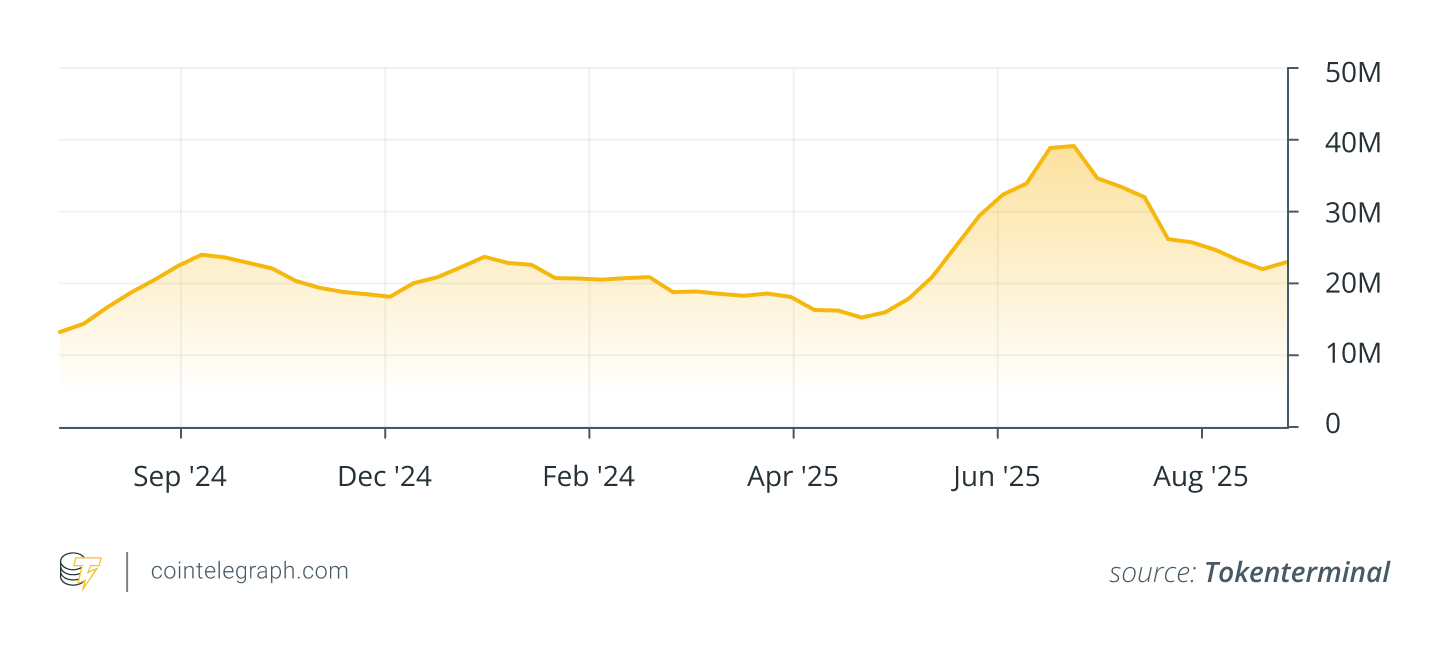
Active addresses (monthly): 21.5 million
-
FDV: $2.92 billion
-
Key drivers: Ultra-low fees ($0.01 average), Coinbase’s 100 million+ user base for onboarding, stablecoin flows and partnerships for consumer DApps.
-
Challenges: Network congestion from high activity, dependence on Ethereum for security and regulatory compliance as a newer ecosystem.
5. Tron
Tron is a high-throughput L1 blockchain focused on decentralized content sharing and integration with Telegram and emphasizes low-cost stablecoin transactions.
-
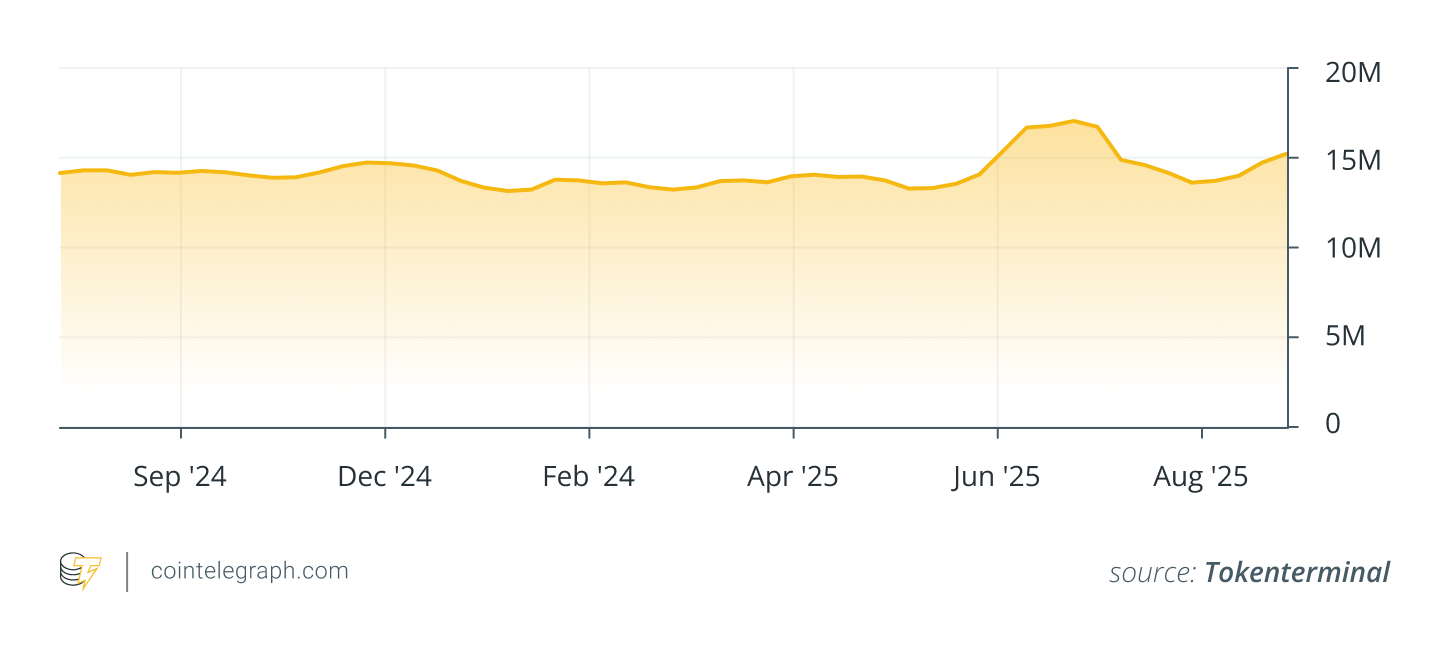
Active addresses (monthly): 14.4 million
-
FDV: $33.5 billion
-
Token trading volume (30 days): $51.7 billion
-
Key drivers: Negligible transaction fees, AI and cross-chain integrations and partnerships like with Rumble Cloud.
-
Challenges: Regulatory scrutiny, centralization risks.
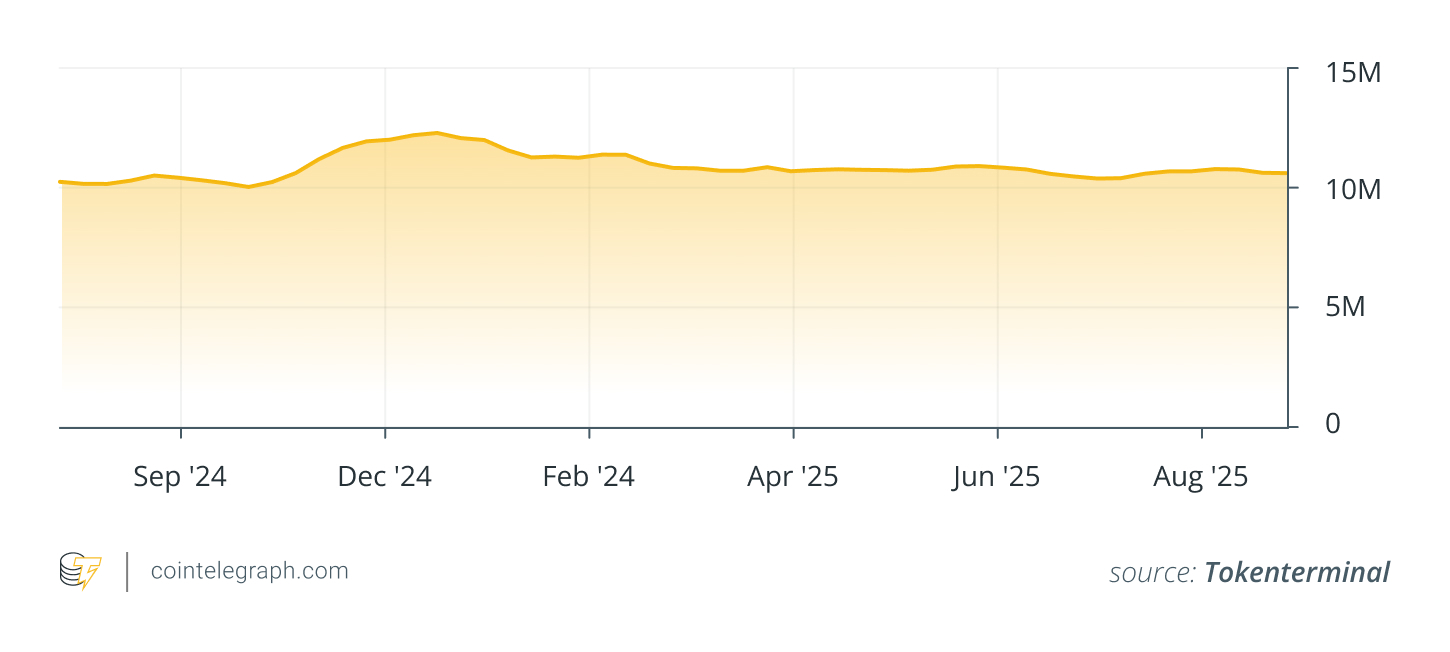
6. Bitcoin
Bitcoin is the original decentralized cryptocurrency using proof-of-work (PoW) consensus. It serves as digital gold for store-of-value and payments.
-
Active addresses (monthly): 10.8 million
-
FDV: $2.3 trillion
-
Token trading volume (30 days): $1.3 trillion
-
Key drivers: Institutional inflows via exchange-traded funds (ETFs). (As of Q4 2024, professional investors with over $100 million under management hold Bitcoin ETFs worth $27.4 billion.) Reduced supply due to halving events and adoption as a strategic reserve.
-
Challenges: High energy consumption; volatility from macroeconomic factors.
7. Aptos
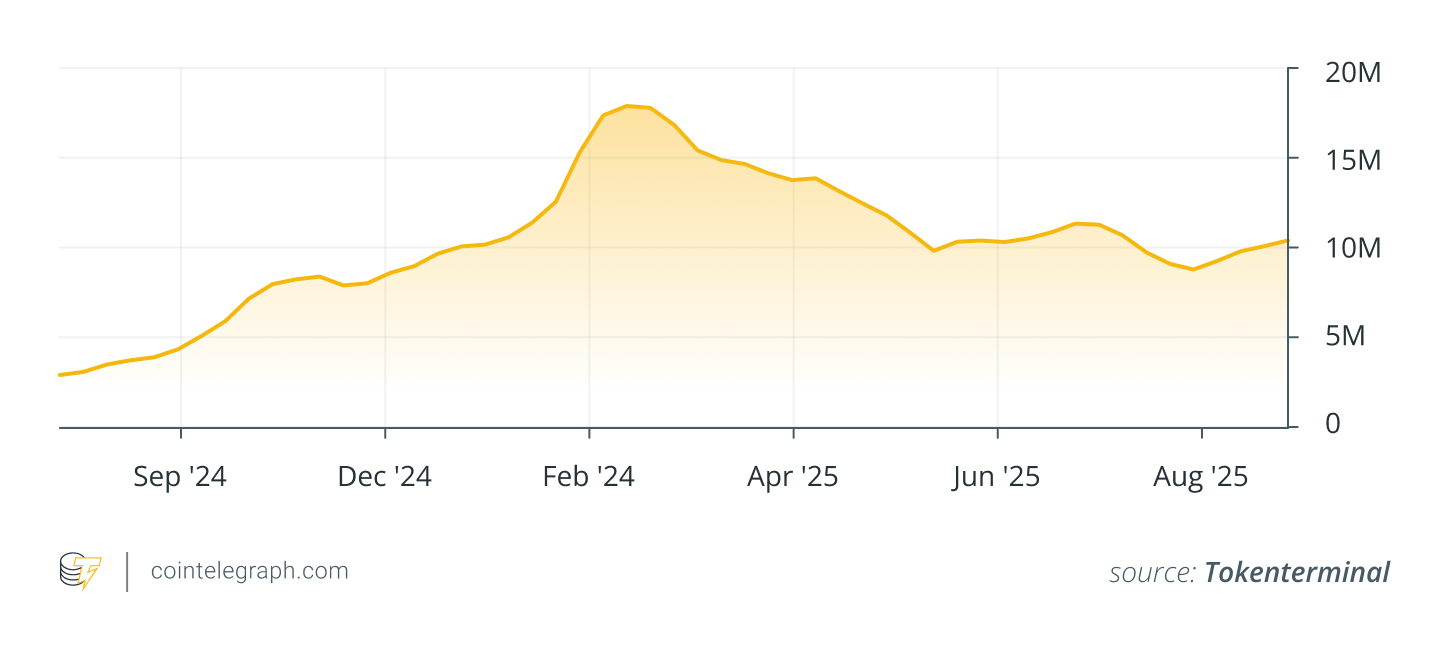
Aptos is an L1 blockchain by ex-Meta engineers using the Move language, emphasizing scalability, DeFi and developer growth for DApps.
-
Active addresses (monthly): 10 million
-
FDV: $5.3 billion
-
Token trading volume (30 days): $13 billion
-
Key drivers: Peak 19,200 TPS; Move language for secure contracts; partnerships like Tether’s USDt (USDT) launch
Challenges: Needs broader adoption and competition from established L1s.
8. Ethereum
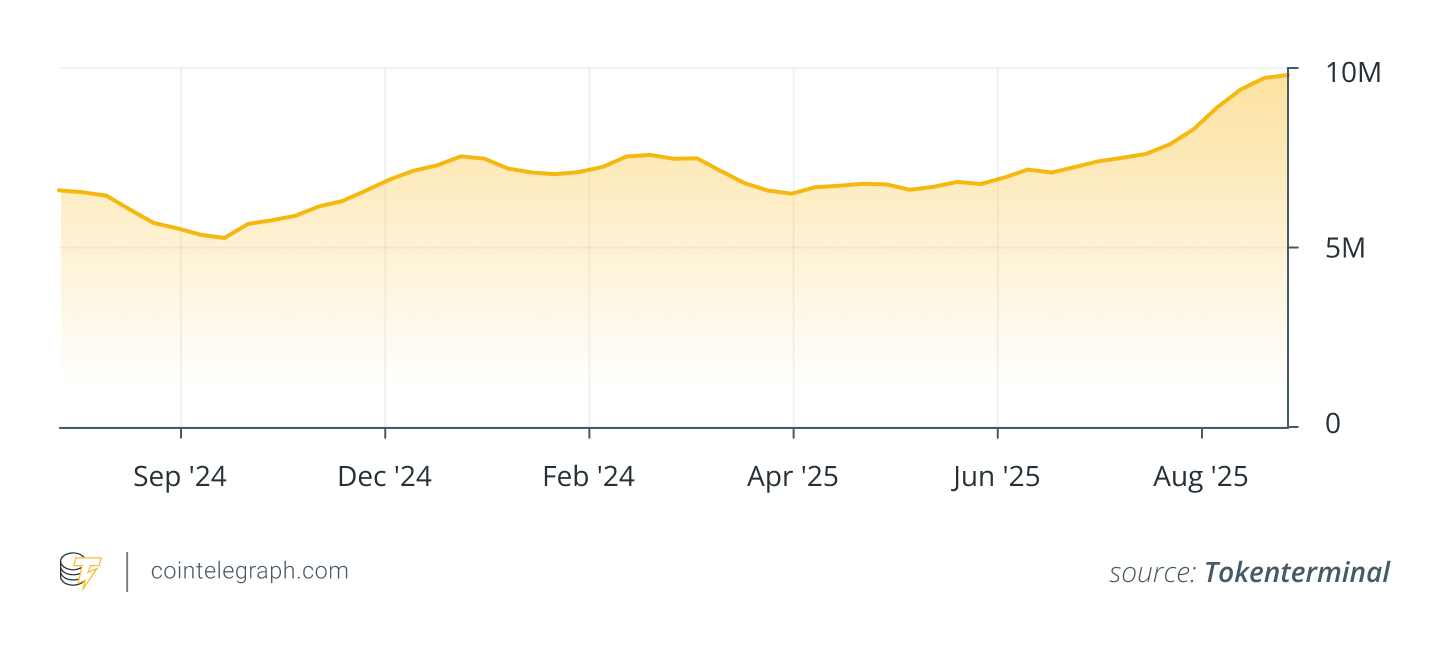
Ethereum is a leading L1 blockchain for smart contracts, DeFi and NFTs, with a vast developer ecosystem using a proof-of-stake (PoS) consensus.
-
Active addresses (monthly): 9.6 million
-
FDV: $522.7 billion
-
Token trading volume (30 days): $1.1 trillion
-
Key drivers: Pectra upgrade for better UX and scalability, ETF inflows and institutional staking.
Challenges: Scalability issues, higher fees than rivals and regulatory pressures.
9. Polygon
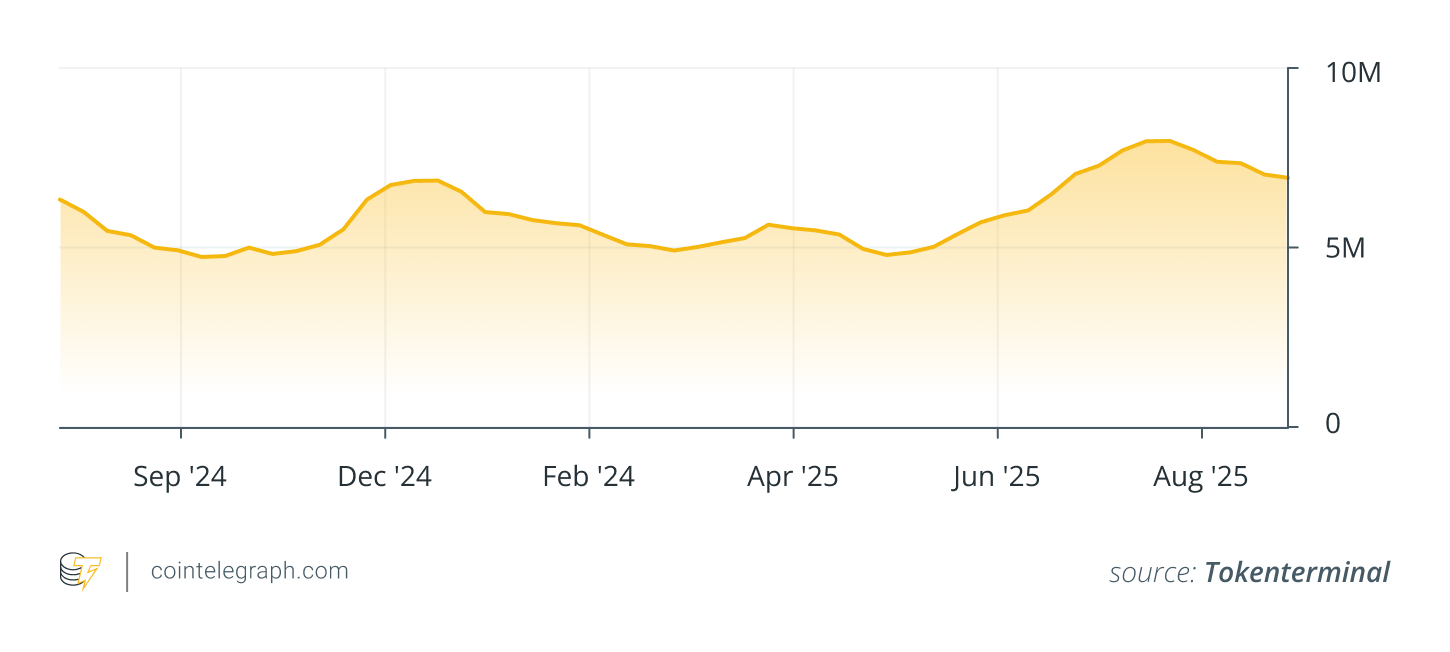
Polygon offers a multichain scaling solution for Ethereum using PoS, supporting DeFi, NFTs and enterprise apps with EVM compatibility.
-
Active addresses (monthly): 7.2 million
-
FDV: $2.6 billion
-
Token trading volume (30 days): $4.2 billion
-
Key drivers: Upgrades like Heimdall v2 for interoperability and partnerships with Fortune 500 firms.
-
Challenges: Regulatory scrutiny under Markets in Crypto-Assets (MiCA) and competition from other L2s.
Did you know? The Polygon upgrade Heimdall v2 has boosted interoperability across chains, solidifying Polygon’s role as a multichain scaling hub in the web3 world.
10. Arbitrum One
Arbitrum One is a leading Ethereum L2 using optimistic rollups for faster, cheaper transactions while inheriting Ethereum’s security.
-
Active addresses (monthly): 4 million
-
FDV: $5.1 billion
-
Token trading volume (30 days): $14.3 billion
-
Key drivers: Integrations like Robinhood for tokenized assets and upgrades like Stylus for lower fees.
-
Challenges: Dependence on the Ethereum mainnet, regulatory uncertainty and competition from Optimism.
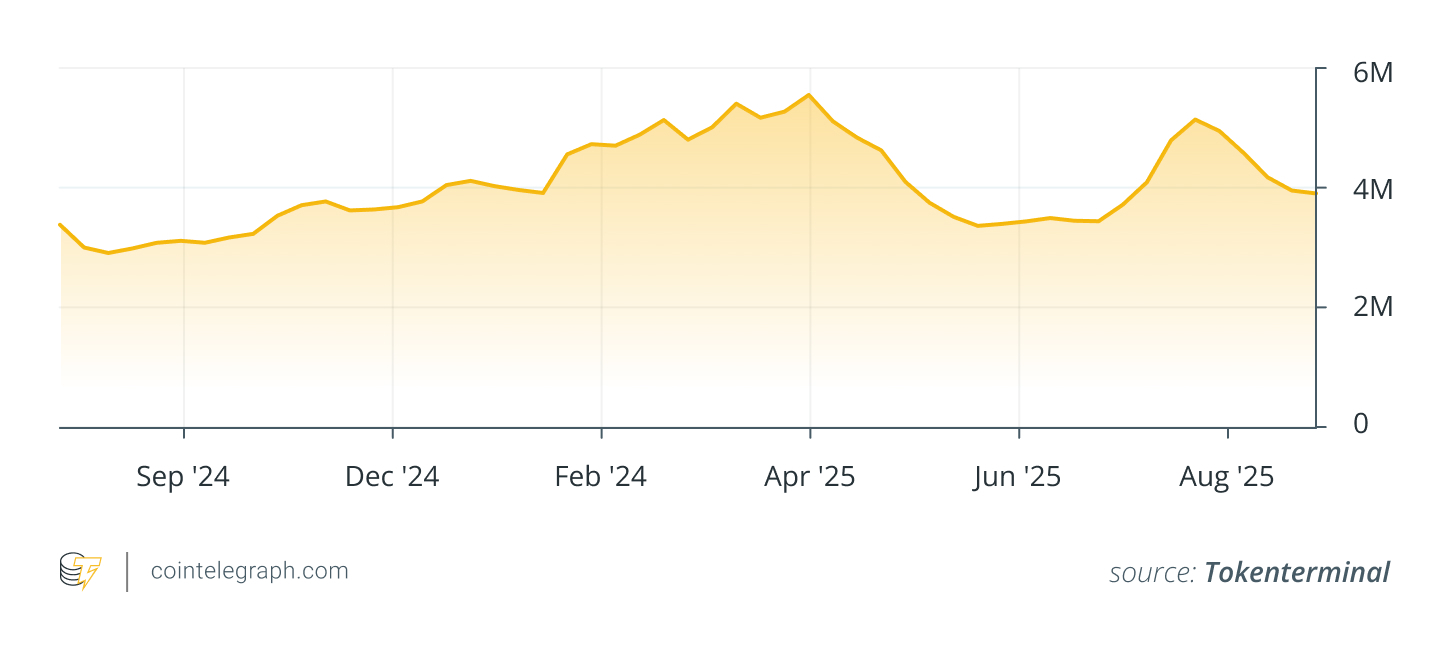
Trends driving blockchain growth
The story of blockchain in 2025 is one of acceleration. New technologies and mainstream acceptance are pushing growth on both the foundational L1 level and the scaling L2 layer. The commonly noticeable trends include:
-
Stablecoin adoption boosting transaction volumes: Stablecoins like USDT and USDC (USDC) are significantly increasing transaction activity. This enhances liquidity and user engagement across ecosystems.
-
Layer-2 solutions enhancing scalability and reducing costs: Scaling solutions like Arbitrum One and Base improve Ethereum’s capacity for handling transactions and lower fees to as little as $0.01 per transaction. This makes DApps more affordable and accessible.
-
DeFi and NFT ecosystems attract new users: DeFi protocols and NFT marketplaces are bringing in millions of new users. Services like GMX on Arbitrum and Polygon’s NFT volume ($227 million in Q1 2025) offer innovative tools for finance and digital collectibles.
-
Integration with mainstream platforms: Blockchains are growing by integrating with major platforms. For instance, Base is built into Coinbase, giving it access to over 100 million potential users.
-
Institutional interest and partnerships: Growing institutional involvement is making blockchain more legitimate. Bitcoin ETFs received $36.4 billion in 2024. Corporate partnerships with blockchain networks have also helped enhance the credibility of blockchains. For instance, Starbucks has partnered with Microsoft and the blockchain network Azure to create a traceability system.
User growth, challenges and the path forward
The rapid growth of the top 10 blockchains by active users in 2025 highlights the expanding role of decentralized technology. Networks like Solana and Arbitrum are leading this adoption with low-cost transactions, DeFi applications and mainstream integrations.
However, key challenges remain:
-
Inflated metrics: Bot activity and inactive addresses can exaggerate true user growth.
-
Scalability vs. decentralization: Some high-speed networks compromise on decentralization.
-
Regulatory uncertainty: Scrutiny of stablecoins and illicit activities creates adoption risks.
-
Market competition: Intense rivalry exists between L1 chains and Ethereum’s L2 solutions.
In response, blockchains are innovating with better bot detection, improved scaling solutions, regulatory compliance and unique offerings like AI and asset tokenization. These efforts are crucial for sustaining long-term growth and shaping the future of the ecosystem.
This article does not contain investment advice or recommendations. Every investment and trading move involves risk, and readers should conduct their own research when making a decision.