
SEOUL — In the early 2000s, an observant driver might have noticed an unusual sight on South Korean streets: Some of the police cars were American-made Ford Tauruses.
Although South Korean patrol cars were normally supplied locally by Hyundai or Kia, the Tauruses were there as a goodwill gesture from the South Korean government, which bought 100 of them in 2002 to mollify American automakers and political leaders upset about the lopsided reality of the automotive trade: South Korean cars sold to U.S. consumers then were subject to a 2.5% tariff rate, but American cars were hit with 8% — and faced a host of complex regulatory hurdles to boot.
As a result, in 2000, 570,000 South Korean cars were imported by the U.S., versus just 2,500 in the other direction.
Thanks to a 2012 free trade agreement, neither country levied a tariff on the other’s cars for nearly a decade. But the one-sided flow hasn’t changed. Last year, South Korea exported 1.5 million cars to the U.S. to the tune of $37.4 billion, but South Koreans bought just about 47,000 vehicles worth $2.1 billion from the U.S.
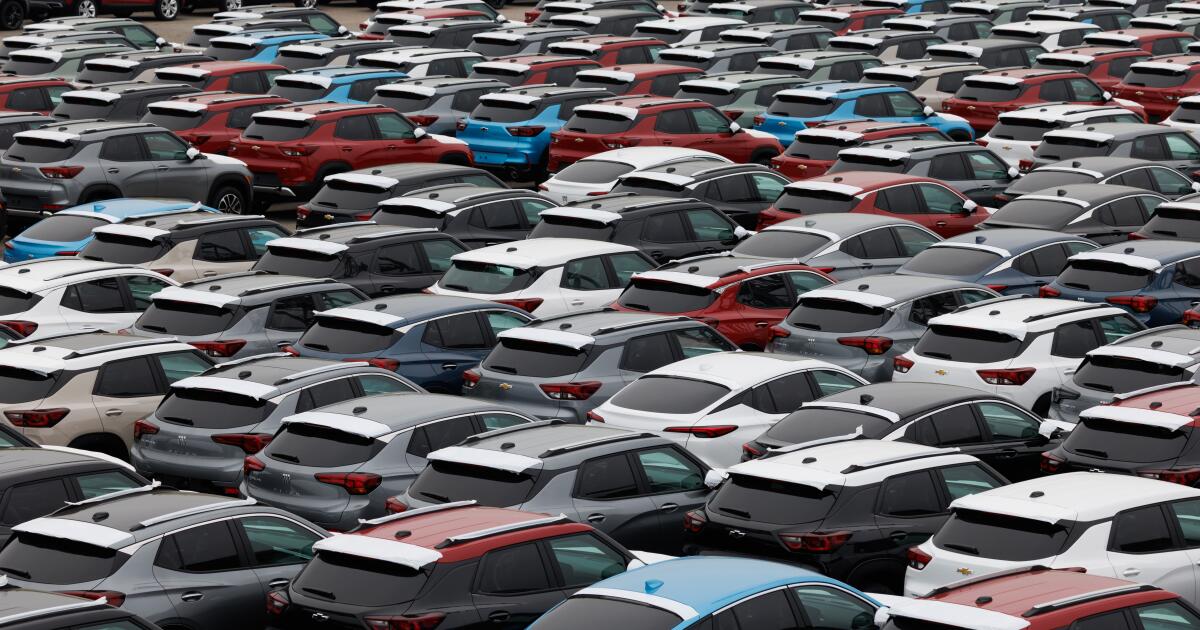
Vehicles for export are parked at a port in Pyeongtaek, South Korea, on July 8.
(Ahn Young-joon / Associated Press)
Righting this disparity, as well as similar imbalances with countries such as Japan, has been a focal point in President Trump’s ongoing trade war.
“Perhaps worst of all are the non-monetary restrictions imposed by South Korea, Japan and very many other nations,” Trump said as he announced his 25% tariffs on all foreign-made automobiles in April.
He isn’t the first president to blame unfair trade relationships for America’s lagging car exports. Obama, during his term, made removing trade barriers such as regulatory hurdles a centerpiece of his agenda to boost American exports.
But in Asia, analysts and consumers tell a different story, which they have been telling for years: They’re just not that into American cars — and neither government campaigning nor increased market access will probably change that.
Leon Cheng, an automotive expert at Singapore-based consultancy YCP, puts it this way: “The deeper issue is product fit, not paperwork.”
In the U.S., cars have been getting bigger, more expensive and more polluting in the last several decades — all the things that make for a tough sell to Asian consumers.
***
At first glance, Vietnam may appear to be one Asian market where American cars are due for a boost under Trump’s trade regime.
Under the trade deal reached by the two countries this month, the Trump administration agreed to cut the previously announced 46% tariff rate against Vietnam to 20%, securing in return “preferential market access for U.S. goods, including large-engine cars.”
American-made sport utility vehicles, “which do so well in the United States, will be a wonderful addition to the various product lines within Vietnam,” Trump said.
While the fine print of the agreement is yet to be finalized, vehicles in this category are expected to be granted a 0% import duty — a significant drop from the 70% rate they faced before.
More than 340,000 passenger vehicles were sold in Vietnam last year — a 12.6% increase from the previous year — and part of that is the growing appetite for both bigger and foreign cars.
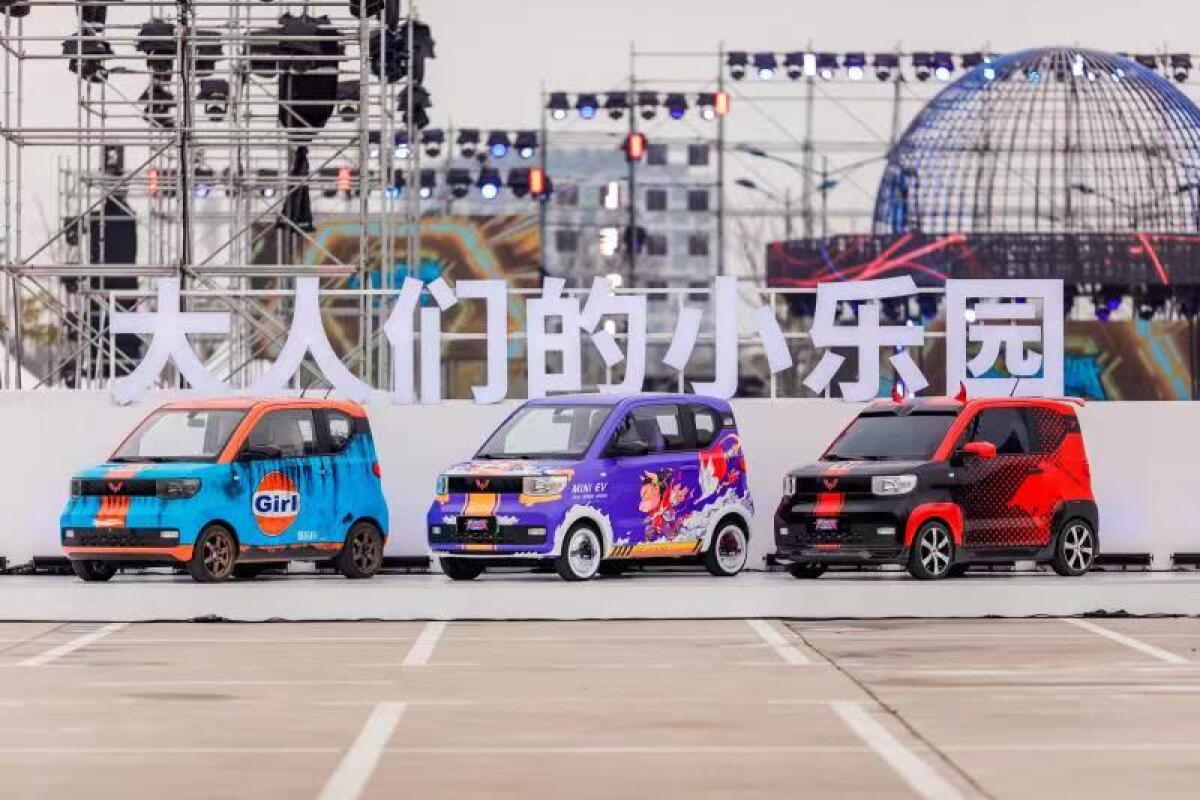
Three Hongguang Mini EVs, the top-selling electric car in China.
(General Motors)
Even so, Cheng doubts that American SUVs will be flying off dealership floors in a country where roads are congested with motorbikes, and the average monthly income is around $300.
“Vietnam’s car market looks booming in headline numbers, but it is still tiny on a per-capita basis. Only about 9% of households own a car, and almost 90% rely primarily on two-wheelers [like motorcycles and mopeds],” he said. “Within that small car-owning slice, shoppers gravitate to what fits narrow city streets, tight parking bays and family budgets: Thai-built Toyota Fortuners, Korean Hyundai Santa Fes, or hometown hero VinFast’s mid-priced EV crossovers. U.S. nameplates are curiosities.”
And other obstacles remain, such as a valued-added tax (VAT) or a 50%-to-60% special consumption tax applied to all bigger engines, so SUVs shipped from the U.S. are a poor sell.
“The Explorer or Tahoe that cost roughly US$82,000 on the showroom floor last spring may fall to the low-60s,” Cheng said. “Cheaper, but still a luxury purchase in Vietnam’s price-sensitive market.”
***
In Japan, which has a well-developed car culture, there are other barriers.
Despite Trump’s charges of unfairness, Japan has in fact kept tariffs on American cars at zero since 1978 in contrast to the U.S.’ 2.5%, and now, 25%. But several non-tariff trade barriers exist, such as different EV charging standards that effectively disadvantage American cars, or a requirement that all cars be equipped with an automatic emergency braking system.
Experts say the deeper issue is that Japanese consumer tastes, which have long favored compact cars suited for denser urban environments, are poorly reflected in American automakers’ bulkier product lines.
“Many people say that [American cars] don’t fit in parking lots or ‘are difficult to handle on narrow roads,’” said Felipe Munoz, an analyst at automotive research firm JATO Dynamics. “American cars are often perceived as ‘hobby cars’ or ‘cars for a niche audience.’”
In order to register new vehicles, Japanese drivers are required to obtain verification that they have access to an adequate parking space from the police. But with spaces much smaller compared with those in the U.S., around 40% of the Japanese automobile market is held by the kei car, a type of minicar unique to the country that the Japanese government has also promoted with tax benefits.
This, along with strong brand loyalty for domestic players, has led to foreign cars making up less than 10% of the Japanese auto market, with German manufacturers taking the lion’s share of that slice. Last year, only 0.3% — or around 16,000 — of all car sales were from American brands, according to the Japan Automobile Importers Assn.
Ultimately, the biggest source of U.S. automakers’ woes in Japan, according to Takeshi Miyao, a Tokyo-based auto analyst, is failing to adapt to local consumers.
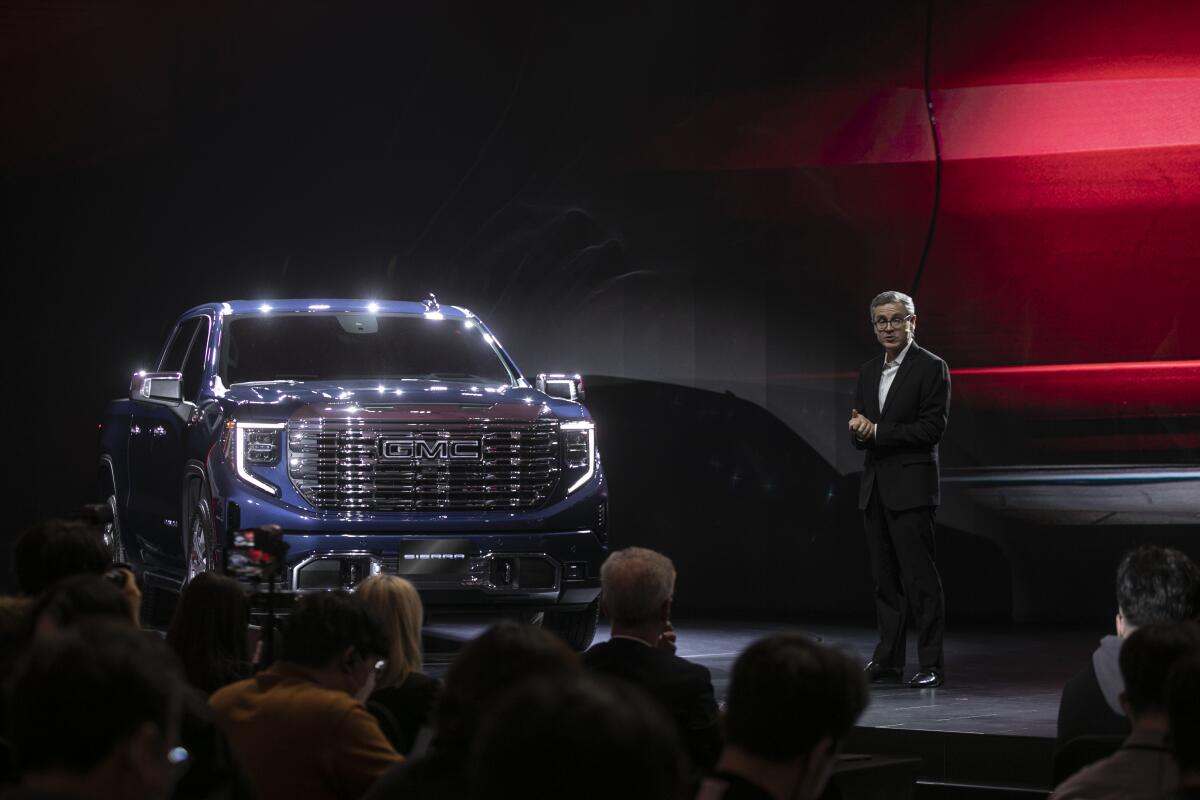
Carlos Meinert, vice president of sales and service division of Korea at General Motors Co., presented a GMC Sierra Denali truck during GM Korea Co.’s launch event in Seoul in February 2023.
(Bloomberg via Getty Images)
While European automakers such as Mercedes, for example, have been proactive in making adjustments like offering their cars in right-hand drive — the standard in Japan — American competitors have historically been reluctant to do so.
“The infrastructure in Japan cannot be adjusted,” Miyao said. “U.S. carmakers do not have the car variations suited to the Japanese market, and they haven’t put much effort into marketing. On the other hand, German carmakers put in very hard work into the Japanese market. For example, Mercedes-Benz Japan was planning a car that would sell in the Japanese market in more than 15 years.”
“Even if all the non-tariff barriers to foreign automobiles in Japan were abolished, U.S. cars still wouldn’t be popular,” he added.
***
The situation is similarly dim in South Korea, despite the fact that there are fewer obstacles to American cars than in Japan.
“There aren’t many trade barriers — tariff or non-tariff — left to speak of,” said Lee Hang-koo, a researcher at Korea Automotive Technology Institute. “But U.S. automakers haven’t put in much effort at all in terms of marketing or appealing to South Korean consumers. Instead they keep shifting the blame to unfair trade practices.”
The Free Trade Agreement signed by former President George W. Bush in 2007, which went into effect five years later, has kept cars tariff-free for both sides since 2016. And subsequent renegotiations of that agreement have eased the majority of regulatory barriers that remained, such as rules for safety or emissions testing.
Under the latest terms, renegotiated during Trump’s first term, up to 50,000 American-made vehicles can be imported into South Korea without undergoing additional local safety testing. These rules have been applied liberally, with South Korean regulators approving American cars with red brake lights despite criticisms that they are confusing to local drivers accustomed to amber ones, and allowing certain Tesla models on the roads even though they do not meet local standards for emergency escape systems.
But American automakers have struggled to make the most of this exemption. Last year, they sold just over 40,000 units in the country — about 15% of the overall foreign car market, according to data from the Korea Automobile Importers and Distributors Assn. And even then, more than half of those were Teslas.
While American business representatives have complained about South Korea’s broader emissions standards, which are stricter than those in the U.S., Lee points out these aren’t easy concessions to make: A Constitutional Court ruling last year found South Korea’s current climate targets were inadequate, meaning emissions standards will probably have even less wiggle room going forward.
“The problem is that with the exception of Tesla, American car companies keep trying to export gas guzzlers that South Koreans won’t buy when they should be trying to sell more electric vehicles,” Lee said.
For South Korean consumers sensitive about the country’s high gas prices, fuel economy is oftentimes the biggest dealbreaker — even if they feel otherwise favorable toward American cars.
“American cars have a unique appeal, they have a clear design philosophy and rich history compared to South Korean cars, which feel a bit too bland for me,” said Hong Seung-ki, a 38-year-old musician living in Seoul.
Hong drove a gun-metal gray Ford Mustang, which he loved, for years. Now, after a brief switch to a Hyundai, he rides a motorbike.
“I’d only buy another American car if I were rich. Right now, I don’t think I could afford to have one as a daily driver,” he said. “Compared to domestic cars in a similar price range, they just don’t have as many features and there’s just too big of a cost differential when it comes to general maintenance like aftermarket service.”
As in Japan, there is the strong impression that American car companies — even those with a production base in the country — have come to see the South Korean market as an afterthought.
Despite demands from their local labor union to shore up their thinning service center network and target the local market more aggressively by shifting EV production to their two South Korea plants, GM Korea exports nearly over 90% of the Chevy Trax and Trailblazer it produces here overseas, with most going to U.S. consumers.
To many, it’s a signal that American car companies have largely thrown in the towel.
***
Still, there is a smattering of success stories that may offer hints as to how American automakers, losing the fuel economy battle to domestic competitors and the prestige market to European ones, might survive in Asia.
In Japan, it has been the surging popularity of Jeep, which has been praised for adapting to local specifications with right-hand drive options and size adjustments. In Vietnam, it is the Ford Ranger, which has dominated the pickup segment and, despite being built in Thailand, is a testament that American designs can still land with the right niche.
In South Korea, the Ford Taurus found some modest success following the government’s promotional push in the early 2000s. But Lee would point to another defining import of that era: the PT Cruiser, Chrysler’s much-mocked oddity that unexpectedly won a cult following in the country.
“It was a strange-looking car with a roly-poly exterior, but it had a lot of space inside and there was nothing in South Korea that could compete with it in its segment,” he said. “Somehow, it just worked.”