


The relationship between capitalization rates (cap rates) and interest rates is more nuanced than first meets the eye. Understanding their interplay is a cornerstone of real estate investment analysis. In this blog post, we dissect historical data, discuss current opportunities, and forecast real estate valuations for the second half of 2024.
Cap rates measure the ratio of a property’s net operating income (NOI) to its purchase price. Because interest rates influence the cost of borrowing, they affect property prices and investor returns. It is often assumed that cap rates move in tandem with interest rates because, in theory, rising interest rates lead to higher cap rates, which in turn lower property values. However, empirical data suggests that this relationship is not as straightforward as the theory.
Historical Context and Theoretical Foundations
While nominal interest rates (i.e., the interest rate that doesn’t take inflation into account) have an impact on real estate values, they do not have the same effect on cap rates as do real interest rates (i.e., the interest rate that has been adjusted for inflation).
First, we can distill the relationship between cap rates and interest rates through the lens of inflation expectations. In a previous blog post, we noted that there is ample research supporting real estate’s ability to function as an inflation hedge. As such, real estate values may suffer if the increase in cap rates is driven by higher real rates, rather than inflation expectations.
Prior cycles of rising rates provide time-series data that are not influenced by current conditions. A 2016 white paper1 by TIAA Global Real Assets concluded that cap rates, as proxied by the NCREIF Property Index (NPI), do not necessarily move in lockstep with interest rates. Using the 10-Year Treasury yield as a proxy, it cited a positive correlation of 0.7 between cap rates and interest rates from Q4 1992 to Q3 2015.
And cap rates are not in real time. Because they are periodically set via appraisals or sparse transaction data, cap rates lag private market values for other real assets.
Cap Rates: Range-Bound or Fixed in the Moment?
Several other factors influence the dynamic between cap rates and interest rates, including other real estate fundamentals, broader macroeconomic performance, capital flows, and investor risk appetites. One of the most prevalent views on the cap rate-to-interest rate relationship is that cap rates move within a range as measured by their relationship to a risk-free rate such as the 10-year Treasury yield.
This basis point spread can be viewed as a protective buffer from any expected rises in interest rates, and it compresses or expands over time. This preferred gage has not shown a consistent behavioral pattern over time, however, and there are several instances in history when cap rates and US Treasuries did not move in unison, with lagged or minimal movement.
The correlation (five-year rolling basis) between US Treasury yields and cap rates fluctuated between -0.82 and 0.79 from 1983 to 2013, according to an analysis by Morgan Stanley. The firm identified eight key periods within that timeframe when corporate bond rates and/or the 10-year US Treasury yield moved upward. Notably, cap rates moved in the opposite direction during five of those periods. The key question here is whether the analysis was based on concurrent cap rates — fixed in the moment — or considered potential lags in cap rate data. Given the periodic appraisal-based valuations associated with private real estate, there is a lag in valuation adjustments, which also smooths volatility. In a different scenario to the analysis, Morgan Stanley adjusted its cap rates by a one-year period and arrived at a similar place.
Other Factors Influence Cap Rates
Morgan Stanley identified several other drivers to the cap rate-to-interest rate relationship, including credit availability, supply and demand, and increases in real rates. The effects of credit availability are intuitive: increased availability of debt capital at more compelling rates is beneficial to overall transaction volumes. This intensifies competition for assets, which further benefits seller pricing within this generally illiquid asset class and compresses cap rates.
A countering effect to increased competition can be the available supply of real estate within a certain sector or market. Simply put, the availability of alternative investment options can drive cap rate expansion by lowering underlying prices. The opposite is true in markets with few investment alternatives: in these markets, underlying real estate prices rise and cap rates compress.
Peter Linneman’s Fall 2020 newsletter reported a correlation between 10-year Treasury yields and cap rates over a ~20-year window. When he dissected cap rates over distinct time periods, however, the data pointed to other factors that influenced them more directly.
Linneman and his co-authors intuited that capital flows should play a significant role in driving cap rates, given that availability of capital and increased competition for assets will significantly impact real estate asset values and compress cap rates.
Linneman’s research findings demonstrate the benefit of examining the components driving capital availability at any given time. His multivariate model utilizes the flow of mortgage funds relative to gross domestic product (GDP) as a proxy for liquidity and historic cap rates as well as the unemployment rate as proxies for market dynamics and risk, respectively.
Ultimately, this model is nearly as accurate in predicting forward cap rates as the regression model of cap rates to real rates is descriptive. Most notably, a key finding is that when mortgage debt grows by 100 bps faster or slower than GDP, cap rates expand by 22 bps for multifamily properties and 65 bps for office properties, suggesting that an increase in mortgage debt as a percentage of GDP drives down value. The model also finds that an increase in unemployment slightly expands cap rates.
When investors are withdrawing capital at the same time lending becomes more restrictive, transaction volume and pricing will fall. This is consistent with commercial real estate (CRE) capital markets over the past one to two years, predominantly driven by the higher rate environment, a volatile stock market, and various challenges with traditional bank lenders and the subsequent emergence of alternative lenders.
Not surprisingly, CRE fundraising activity has slowed to near historic lows, with Green Street Advisors reporting a more than 20% decrease in closed-end fundraising for 20232. But 2024 is on pace to stabilize relative to 2023. Continued hesitancy and other limitations on investing have driven available capital/dry powder for closed-end CRE funds to an all-time high approaching $225B. Open-ended funds haven’t fared much better, with current redemptions outweighing contributions (combined statistic known as net contributions/flows), for only the second time in the last 20 years, the last occurrence during the Global Financial Crisis. Another particularly hard-hit segment has been the non-traded real estate investment trust (REIT) space, where there have been significant outflows since Q2 of 2022, pressuring large REITs from the likes of Blackstone and Starwood.
Fundraising challenges and uncertainty about the direction of interest rates and inflation have negatively impacted recent transaction volumes, which are down 30% year-over-year, and 34% relative to a trailing 10-year average, according to Green Street Advisors.3 To put these numbers in perspective, 2023 saw recent record-low transaction volumes at $244 billion in aggregate, which was near a 10-year low and in line with 2020 and the early 2010s[4]. Transaction volumes surged to $589 billion in 2021 and $530 billion in 2022 during the low-rate, post-Covid periods.
Exhibit 1.
Source: Green Street Advisors, Federal Reserve, NAREIT, NCREIF, EM Investment Partners
These market conditions have contributed to the ongoing decline in valuations as tracked by various indices, with the NAREIT major sector index and Green Street Advisors’ Commercial Property Pricing Index (CPPI) regressing to 119 (with 2015 as the base year at 100), and the CPPI pulling back from a near-recent peak of 154 in 2022 (approx. 23% decline in the average private value across major CRE sectors).
Meanwhile, the lagged impact of appraisal-based valuations is visible in the pullback of the NCREIF Property Index (NPI), in which valuations have fallen approximately 15% to 144 from recent peak valuations of 170 in Q4 2022.
What about cap rates? Relative to recent peak valuations, cap rates across core sectors as tracked by Green Street Advisors have expanded by 190 bps, with the office (255 bps) and multifamily (195 bps) sectors driving the average up.
Today’s Market Dynamics
- Interest rate environment: The Federal Reserve’s monetary policy has been pivotal. Persistent inflationary pressures threaten the pace of future rate cuts. This fluid environment suggests that investors should adopt a diversified strategy across real estate equity and debt positions.
- Inflation: As the main driver behind the recent push in interest rates, inflation is widely impacting investments and investment opportunities. As covered in our earlier article in this series, CRE has the potential to offset the impacts of inflation on an investment portfolio, higher financing rates notwithstanding.
- Cap rate trends: Cap rates for major sectors including multifamily have expanded, resulting in an average 23%, according to Green Street Advisors. An early potentially positive sign is Green Street Advisors’ CPPI showing an 0.7% increase in CRE valuations in May 2024, for the first time since a prolonged period of valuation declines.
Projections for Real Estate Valuations
Given the current landscape, several projections can be made about real estate valuations for the latter half of 2024 and beyond:
- Real estate equity: Well-capitalized investors might find strategic opportunities in undervalued assets. With many CRE loans maturing in 2024, there could be a chance to acquire properties at discounted prices.
- Private credit: The environment remains favorable for real estate private credit. Elevated interest rates present a fleeting opportunity for locking in attractive yields, with expectations of eventual rate cuts further enhancing their appeal.
- Cap rate adjustments: Cap rates are expected to continue expanding, particularly in sectors with less robust rental growth prospects. Private valuations are expected to continue declining, likely until some signs of stabilization become visible in public REITs.
- Potential stabilization and rebound: As inflationary pressures potentially ease and economic conditions stabilize, there might be a window for property values to rebound. The rebound will likely vary across different real estate sectors and geographical markets, however.
Exhibit 2.
Source: Green Street Advisors, Federal Reserve, EM Investment Partners
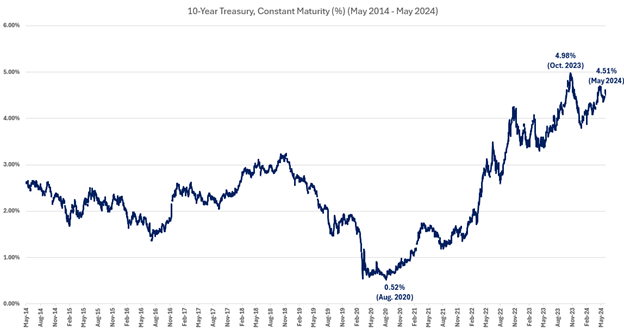
With the continued pressure on real interest rates, and the 10-year Treasury yield hovering around 5%, a consensus expectation is for a period of turbulence in the global economy. A sharp rise in the 10-year Treasury yield has generally been followed by a recessionary period, dating back to the 1960s, according to the CBRE. It anticipates CRE investment volumes to pull back by another 5% in 2024, underpinned by an expected rise in the cost of debt capital/more cautious lending standards.
CBRE further anticipates that, if the 10-year Treasury yield were to rise more than 5%, cap rates in the multifamily and office sectors could fall another 10% to15%. That said, any potential additional reductions in value are mitigated in certain cases by the relative health of most CRE sectors (office aside), which could insulate future internal rates of return (IRRs).
Investors should also consider the flip side of elevated interest rates and elevated cap rates. That is, we can expect property values to increase (cap rates to compress) as interest rates decline and more capital becomes available. Hence, elevated cap rates and the potential for interest rate cuts in the near-to-medium term set the stage for cap rate compression.
Acquiring real estate assets at an elevated cap rate and exiting at a lower terminal cap rate, with rents at least equivalent, means that the seller of the property has harvested returns in the form of appreciation, signaling a period of opportunity for real estate private equity.
So What?
The interplay between cap rates and interest rates remains a critical consideration for real estate investors. Rising interest rates have restricted available capital, exerting downward pressure on property values, but the relationship is not linear and is influenced by a multitude of factors. As we move through 2024, investors should look for opportunities to leverage a mix of private equity and credit strategies.
There is no “smoking gun” when it comes to leading indicators for investment choices, however. Private market real estate exhibits characteristics that can bolster traditional portfolios: an ability to perform well in high inflation regimes, and capitalize on the higher rate environment and current funding gap dynamics while offering superior risk-adjusted returns.
A variety of equity-like alternative investments, including opportunistic or development real estate equity and debt-like alternative investments like private real estate lending can serve as diversification elements within a traditional 60% equity/40% bond portfolio.