

Deep in the mountains of northern Peru, a bloody war is being fought over gold. As its international price sets successive record highs above $3,000 (£2,220) an ounce, criminal gangs, illegal miners and established mining companies battle over the metal.
The conflict is not fought out in the open but in a maze of tunnels that stretch for miles inside the mountains of Pataz, a gold-rich Andean province about 130 miles (200km) inland from Peru’s third city, Trujillo. In early May, the bodies of 13 security workers were found shot dead, their hands bound and some showing signs of torture, in one of the tunnels belonging to an artisanal miner linked to the province’s largest mining company, Poderosa.
After the gruesome discovery, the government imposed a month-long ban on goldmining for all but the company and sent hundreds of soldiers and police officers to enforce a state of emergency and a nightly curfew in the province.
Yet, the massacre of the security contractors, who had been hired to expel intruders, was just the most visible example of the brutal violence which, locals say, has left countless dead, many of them forcibly “disappeared” under rocks and rubble in a labyrinth of 450 subterranean tunnels.
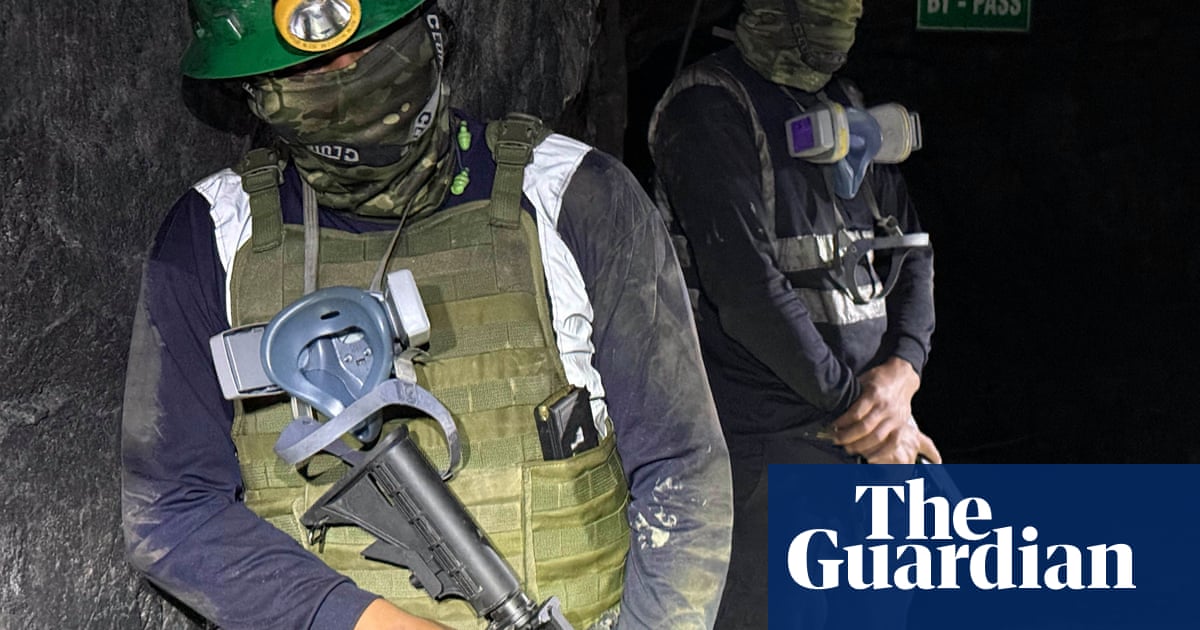
Five hundred metres inside one mineshaft, three men armed with military-grade guns emerge from the gloom to speak to the Guardian.
“We are living moments of terror,” says the group’s leader. “Many confrontations; many compañeros [comrades] gone,” he admits when asked about how many gun battles he had fought as the violence surged in recent years.
The armed gang’s job is to steal mines from small miners or recover mines stolen from their employer and wrest back control, he says. Underground gunfights are inevitable and attacks can come from all sides as armed men known as parqueros steal ore – the gold-bearing rock – by tunnelling in from connecting shafts or invading the mine from other entrances. The gangs burn tyres and pump smoke into the tunnels to drive out miners. Or they attack the security guards, as when the 13 men were killed.
One guard, his face masked by a green mining helmet pulled low over his head, rests his right hand rests on an AR-15 semi-automatic rifle. “We’re a family,” he says, nodding at his companions in rubber boots and bulletproof vests as water drips from the rocky roof of the tunnel.
He does not know much about the international gold price but, as a former soldier, he knows he earns more as a gunman than as a miner – and much more than if he worked back in Trujillo. “We have the training,” he says.
“I do get scared,” he admits, but the monthly wage means he can support his five young children. “It’s all for gold. Pataz has wealth, which generates violence, so they hire us.”
“Your life is worth more than gold,” reads one placard. “Without artisanal mining, many families don’t eat,” reads another. They are being displayed by families in a well-organised protest against the government’s suspension of all but Poderosa’s mining in Pataz.
For more than four decades, Poderosa has leased a mining concession from the government that encompasses much of the province.
Geologically, Pataz is shot through with gold-rich veins of quartz and pyrite in abruptly steep mountains, peppered with hundreds of mineshafts.
“It’s a blessing,” shouts José Torrealva, president of Pataz’s artisanal mining association, in a fiery, crowd-stirring speech to the hundreds of families assembled on the town’s football pitch. “Where you scratch the earth, there’s gold!”
Torrealva, whom prosecutors are investigating for allegedly mining illegally, is a firebrand advocate of what he calls “artisanal” mining. “Who drives the economy in Pataz? We, the small miners, do,” he cries to cheers from the townsfolk.
“They are taking away our fundamental right to work. They are making laws to ‘disappear’ the artisanal miner,” says Torrealva, who owns companies that provide explosives and truck hundreds of tonnes of ore out of Pataz to refineries on the coast.
Only those on a register of informal miners purportedly in the process of formalisation – known by its acronym Reinfo – can sell gold to Poderosa.
In more than a decade, only 2% of more than 84,000 miners registering have completed the formalisation process, which requires them to pay tax and employ clean mining techniques.
Earlier this month, the government removed 1,425 miners in Pataz from the Reinfo registry, meaning they can no longer sell their ore to Poderosa nor operate legally.
Still, mining without a state permit is common. Many miners, such as Brandon Saldaña, 29, resent that his employer is not considered fully legal, even though he pays a team of miners.
“Everybody criminalises us, saying we’re illegal, but it’s not like that. They put everybody in the same bag,” he says as he sits with his fellow miners inside a shaft, smoking and chewing coca leaves laced with lime from a gourd. “Sometimes the informal miner lacks just one document to become formal.”
The bureaucratic process is slow and frustrating. Some of Saldaña’s friends earn more working illegally for one of the many criminal gangs, from local gangsters La Gran Familia and Los Pulpos to the Venezuelan Tren de Aragua that have taken over mineshafts.
after newsletter promotion
The invasion of criminals and outsiders started during the Covid-19 pandemic when poverty rocketed, law enforcement was focused on lockdowns and the price of gold surged to more than twice pre-Covid levels.
Delmatia Jaime, 80, wishes her home town, Pataz, could return to its former tranquillity. “Life here has changed completely,” she says. “There is no trust or security. So many people disappear; every day there is death.”
Perched on a mountainside with a white colonial church in its plaza, the narrow streets of this once-typical Andean village are now choked with brand-new 4x4s.
Poderosa, an $8bn mining company, says it had no affiliation with the 13 men killed in April. But the victims worked for R&R, an unregistered company affiliated with Libmar, a firm owned by the miner Nicolás Cueva. His company sold ore to Poderosa, which buys from about 280 registered artisanal miners in the province, processes the gold on site and sells it to Canada, Japan and Switzerland.
Cueva told the local press that Libmar spent 80,000to 100,000 soles (£16,000-£20,000) a month on security. He also said his company was providing support to the victims’ families.
Since the incident, Poderosa has hired 1,200 security guards, according to Pablo de la Flor, the company’s corporate affairs manager. “That is two security guards for every miner,” he says. “Despite that, it has been impossible to control this spate of violence.”
The organised crime networks behind the gangs of parqueros, who steal the ore, have impressive resources, says De la Flor. It’s a “risky investment” requiring heavy machinery, geologists, mining engineers, hitmen and inside information.
“In some cases, they drill tunnels that are 2km long, costing $2,000 to $2,800 a metre, so somebody is financing that operation.”
Hundreds more miners who do not sell to Poderosa fuel a multibillion-dollar illicit trade in gold ore. In the last four years, 33,708 trucks loaded with 674,160 tons of ore, worth $3.5bn, left Pataz and passed police checkpoints to any one of four dozen crushing plants in a maze of industrial lots in Trujillo, according to the mining company’s data.
Once crushed, lorries transport it to refineries near Lima. The ingots are then shipped principally to India and the United Arab Emirates – importers with laxer standards of due diligence compared with Canada and Switzerland.
In a statement to the Guardian, Poderosa expressed “sincere condolences to the families” and said to be “in permanent communication with Libmar so that the affected families receive the necessary support”.
But Paty Carranza, 23, the widow of Frank Monzón, one of the 13 murdered men, says she has received nothing from Poderosa. She has been receiving anonymous threatening phone calls urging her to remain silent.
Her three-year-old daughter still does not know her father is never coming home.
“I haven’t found the courage to tell her,” Carranza says. “She keeps asking: ‘Where is Daddy? When is he taking us to the beach?”
Carranza is on the second floor of a half-built breeze-block home in El Porvenir, a tough neighbourhood in Trujillo. Monzón was earning a little more than $1,000 a month, more than he could dream of making in the city, and the money paid for their home to be built. “‘Your hubby has money. You’ll want for nothing,’ he used to joke,” Carranza recalls.
In May, the suspected leader of the attackers, Miguel Antonio Rodríguez Díaz, alias “Cuchillo”, was captured in Colombia. The ex-soldier was jailed for three years on pre-trial detention while prosecutors prepared charges of organised crime, contract killing, aggravated homicide and money laundering.
“I can’t get my head around how [the attackers] could have been so brutal,” says Carranza. Her partner’s body was intact save for a gunshot in the back of the neck, but other bodies at the morgue showed signs of torture: broken jawbones, chests opened up, missing arms, legs, some with a head or testicles missing.
“Many people are dead inside those mines; they go inside and are never seen again,” she says. “They sacrifice people for what? To get more gold? It is as if they need blood; that’s what they did with my husband.”