
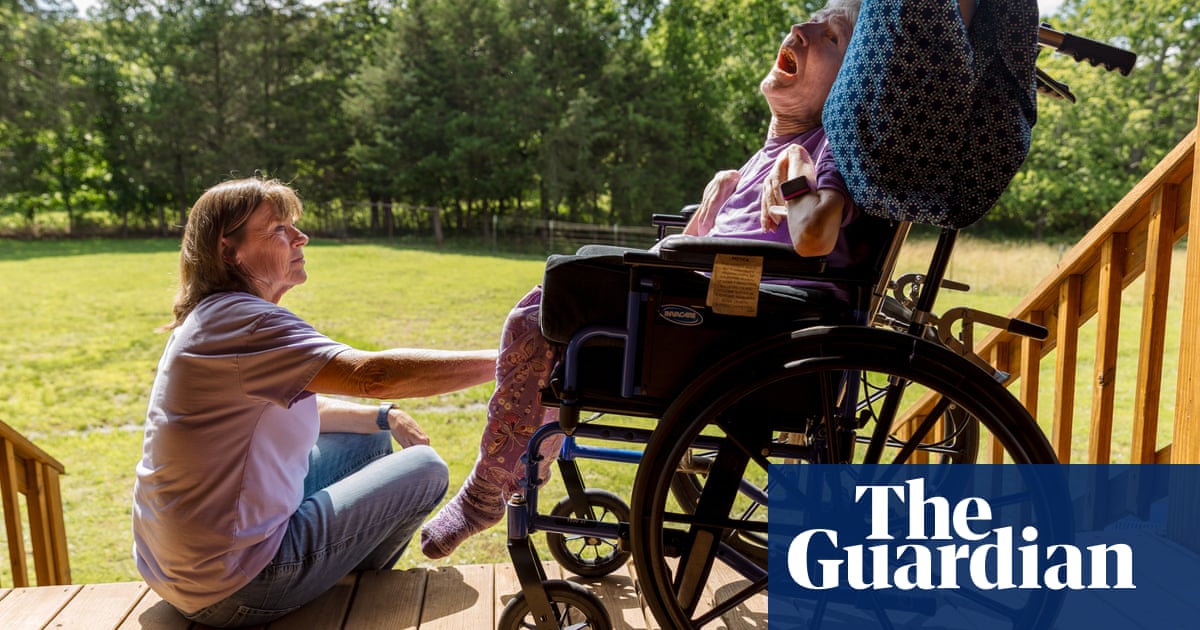

Kelly Fountain of central Arkansas plans to move her family out of the state if work requirements are enacted for Medicaid, given the issues and lack of resources she has already faced in obtaining support for her 24-year-old son with disabilities, Colby.
“If Trump’s budget is passed as it is currently written, we will be leaving Arkansas,” said Fountain. “Our politicians here know very well that people are going to lose their Medicaid, they’re depending on it. People are not only going to lose their healthcare, they’re going to die.”
Fountain’s dilemma is one that millions of Americans may face if Donald Trump’s “big, beautiful bill” passes through Congress in its current form. The bill will cut Medicaid across the US by 7.6 million to 10.3 million people, according to Congressional Budget Office estimates, with the majority of the cuts as a result of work reporting requirements, increasing barriers for enrollment and renewal of Medicaid coverage, and limiting states’ ability to raise state Medicaid funds through provider taxes.
Medicaid recipients and advocates are warning of the negative impacts of work reporting requirements, pointing to the examples of the two states to have already tried work requirements for Medicaid, Georgia and, briefly, Arkansas. In both states, there was a significant increase in individuals without health insurance and medical debt, and no boost in employment, one of the Trump administration’s key arguments for imposing the requirements.
The Medicaid work reporting requirements would begin in December 2026, with proponents of the reporting requirement for able-bodied adults to work, volunteer or attend an education program at least 80 hours a month. The change comes after the Republican House speaker, Mike Johnson, claimed Medicaid recipients were “taking advantage”, “cheating” and “defrauding” the system.
Researchers at the Yale Public School of Health estimate the cuts to health programs, including Medicaid and Affordable Care Act marketplace unenrollment, could lead to 42,500 lost lives annually. The work requirements would require older adults not yet eligible for Medicare, people with disabilities, and caregivers to navigate the reporting requirements to maintain Medicaid eligibility.
In Arkansas, work requirements were enacted in 2018, only to be cancelled months later after a federal court stepped in to block the requirements.
Kelly Fountain’s son, Colby, was born with a rare genetic condition, haploinsufficiency syndrome, and has autism and other health and developmental issues associated with the disorder.
She explained the only way they were able to have the expensive genetic testing done was through Medicaid, which they have also relied on to cover Colby’s medical care.
It took 13 years on a waitlist waiver program for Colby to be able to get into a community-based program where he is learning to do tasks such as grocery shop, cook, or count money, but she said the lack of resources for employment, such as support through employment and transportation, has made it infeasible for Colby to work.
“He still can’t work because there’s no supportive employment. He would need to have staff with him the whole time he’s working in order to train him properly. That does not exist here,” said Fountain. “At one point in time, if we’re fortunate, we’re all going to be disabled at some point in our lives. We all deserve healthcare. It should not depend on whether or not we can find a job. We should be able to access healthcare when we are at our sickest and most vulnerable, and right now Congress wants to eliminate that availability.”
About 813,000 children and adults in Arkansas are currently enrolled in Medicaid, covering over 25% of the state’s population. 64% of adults on Medicaid in Arkansas are working. Most Medicaid enrollees classified as “able-bodied” are predominantly older women and only comprise 15.8% of the total non-working population of Medicaid beneficiaries between the ages of 18 to 64, according to an analysis by the Milbank Quarterly.
“Most who are not working because they can’t find a job, are disabled, children, or elderly,” added Fountain. “We don’t have consistent internet here. They don’t have access to training programs, transition services, and they have understaffed the department of health and services so badly they have to submit their paperwork three, four or five times before DHS says they received it.”
Arkansas’s work reporting requirements pertained to adults ages 30 to 49 with no children, and led to unenrollment of 18,000 individuals before the court blocked further implementation, while no changes to employment were recorded.
Research on the requirements in Arkansas found the administrative costs to implement the policy were $26.1m and also resulted in increased medical debt and delaying of medical care for those who lost health insurance coverage.
Camille Richoux, the health policy director for Arkansas Advocates for Children and Families said the work requirements were more of a “paperwork requirement” and led to confusion. She said about 95% of individuals who lost Medicaid coverage were meeting the requirements or should have qualified for an exemption.
“It was a mess,” said Richoux. “The rollout was chaotic and resulted in just a massive loss of insurance. Employment did not increase, wages did not increase during this time. The only impact was more people becoming uninsured.”
To report their work Medicaid beneficiaries had to use a website, which was glitchy, unreliable, and poorly disseminated to the people affected, she argued.
Despite the serious issues with the requirements, Arkansas is seeking another waiver to impose work requirements on Medicaid beneficiaries, in addition to the requirements in the federal spending bill.
“We could actually have a situation in Arkansas where we have two different work requirements with different components,” added Richoux. “Work requirements are not some incentive for getting a job. They’re just a punishment if you don’t do things right, or if you miss a paperwork, or if the state makes a lot of errors, and that can turn into an entire crisis in your life.”
In Georgia, work requirements enacted in July 2023 have led to similar results, with significant barriers for Medicaid enrollment for eligible beneficiaries due to delays, application issues, and extensive administrative costs of nearly $58m.
Luke Seaborn, a 54-year-old mechanic from Jefferson, Georgia, became the public face of Georgia Pathways to Coverage, Governor Brian Kemp’s insurance program for impoverished Georgians, when it was unveiled last year. Pathways included Medicaid work requirements.
Seaborn has since turned on the legislation, telling ProPublica earlier this year his benefits were cancelled due to red tape twice in the past year. “I used to think of Pathways as a blessing,” Seaborn told ProPublica. “Now, I’m done with it.”
“States are not ready or equipped to implement these work requirements, and that’s going to cause even more harm. What happened in Georgia was they spent all this money on paying consultants to implement a very complicated bureaucratic system to see if people are working, and it slowed down their processing of Medicaid applications and Snap [food stamps] applications for everyone else,” said Natalie Kean, director of federal health advocacy at the advocacy and legal non-profit Justice in Aging, who noted the proposed Medicaid cuts are also shifting more federal costs on to states.
“We know from history, when states have budget shortfalls, they tend to cut home-based care for older adults and people with disabilities first, so even the indirect impacts of this will be really harmful,” Kean added. “What work requirements amount to are penalties for people who lose their job, or when we’re thinking about older adults, for people who have to retire early or often having chronic conditions that prevent them from working full time. These requirements would mean that when you get into that situation, you also lose your healthcare, or you can’t get healthcare in the first place.”
Back in Arkansas, Nancy Morrell, a live-in caregiver in Eureka Springs, said the push for Medicaid cuts had already affected her family. In April 2025, she was notified that the hours that Medicaid would cover for her care of her sister Carolyn, with cerebral palsy, would be reduced by 75 a month despite no changes in her care needs.
“I don’t know why they decided to cut them,” Morrell said. “There was just no sympathy, really whatsoever. It was just, this is what it is, and this is what it’s going to be. And of course, they send you the papers that say that you can ask to appeal it, which is the process that we’re going through right now.”
Morrell claimed a staffer with the Arkansas health department told her “you can be paid to feed her. You just can’t be paid when she’s chewing. So you have to take some time off of that.” The staffer did not respond to multiple requests for comment. Arkansas department of human services declined to comment, citing confidentiality requirements.
Morrell argued she takes care of her sister 24 hours a day, seven days a week, and is only compensated for eight of those hours. She views the additional cuts to those hours as a push to put her sister in a more expensive care facility.
“We take care of her 24 hours a day, but we’re only paid for a third of that, basically. And yet, Medicaid is willing to cut this now,” added Morrell. “The push here is for me to put Carolyn in a nursing facility where she can’t even push a call button for help. She would die within a few months. Which is exactly what they want to save Medicaid funds.”
A spokesperson for the Arkansas department of human services claimed the waiver the state is seeking for work requirements, called Pathway to Prosperity, “is an innovative new approach to a work and community engagement requirement” that will assist “beneficiaries attain economic independence, and by extension improve their health. Beneficiaries who are not exempt and who actively choose not to participate in qualifying activities, which could include training, education, employment and Success Coaching, will be suspended from their Medicaid coverage.”
They claimed the program was “informed by lessons from Arkansas Works, but it is fundamentally different in several key ways, including the focus on data matching rather than individual reporting”.
The Georgia department of community health and White House did not respond to multiple requests for comment.