
Are you confused about Donald Trump’s tariff policy, including why he instigated a global trade war, what its impact will be on the U.S. economy and how hard it will hit your pocketbook?
Join the club. So too are economists, trade experts, political prognosticators and Trump himself. Their bewilderment has only intensified with the White House’s recent announcement of trade “deals” with Britain and China.
Those quote marks are proper, because it’s unclear how much of a bargain Trump has struck with those countries despite his triumphalist rhetoric.
Running a trade deficit is nothing new for the United States. Indeed, it has run a persistent trade deficit since the 1970s—but it also did throughout most of the 19th century.
— Brian Reinbold and Yi Wen, Federal Reserve Bank of St. Louis
On Monday, for instance, Trump declared that he had achieved a “total reset” in trade relations with China. That doesn’t appear to be true, given that the thrust of the announcement was a 90-day pause in the recent round of U.S.-imposed tariffs on Chinese goods and retaliatory Chinese levies on goods imported from the U.S.
Indeed, the announcement appears at least superficially to represent another climb-down by Trump of the stern tariff regime he claimed to be imposing. No one is even sure that the purported cease-fire will survive for the full 90 days. Even if it does, it means 90 days of continued uncertainty about the relations between the two largest economies on the planet.
Praise for Trump’s tariff policy has been largely concentrated among his Cabinet members and other courtiers. Commerce Secretary Howard Lutnick, for one, was effusive about the British negotiations, even though they plainly achieved nothing concrete. “We started at 10% [tariffs] and we ended at 10%,” Lutnick told an Oval Office press gathering last week. “We got it done in 45 days, certainly because we work for Donald Trump.”
Stock market investors have shown every sign of hanging on for dear life as the on-again-off-again tariffs have unfolded.
As of Monday’s market close, the Standard & Poor’s 500 index is down 3.39% since Trump’s inauguration. The tech-oriented Nasdaq index is down by more than 5.3% since the inauguration. Both indices are in the red year-to-date.
Let’s try to clear away some of the confusion.
On Feb. 4, Trump imposed a 10% tariff on all Chinese goods, then raised it to 20% on March 4. That meant that the effective rate on some imports from China rose to 45%, including a 25% levy on imported steel and aluminum. That rose by another 10% on April 5, reflecting global 10% “reciprocal” tariffs that Trump described as countering tariffs placed on U.S. goods by countries around the world. A few days later, Trump raised total China tariffs to at least 145%.
Meanwhile, China was retaliating with its own tariffs on U.S.-made imports, ultimately set at 125%. Trade between the two countries virtually halted. Shipping traffic at West Coast ports, notably the ports of Long Beach and Los Angeles, plummeted amid proliferating predictions of empty shelves in the U.S. by September.
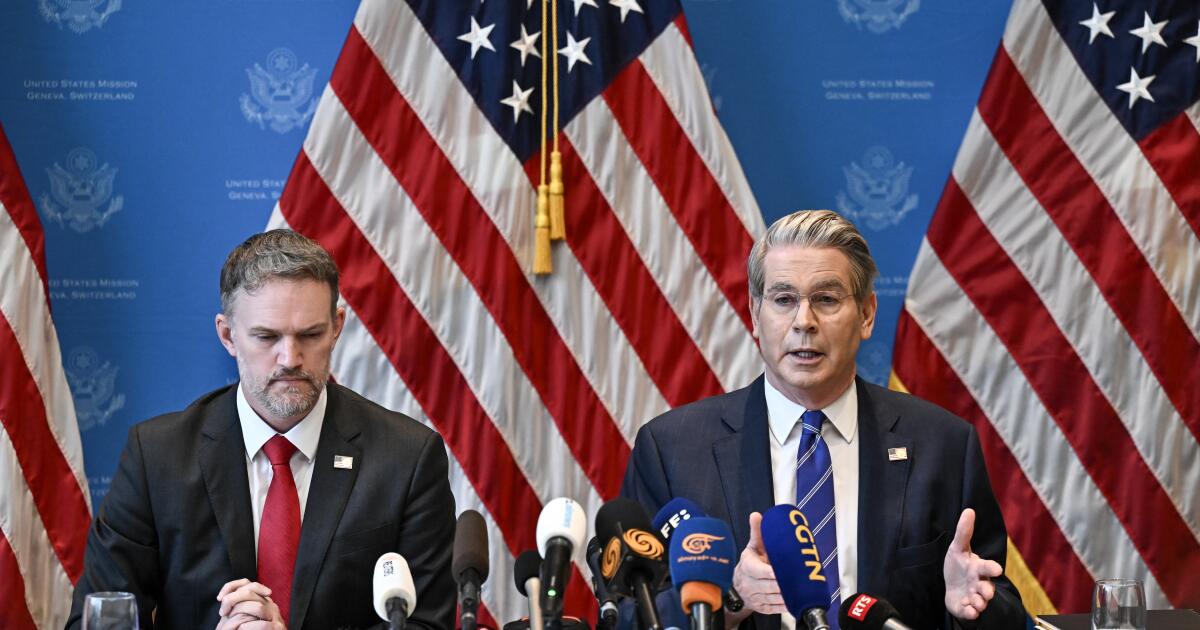
Where are we today? The “reciprocal” tariff on China will remain at 10%; according to Treasury Secretary Scott Bessent, who represented the U.S. at bilateral talks this weekend. Chinese goods will still be subject to an additional 20% levy Trump has described as punishment for China’s role in fentanyl exports to the U.S.
China, in return, cut its retaliatory tariffs to 10% from 125%, but left in place tariffs on U.S. farm goods — an additional 15% on chicken, wheat, corn and cotton and 10% on sorghum, soybeans, pork, beef, seafood, fruits, vegetables and dairy products. That’s bad news for U.S. farmers, for whom China had been a growing market, reaching a record $36.4 billion in 2022 before shrinking to $24.7 billion last year.
The deal Trump claimed to have reached last week with Britain was also murky. To begin with, the rationale for imposing “reciprocal” tariffs made no sense. Trump had justified those tariffs as countermoves to trade deficits the U.S. recorded with the target countries — but Britain is among the major trade partners that have consistently run a trade surplus with the U.S., meaning that it bought more from this country than it sold.
(Britain ranks only eighth among America’s trading partners; Canada, Mexico and China are the top three, respectively.)
As was the case with China, the agreement announced with Britain amounted to an agreement to keep talking, rather than a concrete deal. For all that Trump and British Prime Minister Keir Starmer congratulated themselves for their commitment to “deliver shared prosperity for American and British citizens alike,” the document they issued explicitly states that it “does not constitute a legally binding agreement” but only anticipates a “reasonable period of negotiation.”
Even so, the terms the White House mentioned stoked concerns among U.S. automakers. That’s because they included cutting tariffs on imported British cars to 10% from the 25% imposed on cars and auto parts imported from other countries, chiefly Canada and Mexico under the United States-Mexico-Canada Agreement, which Trump negotiated in his first term.
“It will now be cheaper to import a U.K. vehicle with very little U.S. content than a USMCA-compliant vehicle from Mexico or Canada that is half American parts,” complained the American Automotive Policy Council, a lobbying group for Ford, General Motors and Stellantis. Which British automakers would be its chief beneficiaries? Land Rover, Jaguar, Bentley, Rolls-Royce, Mini, McLaren and Aston Martin. About 103,000 vehicles from those brands came into the U.S. in 2024, auto market analyst Sam Fiorani told the Detroit Free Press.
That brings us back to Trump’s reliance on tariffs as a weapon in trade negotiations. His core belief appears to be that every bilateral trade deficit suffered by the U.S. is harmful to its economy, or an attack on its national security or even its sovereignty.
Many economists find this notion bizarre. “Running a trade deficit is nothing new for the United States,” Brian Reinbold and Yi Wen of the Federal Reserve Bank of St. Louis have observed. “Indeed, it has run a persistent trade deficit since the 1970s — but it also did throughout most of the 19th century.”
For the most part, they argue, trade deficits have been good for the U.S. economy. They reflected the importation of capital goods that fed into America’s rapid industrialization a century ago. More recently, they’ve reflected America’s wealth, which enabled U.S. consumers to buy more from abroad.
The truth is that the international trade regime in place for the last half-century or so has been a boon for American consumers and businesses. The U.S. outsourced the lowest-skilled work for the manufacture of products including electronics and baby clothes to countries with the lowest prevailing wage rates, while turning a blind eye to the abuses visited on those laborers — adults and children alike. Tariffs were low and, perhaps more importantly, stable.
In return, sellers — such as Apple — of those manufactured goods purchased by American consumers became some of the most valuable public companies in the world. U.S. stock prices and the value of high-tech companies in Silicon Valley soared. A new class of billionaire plutocrats, their wealth based less on manufacturing than on services, emerged.
Inexplicably, it was Trump who blew this long-lasting arrangement to smithereens. Not because he thought the globalization of manufacturing was morally suspect, but because he saw it as damaging to the U.S. economy.
It’s true that manufacturing employment saw a precipitous drop from 2000 through the 2008-2009 recession. According to international trade expert Kyle Handley of UC San Diego, some 6 million manufacturing jobs were lost in that period. But international trade was only one of several factors in the decline; automation and “a broad shift toward service sector employment” also played a role, especially in sectors such as healthcare, business and professional services, and communications and transportation.
“Many of the changes are irreversible,” Handley wrote last year. Nevertheless, “nostalgia for the past remains salient in national conversation.”
Trump’s inability, or disinclination, to look deeper into the roots of U.S. trade deficits, which he sees as invariably the result of illicit trade barriers blocking U.S. exports, may explain the bewildering course of White House tariff policy.
For the White House to “suggest that the trade deficit is somehow reflective of trade barriers, and the administration’s cherry-picking of the data (which excludes services where the United States has a surplus) further points to the arbitrary nature of its claims,” Inu Malak of the Council on Foreign Relations observes.
How Trump’s deal-making will proceed from here is anyone’s guess. One question concerns whether they’re even constitutional, since the Constitution vests trade policy in Congress. A lawsuit making that point filed by five small importers harmed by the tariffs will be heard Wednesday by the federal Court of International Trade.
Trump has misused the International Emergency Economic Powers Act, or IEEPA, to claim that authority for himself, the lawsuit asserts. “The government’s position,” Ilya Somin, a constitutional law expert at George Mason University who represents the plaintiffs, told me, “is that IEEPA gives the president the power to impose whatever tariffs he wants, against any country, for as long as he wants, so long as he first declares a ‘national emergency’ (which they argue he can do anytime he wants for any reason).”
But IEEPA doesn’t mention tariffs, the plaintiffs note, and has never been used to impose or increase them. Nor can trade deficits rise to the level of a “national emergency,” as Trump claims, given that the trade imbalances present when he took office had been in place for years, even decades, the plaintiffs say.
The question remaining is how lasting Trump’s disruption of international trade relations will be. His policies have already had one effect: Trust in the U.S. as a reliable trading partner has been profoundly shaken.
America profited from that trustworthiness for many decades. It may not be restored for years to come.