
Like ancient oaks uprooted by tornadoes, some of America’s richest and most powerful institutions have been capitulating to Donald Trump. Law firms, universities, even Supreme Court justices have surrendered to Trump’s most outlandish demands that they cede their governing principles to him and pay financial tribute that runs into hundreds of millions of dollars.
The rationale for some of Trump’s policies—social and economic—are mysterious. But a greater mystery is why these institutions have given in, sometimes without a whisper of defiance.
The capitulation trend has encompassed some American institutions that made their names standing firm against authoritarianism. One is CBS, whose parent, Paramount Global, last month settled a $20-billion Trump lawsuit over the editing of an interview with Kamala Harris at “60 Minutes” by paying $16 million, ostensibly to finance Trump’s presidential library.
A nation of sheep will beget a government of wolves.
— Edward R. Murrow, former CBS News icon
The settlement “resembled payment of an extortion-like penalty to the government for the standard editing” of the Harris interview, Jeffrey A. Sonnenfeld, senior associate dean for Leadership Studies and a leading professor at the Yale School of Management, wrote in The New Republic with two Yale colleagues.
As my colleague Meg James reported, critics blasted the settlement, with one calling it a “spineless capitulation” that would only embolden politicians and others to “weaponize lawsuits and bring regulatory pressure to bear to silence and censor independent journalism.”
Shortly after the settlement, as it happens, CBS announced the cancellation of Stephen Colbert’s “Late Show,” silencing a widely-followed Trump critic (at least on broadcast TV). The network attributed its decision to economic factors, but it’s been commonly seen as related to the settlement with Trump.
Newsletter
Get the latest from Michael Hiltzik
Commentary on economics and more from a Pulitzer Prize winner.
You may occasionally receive promotional content from the Los Angeles Times.
Sonnenfeld ably placed the settlement in the context of CBS’s distinguished journalistic history, which he traced back to the work of Edward R. Murrow in the 1930s and later; under Murrow, he noted, the news division of CBS became “the gold standard of broadcast journalism.”
In settling what many legal commentators regarded as a frivolous lawsuit, Sonnenfeld wrote, Paramount’s goal appeared to be securing the government’s approval of its then-pending $8-billion merger with Skydance Media.
The merger promptly received approval from the Federal Communications Commission and closed on Aug. 7, completing what Sonnenfeld called a “sellout of the Columbia Broadcasting System’s journalistic values to commercial interests.”
Many of the other deals with Trump similarly subordinate the institutions’ moral or ethical values to commercial or financial concerns.
I asked Paramount for a response to Sonnenfeld’s commentary, and received a statement that “companies often settle litigation to avoid the high and somewhat unpredictable costs of legal defense, the risk of an adverse judgment that could result in significant financial or reputational damage, and the disruption to business operations that prolonged legal battles can cause.
CBS is far from alone. Indeed, in the media sphere it was preceded by the Walt Disney Company, which in December settled Trump’s lawsuit over ABC News anchor George Stephanopoulos’ on-air assertion that the president-elect had been found civilly liable for raping writer E. Jean Carroll. In fact, Trump had been found liable for sexually assaulting and defaming Carroll, not for rape. The settlement involved a $15-million contribution for Trump’s presidential library.
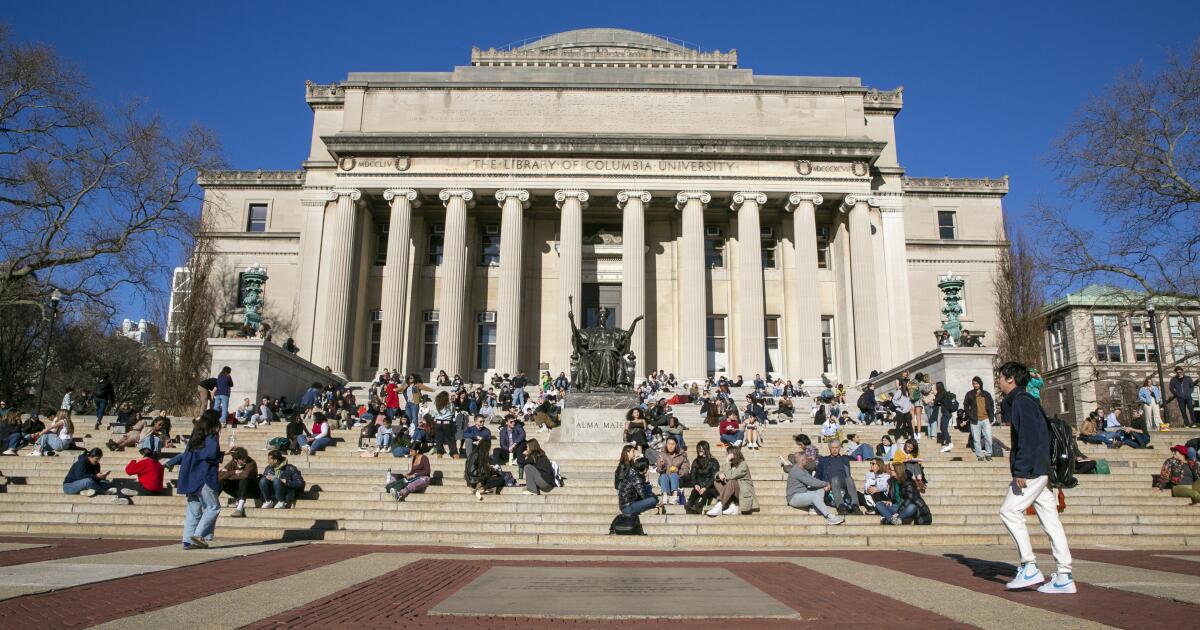
Leading universities have surrendered to Trump accusations of antisemitism and gender discrimination. Columbia (from which I hold a graduate degree) agreed last month to pay $221 million to “resolve” government allegations that it has violated federal anti-discrimination laws. Brown University also reached an agreement with the White House last month to pay $50 million toward workforce development programs in its home state, Rhode Island.
Trump has recently turned his crosshairs on UCLA, freezing more than $300 million in research grants on the ostensible grounds that the university has failed to “promote a research environment free of antisemitism.” UCLA Chancellor Julio Frenk has responded that “this far-reaching penalty of defunding life-saving research does nothing to address any alleged discrimination.”
At least nine leading national law firms have also capitulated to Trump attacks by agreeing to payments totaling $940 million, according to a compilation by Axios, including pro-bono legal representation for conservative entities and other commitments.
These settlements often involve non-financial commitments. Some institutions under Trumpian fire agree to end programs promoting workforce, student and faculty diversity, equality and inclusion, or “DEI,” to cite the common conservative shibboleth, or to eliminate other forms of outreach. In effect, they’re ceding control over their academic structures to the White House.
Institutions that have fought back have often been able to block administration threats in federal trial and appellate courts. That’s been true for four law firms that have challenged Trump. Harvard, the target of a concentrated attack by Trump, has won a temporary restraining order against the administration’s effort to prevent the university from enrolling foreign students. A separate lawsuit over Trump’s threat to freeze scientific and other academic grants to the university and its affiliates is pending.
The surrendering institutions typically have cited the economic consequences of opposition. Trump’s threat to withhold research funding, which can run to billions of dollars a year, has rattled universities. In explaining Columbia’s nine-figure payoff to the administration, Acting President Claire Shipman stated that most of the $400 million in federal research grants that Trump canceled in March will be reinstated, “and Columbia’s access to billions of dollars in current and future grants will be restored.” The university said the settlement would close “a period of sustained federal scrutiny and institutional uncertainty.”
At the law firm Paul, Weiss, Rifkind, Wharton & Garrison—the first law firm to reach a deal with Trump—Chairman Brad Karp said the deal was made to reverse Trump’s executive order cutting its lawyers off from government contracts, revoking their security clearances and prohibiting them from entering government buildings or dealing with federal employees. That all amounted to “an existential crisis” for the firm, Karp told his partners and associates.
It’s possible, though never stated outright, that the surrendering institutions recognize that the clock is running on Trump’s authority. His presidency runs only until Jan. 19, 2029. (Never mind his musings about a third term, which would be unconstitutional. On the Gonna Happen scale, that’s a Not.) They may simply be buying time in the expectation that a succeeding president will reverse the strictures he has imposed. In the meantime, courts may quash his threatened punishments as illegal or unconstitutional infringements of 1st Amendment rights.
“Appeasement may well be a viable strategy when the party being appeased is willing to take the win and stand down,” writes Steve Vladeck of Georgetown law school. But it’s “a potentially catastrophic approach” that can end up enabling, even encouraging, more bad behavior.
Columbia, for example, thought that by acceding to Trump’s demands in March to discipline students involved in a pro-Palestinian protest and placing its Middle Eastern, South Asian, and African Studies Department under “academic receivership” and appointing an outside chair to run the unit for five years, won it a restoration of research funding. This proved to be untrue, leading to its $221-million settlement in July.
Even while mounting a legal fight against Trump, Harvard has shuttered its diversity offices, which served minority and LGBTQ students and women, in July—steps that resembled demands from the Trump administration as part of an offer to restore potentially billions of dollars in research funding. But those actions haven’t appeared to quell Trump’s attacks on the university. The university has said that it “remains committed to cultivating a community where all of its members can thrive.”
The truth is that Trump can do a lot of damage to institutional interests while he remains in office and legal challenges wend their way through the federal judicial system on their way to possible consideration by the Supreme Court. Even if the High Court ultimately finds Trump’s actions to be illegal, the process takes time and money, neither of which the plaintiffs will recover.
As Trump’s public standing begins to erode, new signs of resistance are emerging among his likely targets. Within the Big Ten conference, faculty senates at 14 of the 18 member schools have passed what amount to mutual aid commitments, aimed at coordinating “a unified and vigorous response” to political attacks, in the words of the model resolution developed at Rutgers.
(The other 17 schools are the universities of Illinois, Iowa, Maryland, Michigan, Minnesota, Nebraska, Oregon, Washington and Wisconsin; Indiana University; Michigan State, Ohio State and Penn State; Purdue; Northwestern; UCLA; and USC.) The faculties at Purdue, UCLA and USC haven’t yet signed up, but dozens of other schools have inked so-called mutual academic defense compacts.
One can only wonder if the trend toward capitulation to Trump’s bare-knuckled threats will have lasting consequences for the rule of law, social norms and the reputations of the submissive institutions. Some law firms that made deals with Trump to protect their business interests have lost clients that came to doubt that they would stand up forthrightly for the clients’ interests.
Sonnenfeld alluded to the possible aftermath in his brief against Paramount/CBS, which he described as a “tragic capitulation of First Amendment rights, accompanied by a demoralizing and brand-tarnishing political appeasement.” He closed his essay with a fitting quote attributed to Murrow: “A nation of sheep will beget a government of wolves.”