
The Los Angeles we know has long been an irresistible subject for novelists and moviemakers — so much so that they’ve often tortured reality to make it conform to their imagination.
Robert Towne mined the history of the Los Angeles Aqueduct in his screenplay for “Chinatown” but moved the story ahead up by some two decades, from 1913 to the 1930s, to give his scenario its noir sensibility.
Ridley Scott and his filmmaking team depicted a future Los Angeles beset with darkness and a never-ending downpour of rain for “Blade Runner” — never mind that its source material, Philip K. Dick’s novel “Do Androids Dream of Electric Sheep,” was set in San Francisco, that provincial burg some 400 miles to the north.

Years ago, Mike Davis wrote “fear eats the soul of Los Angeles.” Today, protection dogs, security cameras and guards are big business.
(Wally Skalij / Los Angeles Times)
But the task of depicting a future Los Angeles hasn’t been monopolized by fiction writers. Nonfiction writers have joined them in their obsession. They include the late environmentalist Marc Reisner, author of the indispensable “Cadillac Desert,” the public policy expert Steven P. Erie of UC San Diego, historians such as Kevin Starr and Carey McWilliams, and polemicists such as Mike Davis. Even most of those whose subject is or has been the L.A. of their own time have taken pains to look ahead.
How well have they outlined the future of Los Angeles and Southern California? Let’s see.
The tone of nonfiction conjectures about the future of Los Angeles generally fall into two categories, elegiac or apocalyptic — and sometimes both: “utopia or dystopia,” in the words of Davis.
Davis was the avatar of the latter approach. The first of his books about Los Angeles, “City of Quartz” (1990), mostly looked back at the history of the city’s development. It was his follow-up, “Ecology of Fear” (1998), that really attempted to sketch out a future for the city, based on his vision of “the great unbroken plains of aging bungalows, stucco apartments, and ranch-style homes — as it erodes socially and physically into the twenty-first century.”
Davis drew a line from what he saw as “the current obsession with personal safety and social insulation … in the face of intractable urban poverty and homelessness, and despite one of the greatest expansions in American business history” in the mid-1990s to explain “why fear eats the soul of Los Angeles.”

Mike Davis in his San Diego home in 2022.
(Adam Perez / For The Times)
He wasn’t far wrong. A few years later, I visited the maker of underground nuclear shelters fashioned from corrugated steel at his shop and showroom on the 5 Freeway in Montebello, where he was doing great business for models that started at $78,000 each; “Yes, paranoia does sell” was how I headlined my column. It still does: Guard dogs, surveillance cameras and sentry-protected neighborhood tracts have proliferated all around the Southland.
Davis foresaw the continued development of “tourist bubbles” — theme park-like “historical district, entertainment precincts, malls … partitioned off from the rest of the city” — think developer Rick Caruso’s shopping center the Grove, opened in the Fairfax District in 2002, which presents blank or billboarded walls to the outside world, enclosing a Disneyesque landscape of shops and restaurants inconspicuously monitored by security services.
:::
As opinion pollsters know, when you ask people what the future will look like, they invariably paint a picture that looks just like the present, only more so: If there’s a crime wave when they’re being polled, they foretell a world beleaguered by armed gangs; if there’s a recession, they expect a world of unrelieved poverty; if it’s a period of technological advancement, they foresee a world of flying cars.
Writers projecting a future of L.A. tended to fall into the same pattern. The Slovenian transplant Louis Adamic, who had emigrated to the United States in 1913 and settled in the port community of San Pedro, scrutinized Southern California with pitiless objectivity in a 1930 essay titled “Los Angeles! There she blows!”
Adamic mentioned the conviction among Angelenos that their city “will ultimately — perhaps within the next three or four decades — be the biggest city in the world.” And he acknowledged that “the place has many great advantages, among the foremost, of course, being Climate, and but a single drawback, which, however, is an extremely serious one — that of water shortage.”
Nevertheless, noting that the city’s population had doubled over the previous 10 years to nearly 2 million, he confidently predicted that it would number 3 million by 1935. It didn’t reach that mark until the 1980s, and it’s not the first time, nor the last, that a prediction of the city’s future overshot the target. His concern about water, of course, was spot-on.
Another writer who extrapolated from what he saw of the Los Angeles of his time was Morrow Mayo, whose 1933 book “Los Angeles” is quoted elsewhere in The Times’ Future of L.A. package. Mayo expressed the opinion that even if “the territory known as the ‘City of Los Angeles’” grew from its then-population of 1.2 million to 4 million or more, he doubted that “it will ever be permanently the great vibrant, vital, nerve-center of the Pacific coast.”
The reason, Mayo wrote, was its climate — “meant for slow-pulsing life; a climate where man, when he gets adjusted to the environment, takes his siesta in the middle of the day. Go-getterism in this climate does violence to every law of nature.”
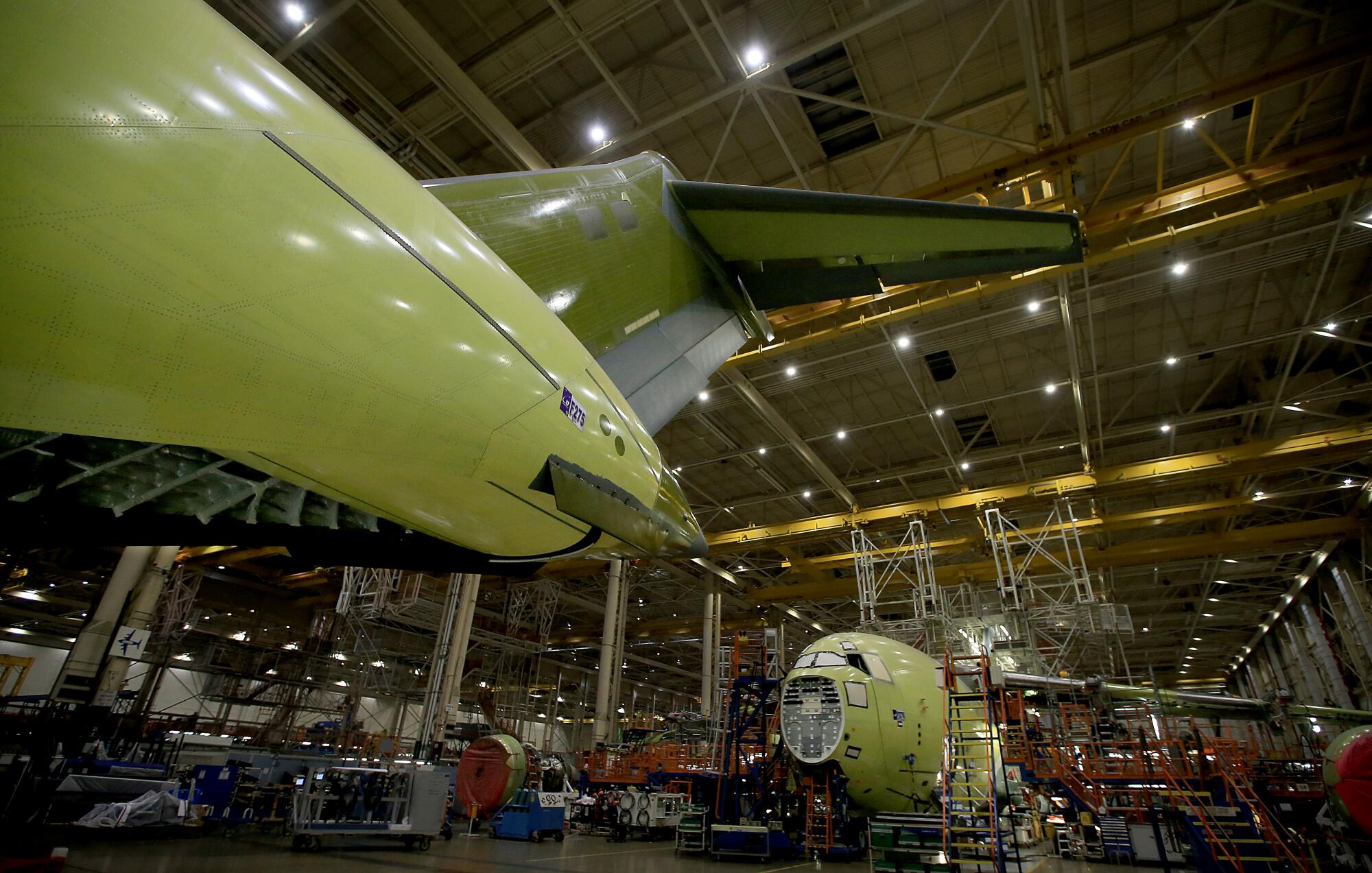
Boeing C-17 military transport planes in various stages of completion at a company facility in Long Beach. Carey McWilliams wrote that the aircraft industry was “likely to remain in the region and even to expand production,” but Boeing’s military aircraft assembly line was shut down in 2015, ending an era.
(Los Angeles Times)
What kept Los Angeles even marginally vibrant was the steady influx of vigorous immigrants from the East and Midwest. After a few generations under the sun, Mayo concluded, “it will settle back to normalcy, and become in tune with nature, for man has never yet failed to adjust himself to the climate in which he lives.”
Thus did Mayo pioneer the stereotype of the laid-back Angeleno with barely a care in the world.
On the other hand, Mayo quoted a fellow prognosticator as finding in the city’s industrial districts “that same peculiarly contented type of workman, the same love of little homes ‘across the street from the factory,’ the diligence and care for the flowers in the front yard, or the fruit trees and vegetables in the rear, a total lack of the Bohemian spirit, the love of a comfortable, humble existence,” that could be seen in Philadelphia.
As a picture of Los Angeles, Mayo wrote, “I suspect that it is prophetic. ‘Los Angeles — the Philadelphia of the West.’”
Such miscalculations point to another pitfall facing those who would dare to predict the future of Los Angeles: Change has come so rapidly that any prediction can be confounded within the lifetime of its author. Thus Carey McWilliams, that indefatigable chronicler of the California pageant, wrote in his book “Southern California Country: An Island on the Land” that the aircraft industry was “likely to remain in the region and even to expand production.”
McWillliams wrote those words in 1946; by 1980, when he died, the industry had crashed in Southern California, entering a long period of retrenchment that ended with Boeing’s closing of the region’s last commercial aircraft manufacturing plant in 2005. The Long Beach plant’s 300 workers were transferred to Boeing’s military aircraft assembly line, but that was shut down in 2015, ending an era, as The Times observed, in which the region was. “once synonymous with the manufacture of aircraft.”
The trajectory of the Los Angeles ecology, and by extension that of Southern California and the entire state of California, was the subject of Reisner’s 1986 book, “Cadillac Desert.” He viewed the water politics of the region, quite properly, through the prism of winner-take-all economics. Water was wasted by farmers and urban residents because it was almost free. That was already beginning to change in his time, he observed, but the process would need years, even decades, to play out — if it ever could.
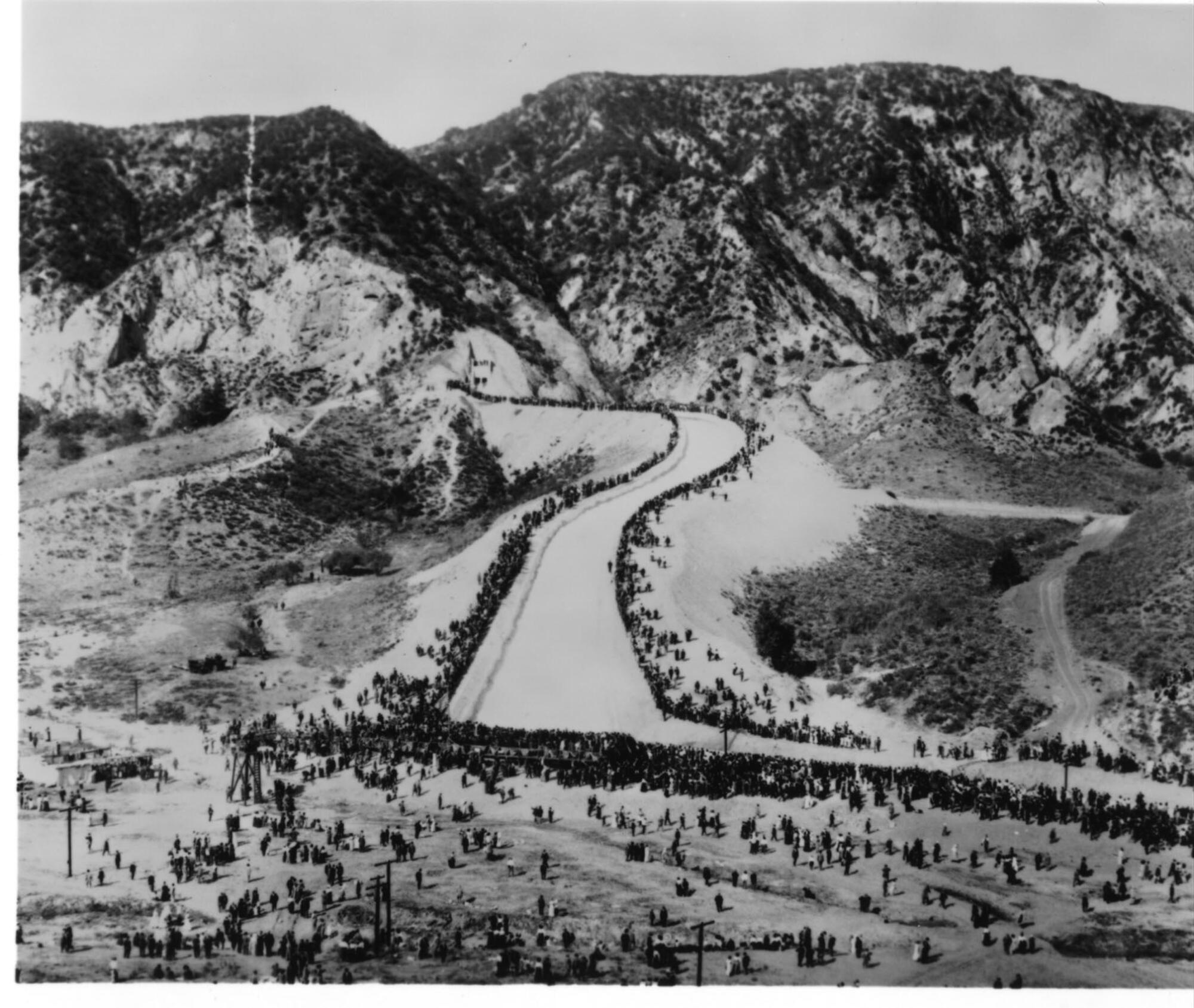
In his 1986 book, “Cadillac Desert,” Marc Reisner viewed the water politics of the region, quite properly, through the prism of winner-take-all economics.
(L.A. Department of Water and Power)
“The West’s real crisis is one of inertia, of will, and of myth,” he wrote in the closing pages of “Cadillac Desert.” Reisner looked ahead, hopefully, to a West that “might import a lot more meat and dairy products from states where they are raised on rain, rather than dream of importing those states’ rain …. A region where people begin to recognize that water left in rivers can be worth a lot more — in revenues, in jobs — than water taken out of the rivers.”
“At some point, perhaps within my lifetime, the American West will go back to the future than forward to the past.”
Regrettably, Reisner, who died in 2000, didn’t live to see that happen. Whether his hope will ever be fulfilled remains an open question.
Perhaps the most penetrating look at the future of Los Angeles and its state came from Peter Schrag, a former editorial page editor at the Sacramento Bee. In his 1998 book “Paradise Lost,” Schrag sought not simply to foretell the region’s future, but to explicate how its future foretold what was in store for the country as a whole. (Its subtitle was “California’s Experience, America’s Future.”)
When he wrote the book, California was in one of its boom phases. It was again “the driving engine of national economic growth and likely to remain in that position until well into the next century …. Because of foundations laid forty years go … it is at the forefront of the world’s leading-edge technologies and of its creative energy.” (He was right about that, at least up to this moment.)
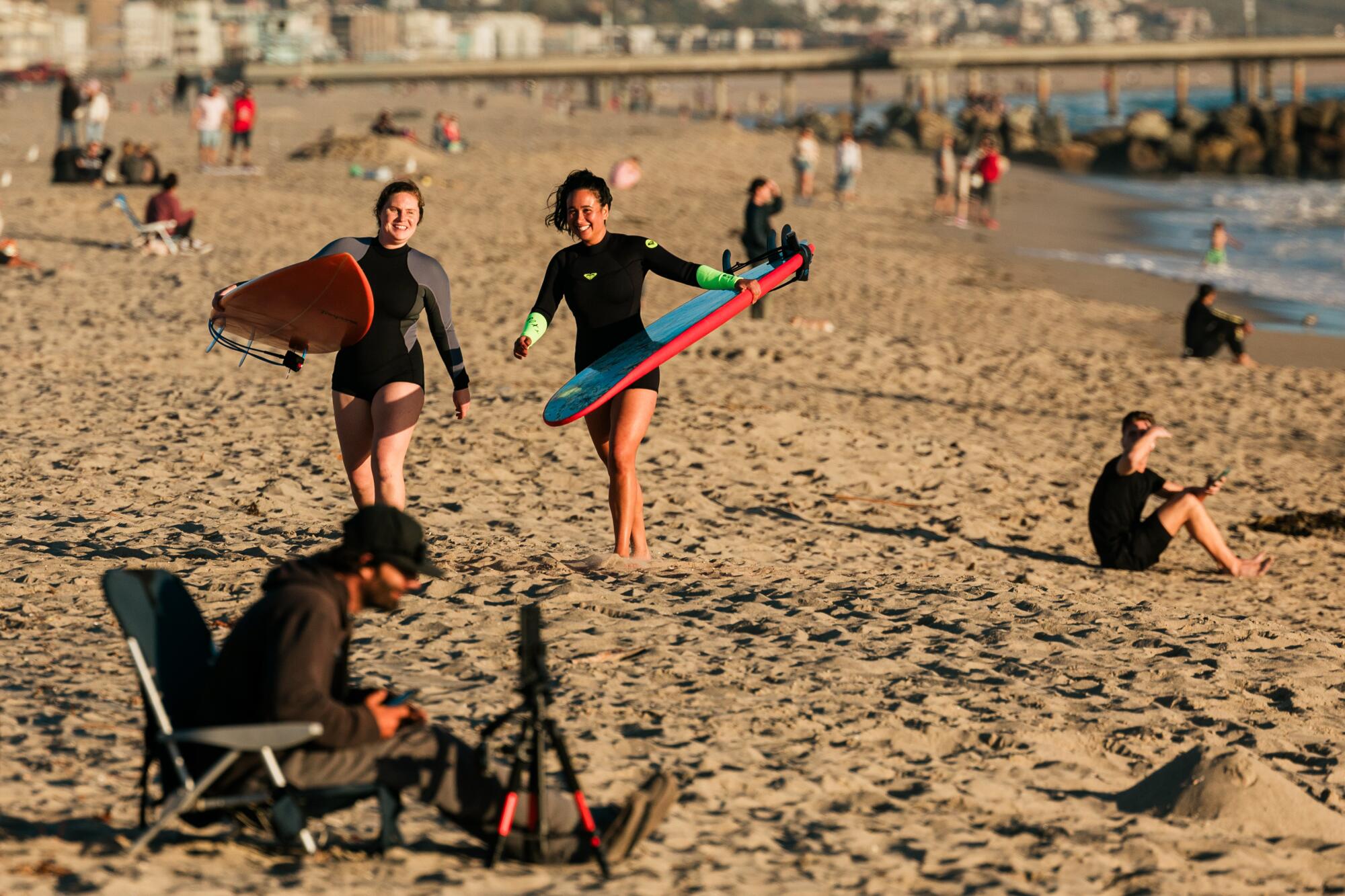
Surfers enjoy a day at Venice Beach. Los Angeles and California are the subject of unending curiosity for readers of history and current affairs no less than for consumers of novels and movies.
(Jason Armond / Los Angeles Times)
But Schrag also pointed to the state’s “increasingly dysfunctional governmental and fiscal public institutions, the depleted state of its public infrastructure, services, and amenities, the growing gaps between its affluent and its poorer residents, and its pinched social ethos,” which “hang like dark clouds in the sunny skies.”
California had exported to other states the facile low-tax policies of Howard Jarvis and Ronald Reagan’s view of government as “the problem, not the solution.”
In addition, Schrag saw that the emergence of social media “may insure against the power of Big Brother to dominate communications, but they also amplify the power of shared ignorance …. What used to be limited to gossip over the back fence is now spread in milliseconds.”
And he foresaw how the changing demographics of California would be replicated nationwide:
“The new kids now crowding into the schools and universities of California — black, brown, Asian — will constitute the majority of the state’s workforce, and a good part of the nation’s, in the next decade, and forever after,” he wrote.
Schrag had his finger on an essential truth about Los Angeles and California that remains true to this day: They’re the subject of unending curiosity for readers of history and current affairs no less than for consumers of novels and movies. That has been true since the vision of a land of gold — El Dorado — drew the Spanish conquistadors to these shores. The world wishes to know what L.A. and California are, and where they are headed.
Kevin Starr wrote: “In recent times, the American people have turned to California and asked it to create a technology revolution, and California responded.”
(Bloomberg via Getty Images)
Kevin Starr, writing in 1995, understood how that impulse would play out in the decades to come. “The United States is testing its future through California,” he said in an essay for the website of the California State Library, which he served as state librarian from 1994 to 2004. Establishing California as a “bellwether state,” he wrote: “The American people are asking a series of questions which now become the California challenge …. Can the American people turn to positive effect the cultural diversity of a nation in the process of being transformed? … Can the American people maintain their standards of living and education?”
Starr’s answer to the questions he posed was a resounding yes! “In recent times,” he wrote, the American people have turned to California and asked it to create a technology revolution, and California responded …. The American people have turned to California for new models of lifestyle, new ways of enjoying and celebrating the gift of life, and California responded with an outpouring of architecture, landscaping, entertainment, sport and recreation.”
The confidence that Starr projected 20 years ago may have faded, and may fade further in the future in Los Angeles and up and down the state. But one thing that probably will remain true is that the region’s path into the future will inspire writers to keep peering into their crystal balls, cloudy as they are.