
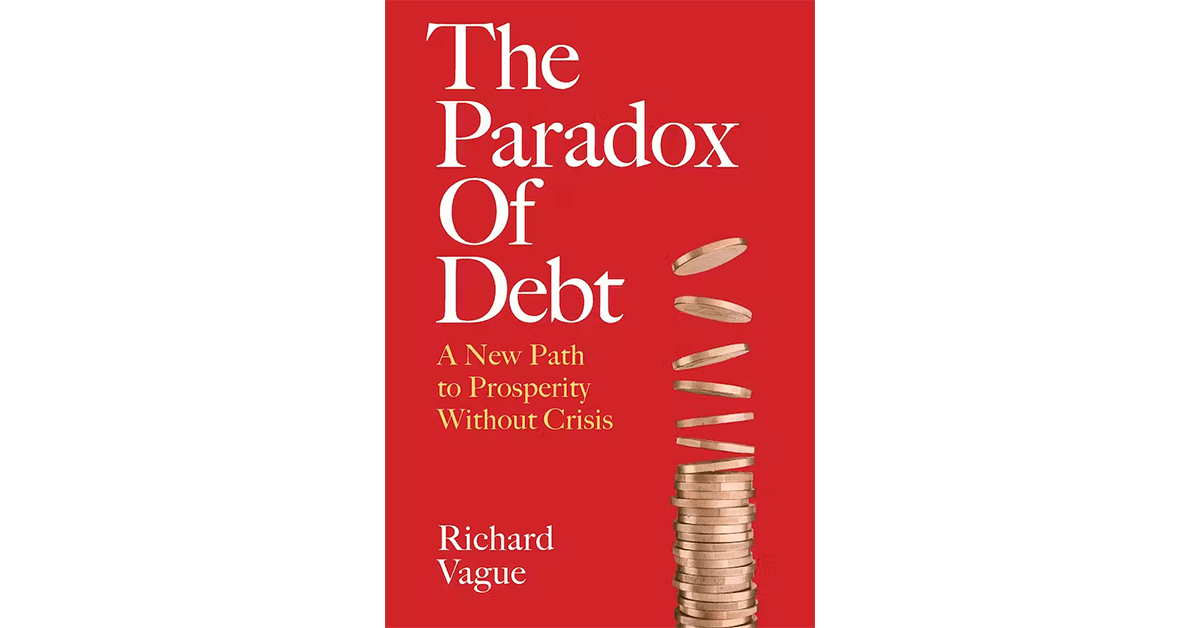

The Paradox of Debt: A New Path to Prosperity without Crisis. 2023. Richard Vague. University of Pennsylvania Press.
In 2004, Vice President Dick Cheney drew no small amount of derision when he opined that “[President Ronald] Reagan proved that deficits don’t matter.” Richard Vague suspects that Cheney may well have been right.
In The Paradox of Debt: A New Path to Prosperity without Crisis, Vague — banker, venture capitalist, and Pennsylvania’s secretary of banking and securities — goes a long way toward making the case. The postcard version of the book’s “paradox” stipulates that without debt there can be no growth and that growing economies organically generate inexorably rising debt, both government and private. There is nothing particularly wrong with such gradually rising debt levels, Vague asserts; they are a normal part of the increasing prosperity wrought by technological advance that requires ever more funding. Yes, occasionally excessive debt does produce crisis, but only under specific conditions.
Vague’s value added to this unconventional notion is his detailed examination of national money flows among its various compartments: households, the finance sector, nonfinancial businesses, government, and what he piquantly calls the ROW (rest of the world). For example, in 2021, the massive federal stimulus resulted in income “gains” of $1.77 trillion, $0.86 trillion, and $0.30 trillion that accrued to, respectively, the household, ROW, and nonfinancial business sectors, almost completely paid for by the “loss” sustained by the government sector.
The author is no fan of Milton Friedman’s assertion that inflation is “always and everywhere a monetary phenomenon.” He maintains that the price increases of both the 1970s and the past few years were more likely the result of supply shocks. Vague adds that a more systematic examination of the relationship between inflation and monetary supply “demonstrates that periods of low inflation have sometimes been preceded by high money supply growth and that episodes of high inflation often occur without high money supply growth.” He further observes that when inflation finally fell to 2% by 1986, the money supply was exploding. At today’s higher debt levels, Vague posits, monetary tightening is likely to be far more painful than in the Volcker era, a prediction that has not been borne out — yet.
Apropos of its title, most of the book examines “the paradox of debt,” the tension between debt as the lifeblood of a growing economy and of the dangers of too much of it, with a major focus on exactly what constitutes “too much.” Start with the most widely used metric, the ratio of debt — government, private (which includes both household and nonfinancial corporate), and their total — to GDP. Vague points out that the tolerable levels of these ratios need to be considered in relation to the size of the nation’s financial sector. On the one hand, Argentina’s underdeveloped financial sector in 2021 did not tolerate an 81% ratio of government debt to GDP; on the other hand, in 2021, Japan carried a government debt-to-GDP ratio of 221% without breaking a sweat. Similarly, while most high school students learn about the crippling US government debt overhang from the Revolutionary War, it amounted to only 25% of the new nation’s GDP, a huge problem indeed in a new nation without a functioning financial system.

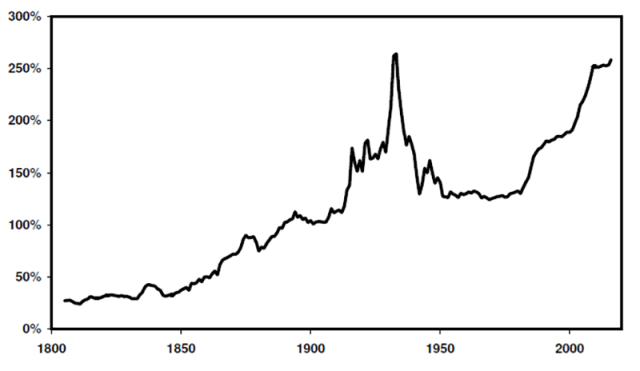
In Vague’s taxonomy, debt can be further broken down into Type I and Type II, dedicated to the purchase, respectively, of new and existing assets. Type I debt corresponds to economic growth, and Type II debt, such as for the purchase of existing real estate, gets added on top of it, so the overall debt-to-GDP ratio tends to increase inexorably, as manifested in nearly all developed nations over the past few centuries. See, for example, total US debt/GDP in the following graph.
Total US Government and Private Debt to GDP Ratio
Source: Tychos Group
Growth can be fueled by three different sources of debt: government, business, and household. Is there a way to grow an economy without debt? Yes — with a trade surplus — but even nations that run large trade surpluses, such as Germany and China, still fuel the lion’s share of their growth with largely private debt. There is also a positive relationship between debt levels and asset prices. This relationship is most obviously demonstrated by the powerful bull market in the wake of the massive increase in US government debt incurred from the response to the COVID-19 pandemic. The author also notes that since Germany partially fuels its economic growth with an export surplus, its lower private and government debt levels result in lower stock prices.
Vague examines the temporal patterns of government and private debt for the United States, the United Kingdom, Germany, France, China, Japan, and India. He develops a compelling cyclical model of the interplay between debt’s private and government components over four epochs in the United States, each beginning with a major and expensive conflict: the Revolutionary War, the Civil War, World War I, and World War II.

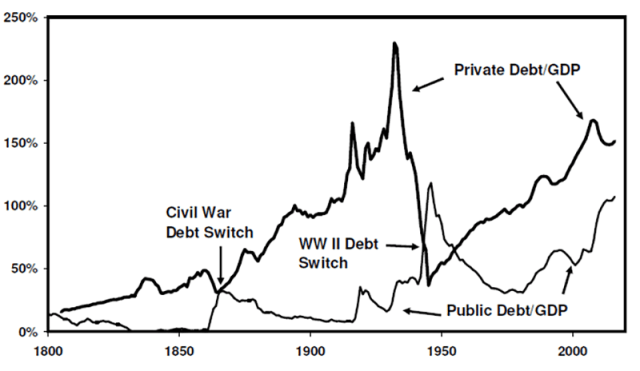
All four cycles featured the buildup of a large government debt to pay for the war effort followed by a “debt switch” to private debt as the government leverage was replaced with private sector leverage, which powered the economy and helped pay down the government debt. The spectacular buildup of private debt relative to GDP following World War I, shown in the below fueled the Roaring ’20s stock bubble. Vague notes, as have others, that the rapid buildup of private debt is usually followed by a financial collapse attendant to rapid deleveraging in the buildup’s aftermath.
US Government Debt to GDP and US Private Debt to GDP Ratios
Source: Tychos Group
The end of the first two cycles, occurring roughly in the 1840s and during the last two decades of the 19th century, saw devastating depressions that were likely as severe as that of the 1930s. There was no government rescue during these first two epochs. The last two cycles, however, saw a new, fourth phase of government rescue powered by government debt during the New Deal, following the Savings and Loan Crisis of the late 1980s, after the 2007–2009 global financial crisis (GFC), and again as a response to the COVID-19 pandemic.
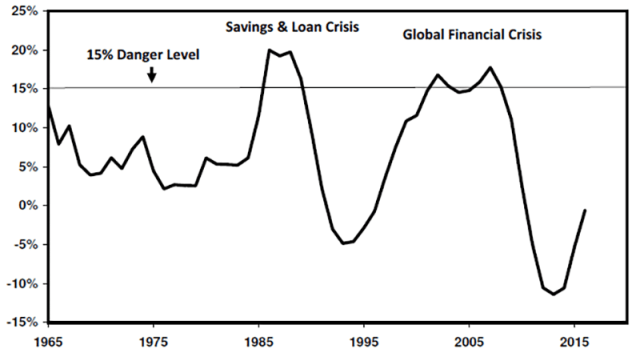
As have many observers, Vague identifies the rapid buildup of private — and particularly household — debt as the primary risk factor for a subsequent financial panic. His dataset suggests that any increase in private debt of more than 15% over five years sets the stage for a self-perpetuating cycle of debt-driven asset price increases and their attendant euphoria-borne further increases in leverage and asset prices, depicted below.
Five-Year Increase in US Private Debt to GDP Ratio
Source: Tychos Group
Government debt is far less dangerous, since governments can print their way out of trouble (assuming that the debt is denominated in domestic currency). At this point, the author goes full Cheney, declaring that “there are no limits on government debt growth, or at least not limits that would become salient anywhere near as quickly as for private debt.” Long before excessive government debt causes systemic fiscal instability, Vague posits, the resulting asset price inflation will result in societal instability arising from wealth and income inequality. The cure? Debt forgiveness along the lines of the debt jubilees regularly seen in ancient Mesopotamia, where the 20% interest rate on silver loans and the 33% rate on grain loans threw peasant farmers into default faster than you can say “compound interest.”
Perhaps Vague is right about all this, but most readers would still desire some discussion of the risk of a government debt spiral, for which Japan is surely the canary in the coal mine if bond rate increases in that country push servicing costs beyond tolerable limits.

The Paradox of Debt is marred by a more serious — and perhaps fatal — omission: It is beyond strange that such a comprehensive work of macroeconomics contains no bibliography or substantive reference notes. For example, although the book does sketch out Hyman Minsky’s seminal work on leveraging/deleveraging booms and busts, it does not label it by its name — the instability hypothesis — let alone provide a citation. One wonders just how the acquisition and structural editors at the venerable University of Pennsylvania Press gave the book such a glaring pass. Vague acknowledges by name four collaborators, but does not identify the organization both he and they apparently work at; with a little digging, one finds Vague and his associates are affiliated with an obscure nonprofit, the Tychos Analytics Group. In fairness, the book does feature appendices, one of which refers to the online data files upon which the book’s text and graphics (and this review’s exhibits) are based.
This absence of bibliographic referencing is a shame. With some trepidation, this reviewer can recommend that investment professionals read this compelling and provocative volume but that they withhold judgment for a better-documented treatment of the book’s major points.
If you liked this post, don’t forget to subscribe to the Enterprising Investor.
All posts are the opinion of the author. As such, they should not be construed as investment advice, nor do the opinions expressed necessarily reflect the views of CFA Institute or the author’s employer.
Professional Learning for CFA Institute Members
CFA Institute members are empowered to self-determine and self-report professional learning (PL) credits earned, including content on Enterprising Investor. Members can record credits easily using their online PL tracker.