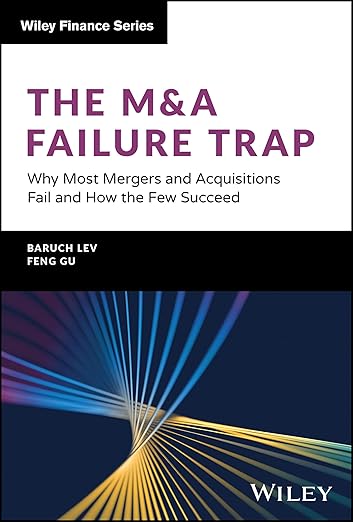

The M&A Failure Trap: Why Most Mergers and Acquisitions Fail and How the Few Succeed. 2024. Baruch Lev and Feng Gu. Wiley.
At an early-1980s presentation by a leading investment bank to a business school alumni group, the bank’s CEO was confronted during the Q&A session about the high failure rate of corporate mergers and acquisitions (M&A), from which Wall Street derives a significant chunk of its revenues. The CEO responded by pointing out that companies’ internal projects — their investments aimed at building businesses from scratch rather than buying them — also fail at a high rate. He did not mention the perverse incentive whereby divestments made in the wake of failed acquisitions generate additional fees for bankers. Neither did he cite any data on comparative success ratios of internal and external corporate growth initiatives.
Thanks to Baruch Lev, professor emeritus of Accounting and Finance at the New York University Stern School of Business, and Feng Gu, chair and professor of Accounting and Law at the School of Management, University at Buffalo, we now have an authoritative measure of the M&A failure rate. Lev and Gu define failure in terms of post-acquisition sales and gross margin trends, stock performance, and goodwill write-offs. Based on a sample of 40,000 transactions over 40 years, they find that 70% to 75% of M&A deals fail. That is twice the 36% failure rate for internal projects reported by project management application service provider Wrike, Inc.
As if these figures were not sufficiently dismaying, Lev and Gu report in The M&A Failure Trap that the failure rate is on the upswing. Acquisition premiums have risen, and average goodwill write-offs have gotten larger. Moreover, conglomerate acquisitions — purchases of companies unrelated to the acquirer’s core business—have made a strong comeback.
This comeback has occurred despite the de-conglomeration of most of the widely diversified corporate giants of the 1960s — after their shares traded at discounts to focused companies’ stocks and management failed to produce the synergies they claimed would emerge from their frenetic dealmaking. Lev and Gu further note that the usage frequency of “synergy” in corporate merger announcements tripled between the 2000s and 2010s.
Investors will find this book an invaluable resource. In addition to being called upon to vote on major M&A proposed transactions, shareholders sometimes suffer horrendous losses due to ill-conceived and poorly executed acquisitions. Based on rigorous statistical analysis of their huge sample of deals, the authors identify 43 different factors that enhance or detract from the probability of success.
For example, the larger the deal size, the higher the percentage of the payment for the acquisition that is made in the acquirer’s stock, and the higher the S&P 500’s return in the year preceding the transaction, the greater the probability of failure. Lev and Gu condense their analysis into a 10-factor model that is practical for investors to employ in assessing the merits of a prospective merger.
The authors leaven their abundant quantitative detail with colorful prose. They supplement their quantitative findings with case studies of both successful and unsuccessful M&A. Such prominent deals as Hewlett Packard/Autonomy, AOL/Time Warner, and Google/YouTube are examined for clues that can predict the fates of future transactions.
Lev and Gu do not shrink from identifying culprits as they explore the underlying causes of the high M&A failure rate. These include (in their phrase) “commission-hungry investment bankers.” They also point to overconfident CEOs and boards of directors who, despite substantial evidence to the contrary, imagine that a transformational acquisition can pull a company’s profitability and stock performance out of the doldrums. CEOs receive extra compensation for completing such transactions but are not penalized if the transactions fail.
Flawed incentives for CEOs also help explain the above-mentioned resurgence of conglomerate acquisitions. Spreading a corporation’s operations across a wide range of unrelated businesses provides no genuine benefit to shareholders, who can diversify on their own by holding stocks of companies in many different industries.
In contrast, the manager of a single-line-of-business company has no hedge against an industry downturn that will adversely affect CEO compensation. Spreading risk by transforming the company into a conglomerate makes strategic sense for the CEO, who has a more direct say than shareholders in the matter.
In addition to describing this sort of agency cost and presenting extensive evidence that corporations should strongly consider internal investment as an alternative to acquisitions, especially considering the buy-rather-than-build route’s frequently formidable integration challenges, the authors address accounting issues that are pertinent to M&A, such as the subjectivity of the fair value estimates required for calculating goodwill.
This discussion draws on Lev and Gu’s expertise in financial reporting, as displayed in their pathbreaking The End of Accounting and the Path Forward for Investors and Managers (2016), reviewed here in June 2017. They also write about the disturbing phenomenon of acquisitions made with the intention of terminating a successful competitor’s operations.
It in no way diminishes The M&A Failure Trap’s overall excellence that it includes a couple of mistaken quotation attributions. Publishers ought to instruct their editors to make use of Quote Investigator®. Had this book’s editors checked that indispensable website, they would have learned that there is no reliable evidence that P. T. Barnum ever said, “There’s a sucker born every minute.”
That is an example of an anonymous saying being put in the mouth of a famous person, as happens with many aphorisms. Similarly, in the case of “It’s difficult to make predictions, especially about the future,” which Lev and Gu (along with many other writers) attribute to the physicist Niels Bohr, Quote Investigator concludes that the author of the “comical proverb” is unknown. Bohr died in 1962, and no published linkage of his name to the witticism prior to 1971 has been found.
Notwithstanding these very minor editorial shortcomings, The M&A Failure Trap must be judged a rousing success. Massive M&A deals make headlines but too rarely make money for stockholders. “Fondly do we hope, fervently do we pray” (yes, Abraham Lincoln did actually use those words in his second inaugural address) that the corporate executives, directors, and investors to whom the book is addressed will imbibe its important message and adapt their future behavior in line with its precepts. The reduction in wealth destruction that could result from such a change would represent a colossal societal gain.