
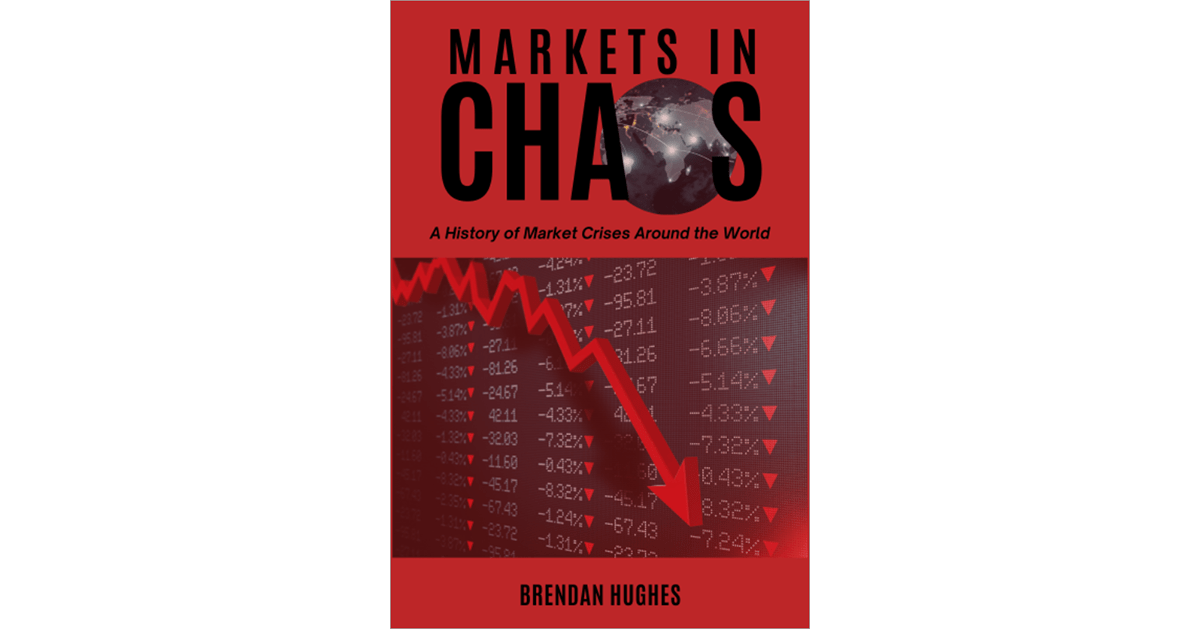

Markets in Chaos: A History of Market Crises around the World. 2024. Brendan Hughes, CFA. Business Expert Press.
Should history teach or merely inform? This question lies at the heart of Markets in Chaos, a broad yet succinct historical overview of macroeconomic crises around the world and across time. No mere exposition of financial market ructions in such places as Weimar Germany or Japan in the 1990s, this volume studies the mechanics of market disruptions in depth with a view toward educating the reader and investor. The writing is clear, and the case studies are well researched. The author’s discussion and analyses are not only instructive but also relevant. Many of the events reviewed will be familiar to finance and investment professionals. Nonetheless, this volume should be a part of any (aspiring) practitioner’s library, if for no other reason than to provide invaluable perspective on the context in which financial decisions are made and guidance on how best to navigate macroeconomic dislocations in the service of clients. Additionally, the case studies could supplement the CFA Program curriculum on the topics of macroeconomics and risk management.
Financial market regulators, economists, policymakers, portfolio managers, and risk officers will find this book a timely and welcome refresher. As the author, Brendan Hughes, CFA, makes clear throughout, some decision makers will need to pay more heed than others.
Market history, for want of a less hackneyed turn of phrase, often does rhyme, if not repeat, as the events analyzed between these pages make clear. Common themes arise time and again. Central banks print money, economies are financialized, fiat currencies hamper productivity growth, and government corruption places fragile economies in a doom loop. Cheap money leads to financial excess. Does no one learn?
Throughout the narrative, Hughes draws frequent parallels between macroeconomic events, comparing and contrasting policy decisions and market outcomes, emphasizing the missteps and the lessons learned. Some governments learn from their mistakes; others, not so much. Chile’s experience in the 1980s stemmed from a dearth of oversight and a surfeit of credit creation. The government’s lack of adequate foreign exchange reserves and overreliance on copper extraction for export revenue led the economy into recession once the commodity boom subsided. Similar circumstances were present in Iceland prior to the global financial crisis (GFC) and Indonesia in the late 1990s during the Asian financial crisis. Market shocks lay bare undiversified economies’ problems. Whereas Chile subsequently demonstrated fiscal probity and supported free trade, proper oversight, and more prudent bank lending policies that made its economy relatively stable in a region whose other economies are not, Iceland and Indonesia continue more or less on a path of economic fragility and volatility.
The frequent cross-references in the book tie the narrative together and help reinforce critical concepts. While the chapters may be read in isolation, the discussion and analysis make for a smooth progression between them. Separated by time and region, the macroeconomic dislocations of the economies and markets that form the events in this volume share experiences and teachable moments. To paraphrase George Orwell, all markets and economies are alike — some more so than others.
Hughes’s approach to the subject matter is instructive and well organized, allowing for ease of reference and understanding of how concepts interrelate. With the exception of the chapters that explore market dislocations in the farther reaches of history (18th century France, 19th century America and Europe, and Ancient Rome), where a lack of data from the time periods in question would preclude an assessment of how companies were affected, each chapter provides a background and market impact, the impact on businesses, and a review of how the disruptions affected the macroeconomy. The closing chapter offers useful, if familiar, guidance on how to apply financial history to everyday investment decisions: Stay invested, but prudently; diversify across both asset classes and countries, avoid market timing, do not invest in businesses that require leverage to achieve good returns, do invest in those that require little capital to operate and have pricing power. Thousands of years of history can improve investors’ understanding of possible outcomes and better inform their investment decisions.

Hughes does not merely examine the historical record but weighs in on the implications of recurring themes at both a macroeconomic level and a microeconomic level. In his estimation, the US Federal Reserve has strayed from its mandate, for years creating cheap money that stokes inflation and provides fodder for speculation and inflated property markets. Fractional reserve banking only compounds the problem. A return to the gold standard in some measure — the author undertakes an informative and critical examination of its history — along with a link between money supply and GDP growth and full-reserve banking, which would better align the goals of central banks and private commercial banks, would alleviate the risks attached to fiat currencies and create conditions propitious for a more stable economy less prone to inflation.
European monetary union, itself due in part to the eventuality of the United States’ abandonment of the price link to gold more than two decades earlier, presents a problem of mismatch between a shared currency and member countries’ economic and political circumstances. The disparate experiences of the Greek and German economies in the 2010s are telling. The euro’s longer-term prospects would appear questionable.
Hughes puts the current state of financial services under the microscope. Banking has its rewards and risks, the latter giving rise in very recent history to new financial technologies that offer financial services with banking features — think Venmo, SoFi, and Credit Karma — but which lack proper surveillance. Regtech is still catching up to financial innovation. The jury is still out on the hidden risks that the emergence of shadow banking has created. Designed as an alternative to the risks of centralized finance, cryptocurrencies labor under flaws similar to those of commercial banks, as the fate of many cryptocurrency exchanges attests. Stablecoins look to be anything but stable. If we have learned nothing else, it is that the future is uncertain. COVID-19 revealed the flaws of the financial edifice created at Bretton Woods. Negligible interest rates have created inflation. The Fed failed to turn down, if not off, the monetary spigot well after the US economy recovered from the macroeconomic effects of the coronavirus. The combination of demand-pull and cost-push varieties of inflation, concepts that the author explores several times, is only exacerbating an overheated global economy, along with the onset of war in Ukraine that has inflated oil and commodity prices. The current and unusual state of a tight labor market with wage inflation exemplifies how we are in somewhat uncharted territory. The standard policy maneuver of raising interest rates when applied to a ballooning federal deficit would increase debt service costs exponentially. This and the price of federal entitlements could well result in dollar debasement and imperil the US dollar’s reserve currency status. Sanctions on Russia’s economy and the United States’ fractious state of relations with other state actors could lead certain economies to seek alternative reserve currency options, potentially further lessening the dollar’s stature.

Hughes’s outlook for the US economy and markets is decidedly downbeat. The menu of policy options for a United States with extreme fiscal bloat, low GDP growth, and a declining birth rate are unpalatable. Growing out of a massive deficit will not happen. Tax hikes may well occur but will impede growth. Expenditure reductions are politically unpopular. Printing money will only exacerbate the current state of affairs. The current world order may be ceding to a new one. As the author makes clear, past is not prologue.
If you liked this post, don’t forget to subscribe to Enterprising Investor and the CFA Institute Research and Policy Center.
All posts are the opinion of the author. As such, they should not be construed as investment advice, nor do the opinions expressed necessarily reflect the views of CFA Institute or the author’s employer.
Professional Learning for CFA Institute Members
CFA Institute members are empowered to self-determine and self-report professional learning (PL) credits earned, including content on Enterprising Investor. Members can record credits easily using their online PL tracker.