
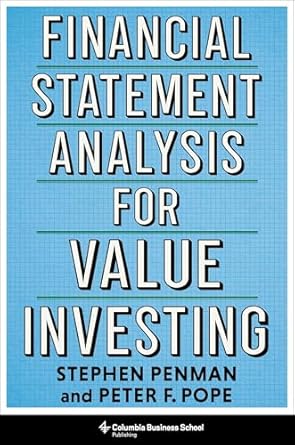

Financial Statement Analysis for Value Investing. 2025. Stephen Penman and Peter Pope. Columbia University Press.
The discipline of value investing has had a tough time of late. The relentless ascent of passive investment strategies, the prolonged outperformance of growth stocks since the Global Financial Crisis, and the soaring overall valuations in developed markets (where time-tested valuation principles no longer seem to apply), to name but a few, have all contributed to its struggles. As a result, the heirs of the Graham and Dodd tradition are numbered these days and relegated to deep-value strategies in emerging markets or Japan. Is this merely a temporary aberration, or does the tradition need some refinements to remain relevant in today’s financial landscape?
Against this backdrop, Stephen Penman, the George O. May Professor Emeritus at Columbia Business School, and Peter Pope, Professor Emeritus of Accounting at the London School of Economics, have published a 432-page tome entitled Financial Statement Analysis for Value Investing, a work firmly rooted in the Graham and Dodd value investing tradition. The book also expands on the framework developed by Penman in his 2011 work, Accounting for Value.
In both books, readers will encounter classic value investing concepts, such as negotiating with Mr. Market or the importance of a margin of safety, and some insights from modern portfolio theory, such as the neutrality of dividends or a company’s capital structure in creating value for shareholders. Practitioners will find this surprising and eclectic combination of ideas refreshing and enlightening. As the authors succinctly state in the introduction:
You will find the book contrasts with many investment books. The ubiquitous beta is not of highest priority by far. The common discounted cash flow (DCF) is put aside. Indeed, the book is skeptical about valuation models in general. Perhaps surprisingly, the book takes the position that it is best to think that “intrinsic value” does not exist. For a value investor that sounds like heresy, but intrinsic value is just too hard to pin down. That requires an alternative approach to be put on the table, one that challenges the market price with confidence. Some investors see the alternative as trading on multiples, smart beta investing, factor investing, and more. The book brings a critique to these schemes.
So, what do the authors propose? The cornerstone of the book is the residual income model. First formalized in the 1980s[1] and 1990s[2], much later than other valuation frameworks such as the dividend discount model, the residual income model was popularized in the 1990s by the consulting firm Stern Stewart and briefly adopted by the management teams of several large U.S. corporations to gauge whether their investment decisions were creating value for their shareholders. However, despite numerous academic papers on the model, its adoption by practitioners has remained limited, lagging behind more widely used approaches such as valuation multiples and the free cash flow model.
As a quick refresher, the residual earnings model instructs us to think about valuation through the lens of the future residual (or economic) earnings that a business is expected to generate. Residual earnings are simply accounting earnings after taking into account a cost of capital charge. These future residual earnings must then be discounted back to the present and added to the company’s current book value to arrive at a valuation for the equity. Notably, if a company’s return on equity matches its cost of capital, it will generate accounting earnings but no residual earnings, meaning that its shares should trade at book value. The elegance of the model lies in the seamless integration of business fundamentals with accounting figures, which in turn produce a valuation for the investor.
Although the three valuation frameworks (dividends, free cash flows, and residual income) are mathematically equivalent, the residual income stands out for its ability to capture the true sources of value creation for shareholders. Companies that do not pay dividends or reinvest in profitable growth opportunities would be hard to value using the dividend discount or the free cash flow model, respectivel, but they do not obstruct the residual income framework.
The reason this model captures value creation more accurately (and earlier) is rooted in the accruals that govern current accounting systems. While so-called “cash accounting” is often favored by practitioners over accrual accounting on the oft-touted premise that cash is closer to “hard and cold facts” whereas unscrupulous management teams can easily manipulate accruals, Penman and Pope show that this conventional wisdom is simply misguided. First, cash flows themselves can also be manipulated by management teams.
Second, there are a plethora of transactions that do not involve cash flows yet still shift value between stakeholders, with stock compensation being probably the most prominent example. But most importantly, earnings are usually recognized earlier than cash flows under the “realization principle.” For instance, sales on credit are recognized before the company gets the cash, capital investments are depreciated over time (increasing earnings at the onset of the investment), and pension obligations are accounted for immediately, even though cash will not flow out of the company to pay the promises until decades later. The important implication for investors valuing stocks in the real world, where the future is uncertain, is that “[w]ith this earlier recognition of value added, there is less weight on a terminal value in a valuation.”
In summary, an accounting system based on accruals and the realization principle inherently reflects sound thinking about how firms create value for investors, as well as some guidelines for understanding risk and return. Value is capitalized on the balance sheet only when the certainty of the investment is high, and subsequent earnings are added to book value only when they are realized. From this standpoint, alternative forms of “carrying” the accounting book, such as fair value accounting, fail to uphold these principles. Throughout the book, Penman and Pope criticize fair value accounting for encouraging speculative behavior by placing uncertain values on the balance sheet, which ultimately contributes to investor speculation — as was exemplified during the dotcom bubble.
The book devotes many chapters to refining the traditional residual income model, which, due to its reliance on equity metrics such as book value, net income, and return on equity, fails to adequately address the issue of financial leverage. The point here is that one might think that adding leverage would mechanistically create value for shareholders since higher leverage would boost residual earnings by increasing the return on equity.
As Penman and Pope explain, however, this line of reasoning is flawed, as the increase in leverage will increase the risk of the investment and, thus, the discount rates, leaving the valuation unaffected. To resolve this, the authors introduce the residual operating income model, which uses enterprise value metrics, e.g., net operating assets instead of shareholders’ equity, net operating income instead of net income, and so forth. In doing so, this model redirects the investor’s attention to the true source of value creation in any company: the operations of the business.
Finally, the book leaves some space for the “growth versus value” debate, a topic Penman himself explored in a 2018 Financial Analysts Journal paper[3], as well as the relationship between firm size and equity returns. Readers will find that a coherent accounting framework and its implications for how valuation multiples work go a long way to understanding the issues at stake here. Penman and Pope argue that simplistic and often misleading labels such as “growth” or “value” fall short in advancing the conversation and cannot replace a thorough understanding of accounting principles.
In conclusion, practitioners will find Penman and Pope’s book not only highly relevant but also brimming with invaluable insights. What sets this work apart from countless other “investing” manuals is its ambitious aim: to offer a series of disconnected anecdotes and a cohesive and alternative framework for challenging market prices. The authors skillfully intertwine theoretical depth with abundant real-world examples, reinforcing the reader’s hard-earned intuitions. I have no doubt that this book will become an enduring classic in the Graham–Dodd tradition and perhaps the Holy Grail for future generations of intelligent investors.
[1] See, for instance, K. Peasnell, “Some Formal Connections Between Economic Values and Yields and Accounting Numbers,” Journal of Business Finance and Accounting 9, no. 3 (1982): 361–381.
[2] J. Ohlson, “Earnings, Book Values, and Dividends in Equity Valuation,” Contemporary Accounting Research 11, no. 2 (1995): 661–687.
[3] S. Penman and F. Reggiani, “Fundamentals of Value versus Growth Investing and an Explanation for the Value Trap,” Financial Analysts Journal 74, no. 4 (2018): 103-119.