


Bitcoin’s core software lowered the default minimum relay fee for transactions, marking one of the most significant changes in years for economically moving funds across the network.
Bitcoin Core 29.1, released on Sept. 4, sets the default minimum relay fee rate to 100 satoshis per thousand virtual bytes (0.1 sats/vB), a 90% reduction from the previous default rate of 1 sat/vB. Users pay their fees in satoshis (the smallest unit of Bitcoin) multiplied by the size of their transaction.
While every individual node operator can change this setting, most are expected to stick with the default value. Nodes do not relay and mostly ignore transactions with fees lower than the value they set for the minimum relay fee rate.
The decision to make the change was made by Bitcoin Core developers on Aug. 15 “in response to bitcoin’s exchange rate changes in the last ~10 years.” The proposal stated that the minimum fee is a denial-of-service (DoS) attack protection rule, but suggested that, with prices now significantly higher, a lower fee in Bitcoin (BTC) is acceptable.
Adoption expected to roll out slowly
According to BitRef data, over 72.5% of all Bitcoin nodes (18,811) run the Bitcoin Core node software, and the remaining almost 27.25% run Bitcoin Knots, a fork of the Bitcoin Core software focused on ensuring more user control. A deeper analysis found that the most popular node software is Bitcoin Core 29, with 4,510 nodes representing over 18% of the network.
Related: Ordinals dev floats forking Bitcoin Core amid censorship concerns
This is followed by 3,991 Bitcoin Core 28.1 nodes (nearly 16%) and 3,083 Bitcoin Knots 29.1 nodes (12.31%). Only 571 nodes run Bitcoin Core 29.1, representing less than 2.3% of the network.
While Bitcoin Knots 29.1 is based on Bitcoin Core 29.1, it does not inherit its new defaults. Instead, with this update, Knots decided to “make most policy options configurable in GUI Options, and add ‘corepolicy’ option to use Bitcoin Core defaults.”
A majority of the 571 Bitcoin nodes running Bitcoin Core 29.1 and a hard-to-predict portion of the 3,083 Bitcoin Knots 29.1 nodes are likely running the newer, lower minimum relay fee policy.
Related: Bitcoin Knots gain ground: Will a chain split kill BTC price?
Community reacts to lower fees
A Bitcoin Core developer, Gloria Zhao, said the change is also motivated by a recent trend in which transactions cheaper than the previous limit are mined either way. This is because, while the default value was set one way, node operators were allowed to run the value that they prefer.
This caused issues, since “blocks with lots of sub-1sat/vB transactions don’t propagate as quickly to nodes that rejected or didn’t hear about those transactions earlier.” Still, to keep the network protected against spam and DoS attacks, Zhao highlighted the need to avoid making the default value too cheap, but still lower to prevent the described block relay issues.
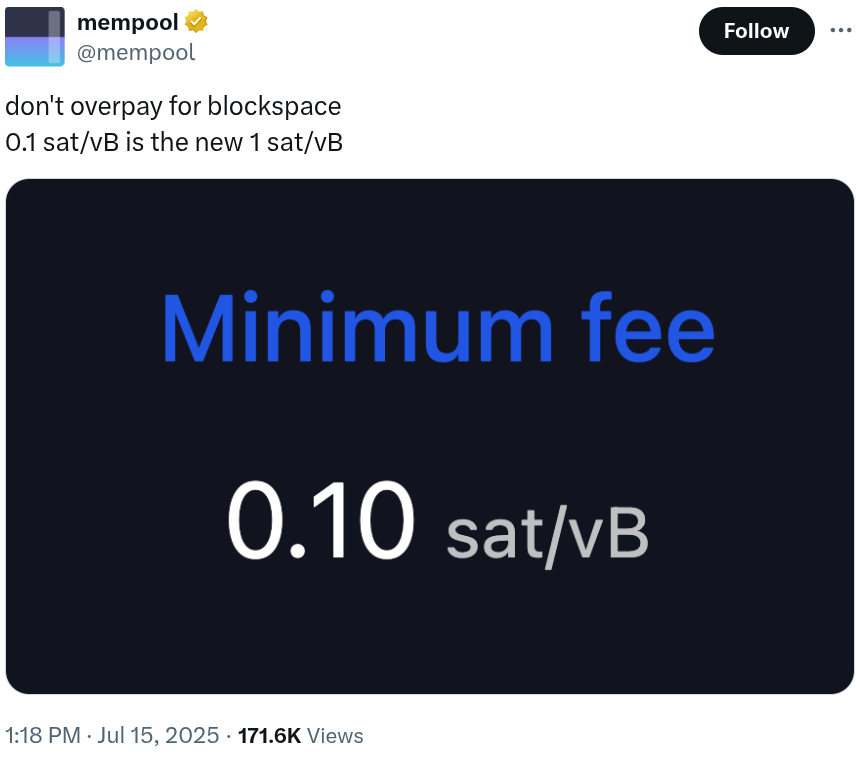
Bitcoin network data service Mempool.Space also advocated for lower fees, advising users not to overpay for the space that they use on the blockchain. “0.1 sat/vB is the new one sat/vB,” it wrote in a mid-July X post.
Magazine: Bitcoin’s long-term security budget problem: Impending crisis or FUD?