
Business Insights
  • Home
  • Crypto
  • Finance Expert
  • Business
  • Invest News
  • Investing
  • Trading
  • Forex
  • Videos
  • Economy
  • Tech
  • Contact

Archives

  • March 2026
  • February 2026
  • January 2026
  • December 2025
  • November 2025
  • October 2025
  • September 2025
  • August 2025
  • July 2025
  • June 2025
  • May 2025
  • April 2025
  • March 2025
  • February 2025
  • January 2025
  • December 2024
  • November 2024
  • October 2024
  • September 2024
  • August 2024
  • July 2024
  • June 2024
  • May 2024
  • April 2024
  • March 2024
  • February 2024
  • August 2023
  • January 2023
  • December 2021
  • July 2021
  • November 2019
  • October 2019
  • September 2019
  • August 2019
  • July 2019
  • June 2019
  • May 2019
  • April 2019
  • March 2019
  • February 2019
  • January 2019

Categories

  • Business
  • Crypto
  • Economy
  • Finance Expert
  • Forex
  • Invest News
  • Investing
  • Tech
  • Trading
  • Uncategorized
  • Videos
Apply Loan
Money Visa
Advertise Us
Money Visa
  • Home
  • Crypto
  • Finance Expert
  • Business
  • Invest News
  • Investing
  • Trading
  • Forex
  • Videos
  • Economy
  • Tech
  • Contact
Are stablecoins money?
  • Finance Expert

Are stablecoins money?

  • June 26, 2025
  • Roubens Andy King
Total
0
Shares
0
0
0
Total
0
Shares
Share 0
Tweet 0
Pin it 0

Unlock the Editor’s Digest for free

Roula Khalaf, Editor of the FT, selects her favourite stories in this weekly newsletter.

Money is clever, weird stuff. While entirely abstract, it also reifies our social power structure. It’s a form of memory, a way to organise strangers, and a utilitarian means by which the value to society of incommensurable things is plutocratically triangulated. More than that, it’s the stuff we use to pay the window cleaner.

Being a social substance, money is constantly evolving — from giant stone discs, to digital payments. Are stablecoins the next phase? According to the BIS, no. 

Or rather, NO! 🤬🤬🤬

Martin Arnold, in MainFT:

Top central bankers have delivered a scathing assessment of stablecoins, saying they “perform badly” on key requirements for being widely used as money, disavowing US President Donald Trump’s push to make them a pillar of mainstream finance.

The deep and detailed reasons for the BIS’s crossness were expertly picked over by Chris Giles, the most important of which being that:

Instead of owning dollars, perhaps intermediated by a commercial bank, you own tether or USDC coins, which generally need to be converted to US dollars if you want to spend them.

In other words the BIS thinks stablecoins fail the test of singleness. If you’re a crypto bro living in your mom’s basement, failing the test of singleness may be the dream. Among central bankers, it’s the stuff of nightmares.

To qualify as money, money-like-stuff must be accepted by all without hesitation. As long as stablecoins have an exchange rate, this just isn’t going to happen.

Furthermore, the BIS thinks we should all care, and very much. For without common knowledge as to money’s value: 

the monetary system becomes unmoored…

Not great. 

Hyperbolic as it may sound, the idea that large societal costs are incurred when the singleness of money breaks down is not without merit. The go-to example that central bankers, economic historians, and columnists love to use is the American Free Banking Era.

For the non-history nerds we thought we’d take a quick look to see how strong the parallels actually are.

The President’s precedents

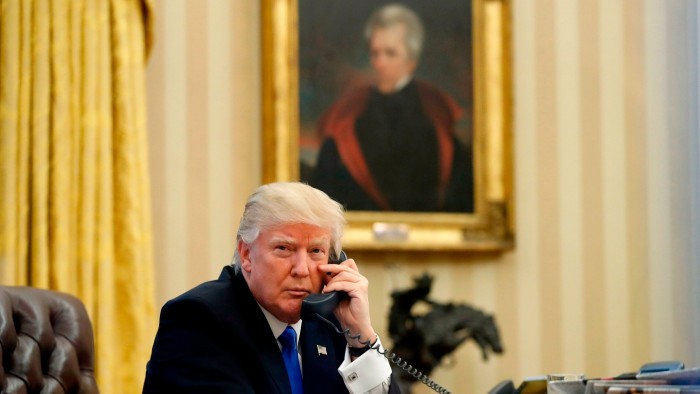
Trump has no love for Jay Powell. But he has yet to match the level of antipathy demonstrated by his second-favourite former President — Andrew Jackson — towards the Second Bank of the United States, the closest thing 19th century America had to a central bank.

In refusing to renew the bank’s charter and withdrawing all federal funds, Jackson ran the institution into the ground and arguably kicked off both the Panic of 1837 and the major economic depression which followed it.

In doing so he also ushered in the so-called Free Banking Era. 🥳

Between 1837 and 1864 pretty much anyone could rock up and declare themselves a bank in those states with free banking laws. Free banks issued their own banknotes, each proclaiming to be worth par. But free banking didn’t mean no rules. As the Philadelphia Fed explains:

The free-banking laws specified that a state banking authority determined the general operating rules and minimum capital requirement … An important rule that states imposed on free banks was the requirement to post collateral in the form of government bonds to back their banknotes.

Furthermore:

Only state and federal government bonds were eligible to be posted as collateral. A typical requirement was for the free bank to deposit with the state banking authority one dollar’s worth of eligible bonds for each dollar’s worth of banknotes. 

State-level oversight and fully collateralised banknotes.

Hmm.

On June 17 the Senate passed The Genius Act. There are still a couple of hurdles to clear before it becomes law, but its main thrust is that states will be able to regulate stablecoins, and issuers will be required to maintain identifiable reserves on at least a one-to-one basis.

The Genius Act requires collateral in the form of things that either are US T-bills, or look a lot like T-bills. Collateral specifications under free banking laws were somewhat looser. And so despite declaring their notes as being worth par, discounts to par of 10 or 20 per cent were not uncommon for 19th century banknotes that traded on secondary exchanges.

Feast your eyes on this chart showing the average, minimum and maximum discounts that Indiana banknotes traded to par value over the period: 

Some content could not load. Check your internet connection or browser settings.

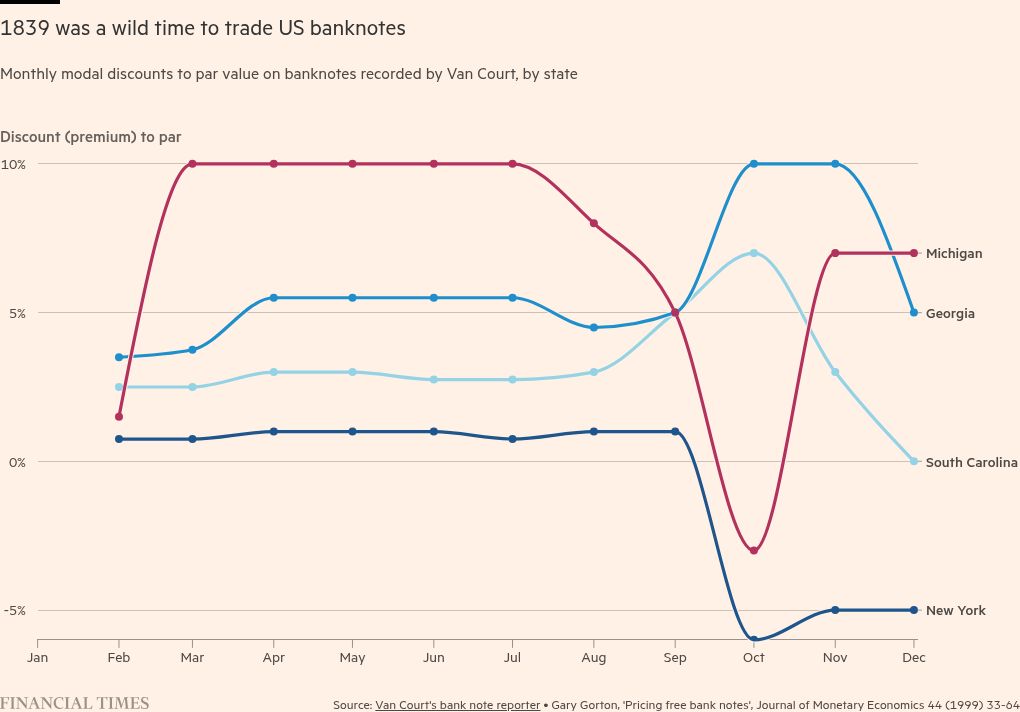
Furthermore, the market value of banknotes fluctuated pretty wildly over shorter-run periods. Here’s a monthly graph of the modal discount to par for banknotes issued across a handful of free banking states during 1839:
Some content could not load. Check your internet connection or browser settings.

Despite being fully collateralised, holders of banknotes frequently suffered losses in the event of bank failures. The period was filled with bank failures.

Free banking came to an end only with the Civil War and the passage of the National Banking Acts of 1863 and 1864 — which unified the currency, helped finance the war, and taxed state bank notes out of existence. Incidence of bank failures plummeted.

So while the parallels look enticing — and we’re old enough to remember the spectacular implosion of Terra’s stablecoin as many as three whole years ago — it would be surprising if post-Genius Act US-regulated stablecoin prices were to rival the feral price action of early 19th century American banknotes.

If not money, what?

We can understand the BIS’s sniffiness. They’re right that stablecoins aren’t money. And we can see why they might be alarmed by their spread.

But we can’t see them going away any time soon. Stablecoins are financial assets with plenty of use cases. As Dan Davies has written — they might usefully shake up the cosy oligopoly responsible for anomalously high card fees that plague ordinary Americans. Furthermore, they’re pretty much essential for those who want to get an on-ramp to the crypto realm. And we can think of no better way to dodge Trump’s planned remittance tax, evade sanctions, or channel criminal funds.

And that’s a big market.

Total
0
Shares
Share 0
Tweet 0
Pin it 0
Roubens Andy King

Previous Article
Contributor: No one can grasp trillions. Here’s how to make sense of federal spending and debt
  • Business

Contributor: No one can grasp trillions. Here’s how to make sense of federal spending and debt

  • June 26, 2025
  • Roubens Andy King
Read More
Next Article
Windows is finally kicking the Blue Screen of Death to the curb
  • Tech

Windows is finally kicking the Blue Screen of Death to the curb

  • June 26, 2025
  • Roubens Andy King
Read More
You May Also Like
CoreWeave’s stock slides as insider selling sparks investor concerns
Read More
  • Finance Expert

CoreWeave’s stock slides as insider selling sparks investor concerns

  • Roubens Andy King
  • September 2, 2025
Is CAT Outperforming the Industrial Sector?
Read More
  • Finance Expert

Is CAT Outperforming the Industrial Sector?

  • Roubens Andy King
  • September 2, 2025
Crude oil climbs on Russian supply risks; Russia and China agree on huge new gas pipeline
Read More
  • Finance Expert

Crude oil climbs on Russian supply risks; Russia and China agree on huge new gas pipeline

  • Roubens Andy King
  • September 2, 2025
Nestlé fired its scandal-clad CEO without a payout—a ‘really unusual’ move, expert says
Read More
  • Finance Expert

Nestlé fired its scandal-clad CEO without a payout—a ‘really unusual’ move, expert says

  • Roubens Andy King
  • September 2, 2025
‘Her kids will have no inheritance’: Will my friend lose her house to Medicaid if she goes into a nursing home?
Read More
  • Finance Expert

‘Her kids will have no inheritance’: Will my friend lose her house to Medicaid if she goes into a nursing home?

  • Roubens Andy King
  • September 2, 2025
Analyst Report: Caterpillar Inc.
Read More
  • Finance Expert

Analyst Report: Caterpillar Inc.

  • Roubens Andy King
  • September 2, 2025
AbbVie’s Elahere gains approval in Canada for ovarian cancer
Read More
  • Finance Expert

AbbVie’s Elahere gains approval in Canada for ovarian cancer

  • Roubens Andy King
  • September 2, 2025
Microsoft CEO Satya Nadella reveals 5 AI prompts that can ‘supercharge your everyday workflow’
Read More
  • Finance Expert

Microsoft CEO Satya Nadella reveals 5 AI prompts that can ‘supercharge your everyday workflow’

  • Roubens Andy King
  • September 2, 2025

Recent Posts

  • How AI Reacts to Unethical Business Ideas
  • jio finance अधिग्रहण अपडेट! jio financial services latest news, jiofin share latest news
  • Labrinth Breaks Silence With Cryptic Euphoria Post: “I’m Done With This Industry”
  • Silver ETF की ताकत अब देख लो | Silver ETF Investment | ETF Me Invest Kaise kare | ETF Investing
  • Federal Reserve Board – Federal Reserve Board issues enforcement actions with former employee of Equity Bank and former employee of First State Bank of Dongola
Featured Posts
  • How AI Reacts to Unethical Business Ideas 1
    How AI Reacts to Unethical Business Ideas
    • March 15, 2026
  • jio finance अधिग्रहण अपडेट!  jio financial services latest news,  jiofin share latest news 2
    jio finance अधिग्रहण अपडेट! jio financial services latest news, jiofin share latest news
    • March 14, 2026
  • Labrinth Breaks Silence With Cryptic Euphoria Post: “I’m Done With This Industry” 3
    Labrinth Breaks Silence With Cryptic Euphoria Post: “I’m Done With This Industry”
    • March 14, 2026
  • Silver ETF की ताकत अब देख लो | Silver ETF Investment | ETF Me Invest Kaise kare | ETF Investing 4
    Silver ETF की ताकत अब देख लो | Silver ETF Investment | ETF Me Invest Kaise kare | ETF Investing
    • March 13, 2026
  • Federal Reserve Board – Federal Reserve Board issues enforcement actions with former employee of Equity Bank and former employee of First State Bank of Dongola 5
    Federal Reserve Board – Federal Reserve Board issues enforcement actions with former employee of Equity Bank and former employee of First State Bank of Dongola
    • March 13, 2026
Recent Posts
  • Sirf 1 Ghante ka bajar #business #vegitablemarket #minivlog #chanduthevillager
    Sirf 1 Ghante ka bajar #business #vegitablemarket #minivlog #chanduthevillager
    • March 12, 2026
  • Federal Reserve Board – Federal Reserve Board announces approval of application by Home BancShares
    Federal Reserve Board – Federal Reserve Board announces approval of application by Home BancShares
    • March 12, 2026
  • 10 Terrifying Sci-Fi Short Films You Can’t Miss
    10 Terrifying Sci-Fi Short Films You Can’t Miss
    • March 12, 2026
Categories
  • Business (2,057)
  • Crypto (2,023)
  • Economy (231)
  • Finance Expert (1,687)
  • Forex (2,016)
  • Invest News (2,446)
  • Investing (2,040)
  • Tech (2,056)
  • Trading (2,024)
  • Uncategorized (2)
  • Videos (1,001)

Subscribe

Subscribe now to our newsletter

Money Visa
  • Privacy Policy
  • DMCA
  • Terms of Use
Money & Invest Advices

Input your search keywords and press Enter.