
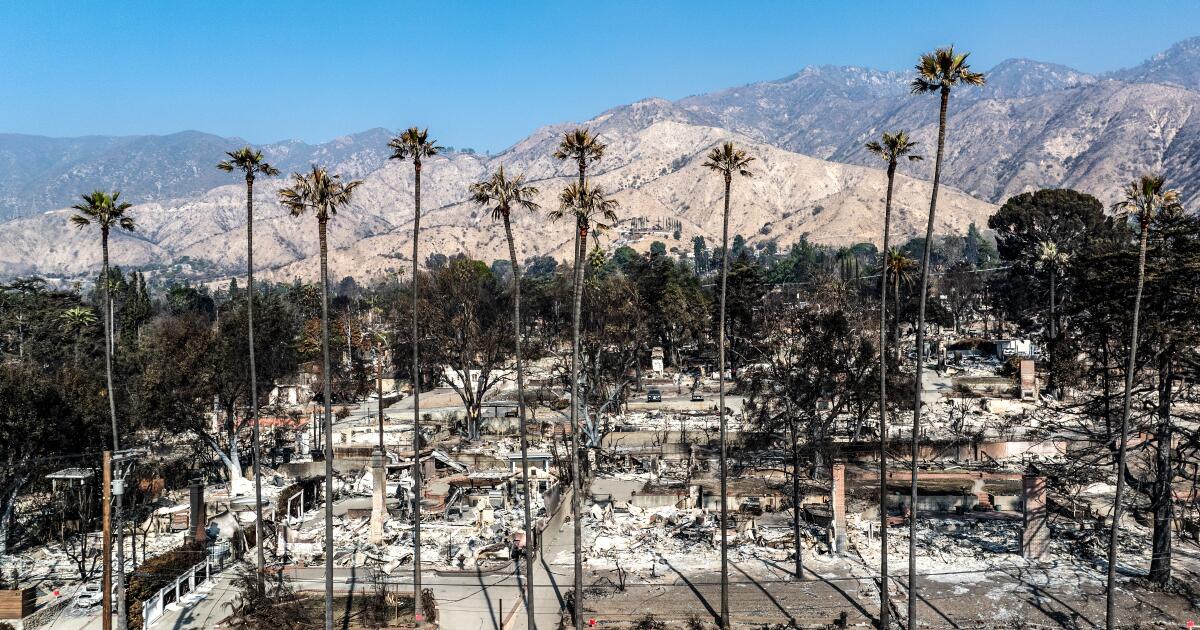

The firestorms that swept through Pacific Palisades, Altadena and other communities Jan. 7 not only devastated thousands of homeowners but highlighted a giant problem: the growth of the state’s insurer of last resort. The California FAIR Plan Assn. offers policies that cover less, but typically are expensive.
Now, California home insurers are facing twin lawsuits filed by homeowners who accuse them of colluding over the last several years to force them into the plan in order to profit from the higher premiums while reducing their liabilities in the event of a catastrophe — just what the lawsuits allege happened after the fires. The result, according to one suit, is the insurers “collectively reaped a windfall worth billions of dollars.”
The Times spoke to both sides, as well as multiple experts to better understand the high-stakes litigation, which faces obstacles but could shake up California’s home insurance industry.
Who is being sued and exactly what do the lawsuits allege?
The Los Angeles County Superior Court suits filed last month name more than 200 insurers and affiliates as defendants, including State Farm, Farmers and Mercury that account for about three quarters of the state’s property and casualty insurance sales. The lawsuits accuse them of unfair competition and violations of the Cartwright Act, a state law that prohibits agreements to restrain trade, fix prices or reduce competition.
The homeowners assert the insurers engaged in a “group boycott” to terminate policies in Pacific Palisades, Malibu, Altadena and other fire-prone neighborhoods in early 2023 and then refused to write new policies. That left the homeowners with no choice but to join the FAIR Plan, where they paid more but the policies are limited, including through a $3-million coverage cap on dwellings.
How would the insurers benefit from such a scheme?
The FAIR Plan was established by the Legislature in 1968 but is operated by the state’s licensed home insurers that share in its profits and losses. By moving homeowners onto the plan, the insurers would profit from higher premiums, while being exposed to fewer losses due to its limited policies. The result was an effective rate increase without the insurers having to undergo a state review, the lawsuits allege.
Why are there two lawsuits?
One lawsuit is a proposed class action and seeks to have policyholders compensated for the alleged higher premiums they paid. The other seeks to compensate homeowners who experienced losses during the fires and then suffered further due to their alleged inadequate FAIR Plan coverage. Each lawsuit seeks treble damages.
What do the lawsuits cite as evidence of collusion?
The litigation claims that the collusion and boycott were carried out through meetings of the FAIR Plan’s governing committee and subcommittees, as well as weekly meetings of the Personal Insurance Federation of California and the American Property Casualty Insurance Assn., or APCIA, two leading trade groups, among other mechanisms. However, the lawsuits do not offer any written documentation from these meetings.
The lawsuits also note that last year, insurers won the right from Insurance Commissioner Ricardo Lara to surcharge their own residential and commercial policyholders if the FAIR Plan runs out of money — which it has since the fires. One of the lawsuits cites the new policy as evidence of the insurers’ “determination to act collusively.”
APCIA issued a statement saying that it has a legal right to voice industry concerns to the government and that it “complies with all applicable antitrust laws.”
So how can the allegations be proved in court?
Stephen Larson, a former federal judge whose firm Larson is one of the two representing the plaintiffs, said that the discovery process will be key.
“We did a tremendous amount of due diligence prior to bringing this lawsuit, and we anticipate there will be requests for documents, there will be interrogatories [written questions answered under oath] and there will be depositions. We’re going to be have the opportunity to depose those that we believe are responsible for this.”
What do insurers say about all this?
Rex Frazier, president of the Personal Insurance Federation, said there was nothing collusive about insurers’ behavior. Instead, it was a logical consequence of being unable to get adequate rate increases as costs and wildfire danger have increased.
“What business, whether the insurance industry or any other business, can survive a highly inflationary cost structure without the ability to raise its prices? We’ve been predicting why the FAIR Plan will grow — we’re not allowed to have meetings we’ve held for 30 years?” he said.
Will it be difficult to prove collusion?
Yes, it will be a tall order, legal experts say. Donald Pepperman, a partner at Waymaker in Los Angeles who specializes in antitrust litigation, said a key defense probably will be that the insurers acted in their own economic self interest in dropping policyholders.
“Why should they be forced to stay in a market that’s not profitable when there are other markets in California where there’s less disasters?” he asked, adding that without more evidence of collusion the lawsuit may not get far — and finding that will be difficult.
“I don’t know that they’re going to be that unsophisticated, that in the FAIR Plan minutes of a meeting they’re going to admit they conspired to pull out of markets or fixed prices.”
Tom Baker, a professor who specializes in insurance at the University of Pennsylvania’s Penn Carey Law school, said the plaintiffs will need to show that they somehow acted in a more “extreme” manner than was supported by their actuarial data, which he agreed will be challenging — though he said the discovery process is a powerful tool.
“The bright side of this lawsuit is that we’re gonna get some information, but count me skeptical about whether they’re gonna succeed, unless they can find some kind of smoking guns.”
Are there less nefarious reasons for insurers pulling back from the California market?
Yes, there are alternative explanations. James Naughton, a former actuary and a professor at the University of Virginia’s Darden School of Business, said that advances in data management have allowed insurers to collect more data than ever about the risks they face, with much of it the same across insurers.
“What could appear to be collusion could also be companies just using the same data. If I’m an actuary at one company, it’s not hard to be an actuary at another company. The information moves,” he said. Naughton added that there also can be “soft collusion,” a concept that refers to actors in a market trading information or having an understanding of their competitors’ strategies, leading to similar decision-making.
What do the plaintiff’s attorneys say about all of this?
“Do we expect to find a document from party A to party B, saying today we’re going to have a meeting to discuss how we’re going to collude with each other on avoiding risk and going to FAIR Plan agenda item? No, I don’t expect we’re going to find that,” said Michael Bidart, with Shernoff Bidart Echeverria, the other plaintiffs’ firm. “Rare is the case in any litigation where you have a document that provides the ultimate direct evidence.”
Instead, the attorneys said they will rely on accumulated evidence to show how the insurers allegedly conspired to drop policyholders in order to move them to the FAIR Plan for their own benefit.
“So anything else we get on top of it is just icing on the cake,” Bidart said.