


Tariffs have reclaimed the economic spotlight. But with their timing and magnitude uncertain, investors are on edge. A fascinating history of tariffs and their effects on investment returns is provided by Baltussen et al in a recent Enterprising Investor blog. This blog takes a complementary approach to exploring their possible implications for returns.
Tariffs change relative prices. Just as large changes in oil prices pushes up energy costs compared to other goods, tariffs make imports relatively more expensive. In economics’ parlance, tariffs are “supply shocks.” And because price adjustment is costly to firms in the short run, import prices rise in response to large tariffs while other prices don’t immediately change despite possibly softening demand (see Romer 2019 for the modern macro explanation of “nominal rigidities”). This causes the average price level to rise. That is, tariffs cause the headline (all items) inflation rate to go up.
This post offers a framework for thinking about the effect of tariffs on major asset class returns by estimating asset classes’ response to supply shocks. By separating inflation’s “signal,” or trend component (determined by fundamental forces) from its shock-driven “noise” component, we can estimate the past response of major asset classes to the latter. This may suggest lessons about their possible response of asset classes to one-time tariffs.
Quantifying Inflation Shocks Using Core and Median CPI
Economic theory and a little analysis allow us to guess at how asset classes might respond to the inflation-shock effect of tariffs.
As for theory, modern macroeconomics describes inflation using a “Phillips curve” framework, named after the economist who first noted that economic slack and inflation were negatively related (Phillips used unemployment and wages). Phillips curves can be specified in various ways. Generally, they explain inflation with three variables: inflation expectations (consumer, business, or professional forecaster), an output gap (for example, the unemployment rate or the vacancy-to-unemployment ratio), and a shock term.
This blog uses a Phillips curve approach to separate inflation’s signal or trend, driven by inflation expectations and the output gap, from noise or the fleeting factors that come and go.
This sidesteps two issues: that tariff shocks pass through to trend inflation by raising inflation expectations and costs of production as well as other channels. There is in fact already evidence that consumer inflation expectations are rising. Incorporating these effects would make this analysis considerably more complicated, however, and so they are ignored for now.
The Phillips Curve tells us that we can decompose inflation into trend and shock components. Typically, this is done by subtracting the trend in inflation from headline (all items) inflation. This blog instead uses the median consumer price index (CPI) inflation rate as calculated by the Federal Reserve Bank of Cleveland as its proxy for trend inflation because of median CPI’s attractive properties.[1]
And instead of using headline CPI inflation as its starting point, it uses core CPI inflation, which excludes food and energy (XFE CPI). XFE CPI is preferred because the difference between XFE and median CPI yields a measure of shocks purged of large changes in the relative price of food and energy. This measure is referred to as “non-XFE shocks.”
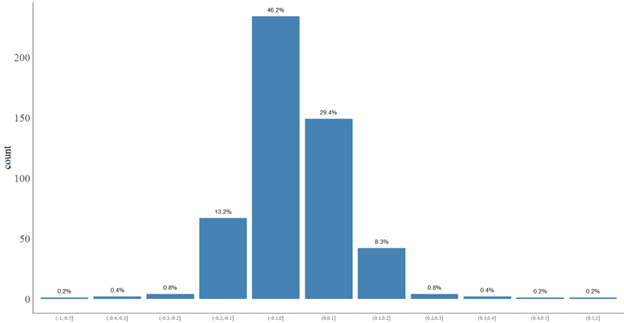
The charts in the panels of Exhibit 1 give a sense of the frequency and size of non-XFE shocks. The scatterplot shows monthly XFE versus median inflation. When they’re equal, points lie on the 45-degree line. Pairs above the 45-degree line are positive non-XFE shocks and vice versa. (The R-code used to produce charts and perform analysis presented in this blog can be found on an R-Pubs page). The histogram shows the distribution of these shocks. Large disturbances are rare.
Exhibit 1. Top panel shows median vs. XFE CPI from 1983 to 2025:3. Bottom panel shows the distribution of the shocks (the distance from the 45-degree line in the top panel); frequencies for each of the 11 “bins” appear on the bars.
Source: FRED
Asset-Class Sensitivity to Inflation Surprises
Having defined non-XFE shocks, we can estimate how major asset classes have responded to them. This may provide a preview of how these asset classes might react to inflation shocks resulting from tariffs.
Relationships are estimated in the customary way: by regressing asset-class returns on non-XFE shocks. The resulting estimated coefficient is the left-hand-side variable’s non-XFE shock “beta.” This approach is conventional, and mirrors that taken in my Enterprising Investor blog Did Real Assets Provide an Inflation Hedge When Investors Needed it Most?
Regressions use monthly percentage changes for non-XFE shocks as the right-hand side variable, monthly returns for the S&P 500 total return (S&P 500) index, Northern Trust Real Asset Allocation total return (real assets) index, Bloomberg Commodities Total Return (BCI) index, Bloomberg TIPS index, and 1–3-month Treasury bill return (T-bills) index as dependent variables. Inflation data comes from FRED and index returns from YCharts. Because sample size varies by asset class regressions are run over the longest available sample period for each asset class, which ends in March 2025 in each case.

One caveat before discussing results. Non-XFE shocks could be due to any large relative price change, except of course changes in food and energy. That is, supply shocks include more than supply-chain shocks.
Unfortunately, there’s no obvious way to isolate the disturbances we’re most interested in using public inflation data. But since we can’t know exactly what form such tariff-induced inflation disturbances will take, an examination of asset class response to non-XFE shocks is a reasonable place to start. With that said, results are shown in Exhibit 2.
Exhibit 2. Regression results.
| Dep. variable | TIPS | BCI | T-bills | S&P 500 | Real assets | |
| Begin date | 1998:5 | 2001:9 | 1997:6 | 1989:10 | 2015:12 | |
| Non-XFE shock “beta” | 0.545 | 4.440* | -0.248*** | 2.628 | 1.365 | |
| 95% CI | (-1.191, 2.280) | (-0.585, 9.465) | (-0.432, -0.064) | (-1.449, 6.704) | (-4.015, 6.745) | |
| Observations | 323 | 283 | 334 | 426 | 112 | |
| R2 | 0.001 | 0.011 | 0.021 | 0.004 | 0.002 | |
| Notes: *p<0.1; **p<0.05; ***p<0.01; standard errors are adjusted as indicated by residual behavior. Sources: FRED, YCharts, Author’s regressions. | ||||||
A positive, significant estimate for the “non_xfe_shock” coefficient suggests that an asset class hedges against non-XFE shocks. A positive-but-not-significant coefficient estimate suggests that it might hedge non-XFE shocks, but that the sample size doesn’t allow us to reject the claim that it doesn’t with confidence. Confidence intervals give a sense for the size of the effect of inflation on returns, and of course for the reliability of estimates.
These findings suggest that commodities (BCI) responded positively to shocks, and T-bills negatively, though the former relationship is estimated less accurately than the latter (i.e., T-bills confidence interval is tighter). Of the remaining asset classes, TIPS, stocks, and real assets enter with the right signs for a shock-hedge (positive) but are too imprecisely estimated to support the claim even weakly. These conclusions are robust to estimation over the common sample period (2015:12– 2025:3).
Bracing for the Tariff-Price Shock
This short exercise suggests that commodities “hedged” shocks to inflation stemming from large relative price changes (other-than food and energy), on average. T-bills did not. (The shock-T-bill relationship could be explained by the fear that a price-level jump may provoke a monetary-policy tightening response and thus higher short-term interest rates.) The reaction of other asset classes considered here — stocks, real assets, and TIPS — is ambiguous.
If the empirical relationships estimated here are stable and if tariffs affect inflation like a non-XFE shock, the approach followed here might help inform directional estimates of how tariffs could affect investment returns.
[1] Outlier-exclusion measures like the median are more efficient measures of the population mean – the trend, in our case – in the presence of “fat tails,” such as those exhibited by the distribution of monthly price changes, than the sample mean. Additionally median and other trimmed-mean inflation measures are both better forecasters of future inflation and are less correlated with future money supply increases (suggesting that they filter out the “supply shocks” that central banks typically react to) than traditional “core” (ex. food and energy) inflation.