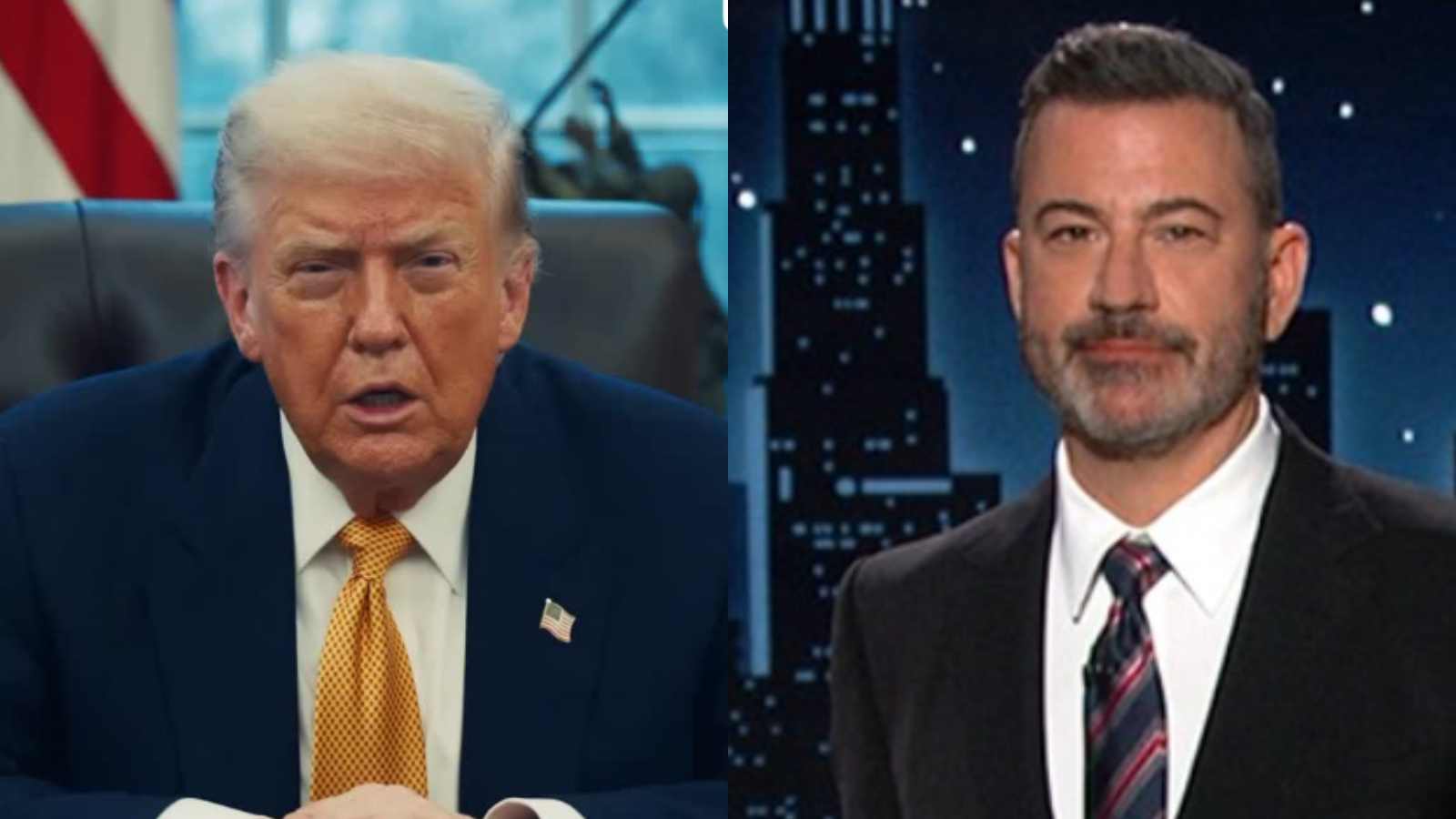

Jimmy Kimmel has really leaned into a new gear lately, ditching the usual late-night niceties for a style of commentary that is arguably more aggressive and confrontational than anyone else’s in the business.
On the night of April 20, 2026, the Jimmy Kimmel Live! stage became a theater of disbelief, one where the host trained his sights squarely on the former President, Donald Trump.
The catalyst for this latest round of intellectual sparring was a report by the Wall Street Journal, suggesting that Trump has been contemplating an unprecedented act of ego: awarding himself the Congressional Medal of Honor.
For a host whose nightly ritual has become synonymous with dissecting the absurdities of the political sphere, this was not just another headline; it was an invitation to hold up a mirror to the phenomenon of unshakable political devotion.
As Kimmel navigated the absurdity of a leader potentially pinning the nation’s highest military honor onto his own lapel, he posed a question that resonated with the weary and the baffled alike: would such a self-aggrandizing act finally be the tipping point for the “zombies” who continue to pledge their worship to him?
It was a moment of sharp, unfiltered commentary that sought to cut through the noise, yet it left many wondering about the actual utility of such harsh labels in a deeply fractured national conversation.
@aaronparnas14-19
The Medal and the Man
The monologue began with the classic Kimmel cadence… a mix of incredulity and sardonic wit, as he dissected the reported claim regarding the Congressional Medal of Honor.
The host did not mince words about the sheer impossibility of the premise, noting that the award is intended for acts of extraordinary valor, not presidential whimsy.
The mental image Kimmel painted was vivid, designed to stick: a leader deciding that the highest military accolade in the land was simply another accessory to be acquired.
He pressed his audience, and perhaps himself, on the logic behind the cult-like adherence of Trump’s supporters, asking if the absurdity of a self-bestowed medal would finally trigger a moment of collective realization, a “wake up” call for those he characterized as “zombies.”
The segment didn’t stop at the medal. Kimmel, always quick to pivot, dragged in other recent absurdities, including Trump’s baffling confusion over the concept of a “corner store” and his commentary on the Strait of Hormuz. It is this rapid-fire delivery that keeps the audience hooked; he connects disparate news threads into a singular tapestry of dysfunction.
When he mocked the idea that someone growing up in Queens would be unfamiliar with a corner store, he was effectively positioning himself as the everyman commentator, grounding the outrage in the mundane realities of the working class.
The humor served as a release valve for the audience, offering a momentary sense of shared sanity amid what many perceive as a topsy-turvy political reality.
However, beneath the laughter lies a deeper frustration… a feeling that the Overton window has shifted so far that we are now debating whether a leader can award himself the equivalent of a military sainthood.
The Strategy of the Late-Night Salvo
One has to look at the mechanics of this performance to understand its true goal. This is not journalism in the traditional sense, but rather a form of cultural navigation.
By labeling supporters as “zombies,” Kimmel is doing more than just cracking a joke; he is reinforcing a shared reality for his viewers. He is creating an “us versus them” dichotomy that is incredibly effective at cementing loyalty among his own fan base.
The laughter in the studio is not just about the punchline; it is a communal affirmation of the viewers’ own political identity. When the host validates the audience’s confusion and anger, he cements his authority as a voice of reason.
This strategy is time-tested in the late-night arena. By framing the opposition not merely as people with different views but as “zombies” who have lost their autonomy, the host removes the need to engage with the substance of their arguments.
If someone is a zombie, you don’t debate them; you simply observe their lack of consciousness. This provides the viewer with a sense of psychological comfort. It allows them to bypass the exhausting work of understanding why millions of people might genuinely support a controversial leader.
It turns political conflict into a horror movie trope… us against the mindless, shuffling horde. While undeniably entertaining, this approach creates a feedback loop where the goal is no longer persuasion or bridge-building, but rather the fortification of a specific cultural bunker. It is television designed to make you feel right, rather than to make you think differently.
Why the “Zombie” Label Might Be Feeding the Beast
There is a glaring contradiction in this approach that bears closer inspection, one that rarely makes it into the monologue.
By consistently casting Trump supporters as “zombies”, people who lack independent thought and are driven by a blind, consuming hunger for their leader, critics of the former President may be inadvertently strengthening the very movement they seek to dismantle.
Human psychology suggests that when people feel dehumanized or condescended to by the cultural elite, their reaction is rarely to reflect on their own beliefs. Instead, they retreat further into their defensive shells, wearing the “zombie” label as a badge of honor, a sign that they are successfully antagonizing a class of people who look down on them.
When a high profile figure like Jimmy Kimmel uses such dehumanizing metaphors, he confirms the narrative that Trump has carefully cultivated for years: that the “mainstream” media and the Hollywood establishment are fundamentally elitist and out of touch with the common person.
Every time the word “zombie” is used to describe a voter, that voter feels more alienated, more defensive, and more committed to the opposition. This creates a vicious cycle in which the comedian’s punchline serves as recruitment material for the other side.
A more effective path to changing minds might involve curiosity or even an attempt to understand the genuine economic and social anxieties that drive this unwavering support.
Yet, that is not the stuff of late-night television. It is not punchy, it does not generate viral clips, and it certainly does not provide the immediate emotional catharsis that a studio audience craves.
But the question remains: if the goal is to win people over, is calling them members of the undead really the best way to open their minds? Or is it simply a way to sell ads while the country remains just as divided as it was before the monologue began?
Ultimately, Kimmel’s performance serves as a powerful reminder of how entertainment has become the primary vehicle for political discourse in our time. The humor is sharp, the observations are biting, and the delivery is pitch-perfect.
But it is also a performance that serves the audience’s ego far more than it serves the democratic process. In the search for the next viral segment, the opportunity to bridge a divide is sacrificed for the sake of a laugh.
We are left with a landscape where the primary function of political satire is to offer comfort to the converted, while the “zombies”, or the people we have decided to label as such, continue their own walk, completely indifferent to the mockery happening on stage.
Until we shift the conversation from character assassination to genuine attempts at understanding, these late-night takedowns will likely continue to be, quite ironically, an echo chamber of our own making.
The irony, of course, is that in trying to wake the zombies up, the loudest voices may be lulling themselves into a deeper, more comfortable sleep of self-assurance.