


Overview of tax regulations in India
For the financial year 2024-2025, Indian tax law treats cryptocurrencies as virtual digital assets (VDAs) under the Income Tax Act, 1961. Section 2(47A) spells out what that means: Any code, number, token or piece of information created through cryptography counts as a VDA. The only exception is money itself — Indian rupees or any other country’s fiat currency.
VDAs include cryptocurrencies like Bitcoin (BTC) and Ether (ETH), as well as non-fungible tokens (NFTs) and similar digital tokens. While it is legal to buy, sell and hold VDAs, they are not recognized as valid payment methods.
In other words, crypto operates in a legally ambiguous space in India in 2025. It is permitted but closely monitored for taxation and anti-money laundering (AML) purposes.
Several agencies in India oversee crypto transactions. The Income Tax Department enforces tax compliance, guided by the Central Board of Direct Taxes (CBDT) under the Ministry of Finance, which sets tax policies.
Meanwhile, the Financial Intelligence Unit (FIU-IND) ensures platforms meet AML standards, while the Reserve Bank of India (RBI) and the Securities and Exchange Board of India (SEBI) shape broader regulatory policies.
These bodies work together to oversee crypto taxation in the country.
The Income Tax (No. 2) Bill, 2025, received presidential assent on Aug. 22, 2025, thereby replacing the Income Tax Act, 1961.
Taxable events for crypto traders in India
India places crypto transactions under a specific tax framework, with a flat 30% tax on gains from transfers and a 1% tax deducted at source (TDS) applied to all transfers, whether profitable or not.
A taxable event in crypto is any activity that creates a tax liability under Indian law. This includes transactions that produce income, gains or measurable benefits in fiat money. If you trade or invest, knowing what counts as a taxable event is key to staying compliant with the Income Tax Act.
Key taxable events include:
- Trading: Exchanging crypto for another crypto or fiat currency is taxable.
- Staking rewards: Counted as income when received.
- Airdrops and hard forks: Treated as income once tokens are credited.
- Mining income: Taxed as income, with later sales subject to capital gains tax.
- Payments in crypto: Considered taxable business or professional income.
Non-taxable events include holding digital assets without selling or transferring crypto between personal wallets. Because these actions do not produce income or gains, they are not subject to tax.
Did you know? Indian law offers no tax relief if you lose your crypto due to theft or hacks. Non-compliance can attract penalties, interest and prosecution for willful evasion.
Crypto tax rates and classifications
In India, income from cryptocurrencies is primarily categorized as either business income or capital gains. If trading is regular and systematic, the earnings are taxed as business income under standard income tax slabs. For most individual investors, profits from buying and selling cryptocurrencies are considered capital gains.
As of Aug. 22, 2025, both short-term capital gains (STCG) and long-term capital gains (LTCG) on VDAs are taxed at a flat 30% rate under Section 115BBH.
This rule is applicable regardless of how long the assets are held. No deductions, except the cost of acquisition, are permitted, and losses from one VDA cannot be offset against another or carried forward.
Business income from crypto is taxed at slab rates but often faces a similar tax burden due to the flat 30% rate for VDAs.
Additionally, a 1% TDS is applied to all crypto transfers above a certain threshold to ensure transparency and compliance across platforms. This includes trades on centralized exchanges and peer-to-peer (P2P) transactions.
TDS on VDAs in India
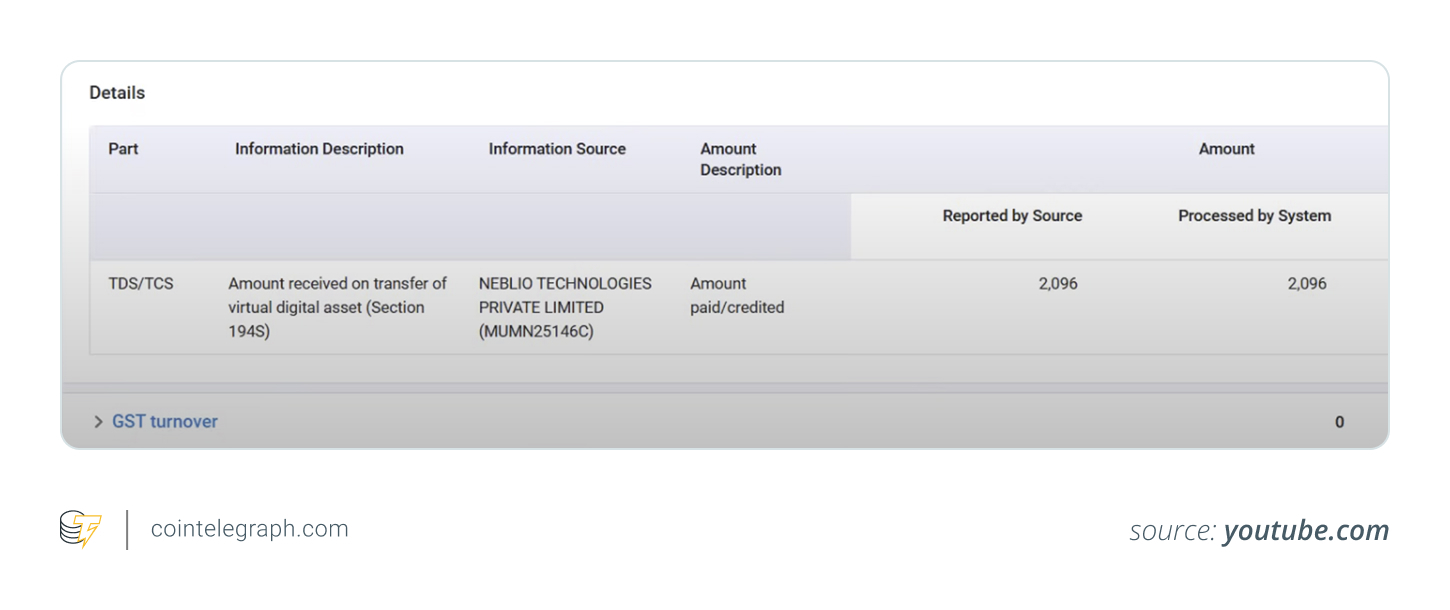
India’s tax framework for cryptocurrencies includes a 1% TDS under Section 194S. This mandatory deduction applies to most VDA transactions and was introduced to improve compliance and monitor the expanding crypto market. The main aspects of crypto TDS are:
- TDS mechanism: When purchasing a VDA, the buyer deducts a fixed percentage of the sale amount as TDS and deposits it with the government. This deducted amount is the tax withheld from the seller’s payment.
- TDS rate and threshold: Section 194S imposes a 1% TDS on the sale amount if transactions exceed 50,000 Indian rupees in a financial year. In certain cases, this threshold is lowered to 10,000 rupees.
- TDS for non-cash transactions: If a buyer purchases a VDA using another VDA (non-cash payment), they must deduct 1% TDS in cash, based on the sale value, and submit it to the government.
- Mixed payment scenarios: When a buyer pays for a VDA with a combination of cash and non-cash (e.g., another VDA) and the cash portion is insufficient to cover the 1% TDS, the buyer must pay the additional TDS amount from their own funds.
- No TAN requirement for specified persons: Under Section 203A, a “specified person” (as defined under the law) is not required to obtain a tax deduction and collection account number (TAN) for TDS purposes.
- TDS exemption for specified persons: No TDS is deducted for a specified person if the total VDA consideration in a financial year is 50,000 rupees or less.
- TDS exemption for non-specified persons: For individuals other than specified persons, no TDS is deducted if the VDA consideration is 10,000 rupees or less in a financial year.
- Precedence over e-commerce rules: If a VDA transaction falls under both Section 194S and Section 194-O (related to e-commerce operators), the provisions of Section 194S take priority.
- TDS on suspense or temporary accounts: If the buyer deposits the VDA payment into a suspense or temporary account of the seller, the seller is responsible for deducting the TDS.
Did you know? Using foreign exchanges doesn’t exempt traders’ profits from offshore platforms. They must declare their transactions in Indian ITRs, which may trigger FEMA scrutiny.
How to calculate crypto taxes in India
To calculate crypto taxes in India, you first need to determine the cost basis, which is the purchase price of the VDA plus related expenses like exchange or transaction fees. This serves as the basis for calculating gains or losses when the asset is sold or transferred.
Traders can use methods such as first-in-first-out (FIFO), last-in-first-out (LIFO) or specific identification to track transactions, depending on the accuracy of their records. The chosen method affects the taxable gain calculation and must be used consistently.
In crypto-to-crypto trades, the transaction is treated as selling one asset (triggering gains or losses) and buying another, with both valued at their fair market price in rupees at the time of the trade.
Certain expenses, such as transaction fees, wallet or exchange charges and crypto tax software costs, can be included in the cost of acquisition. However, Indian law does not allow broader deductions beyond these acquisition costs.
Crypto tax reporting and compliance requirements in India
Indian tax law makes reporting crypto transactions compulsory, with no exceptions for losses. Income must be shown under the VDAs category. ITR-2 usually covers capital gains, and ITR-3 applies to business income. From FY 2025-26, a new Schedule VDA will require each crypto transaction to be reported separately.
Taxpayers must keep accurate records, including transaction details, exchange statements, wallet addresses and rupee valuations, to support their filings. These records are vital, particularly during audits or scrutiny.
For individuals not requiring an audit, the deadline for filing income tax returns in 2025 is July 31, 2025. Businesses requiring an audit must file by Oct. 31, 2025.
Non-compliance can lead to penalties, such as interest on unpaid taxes, fines for late filing and potential prosecution for deliberate tax evasion. Therefore, timely and accurate reporting is crucial for crypto traders and investors.
Did you know? Gifts in crypto are taxable if the value exceeds 50,000 rupees, unless received from relatives or during specific exempt occasions.
Challenges and common issues for crypto traders in India regarding taxation
Taxation is a complex issue for crypto traders in India due to changing regulations and limited clarity in certain areas of the crypto ecosystem. Although gains from VDAs are taxed, several challenges create confusion and compliance difficulties.
Key challenges include:
- Lack of clarity in tax laws for DeFi and NFTs: Regulations for staking, lending and NFT sales are unclear, resulting in inconsistent reporting.
- Tracking high-volume trades across multiple platforms: Frequent trading on various exchanges makes it challenging to accurately calculate gains and maintain records.
- Tax implications of cross-border transactions: Using foreign exchanges or wallets raises issues related to the Foreign Exchange Management Act, 1999 (FEMA), double taxation and international reporting requirements.
- Dealing with lost or stolen crypto assets: Indian tax law offers no relief for theft or loss, leaving traders uncertain about how to report such events in their filings.