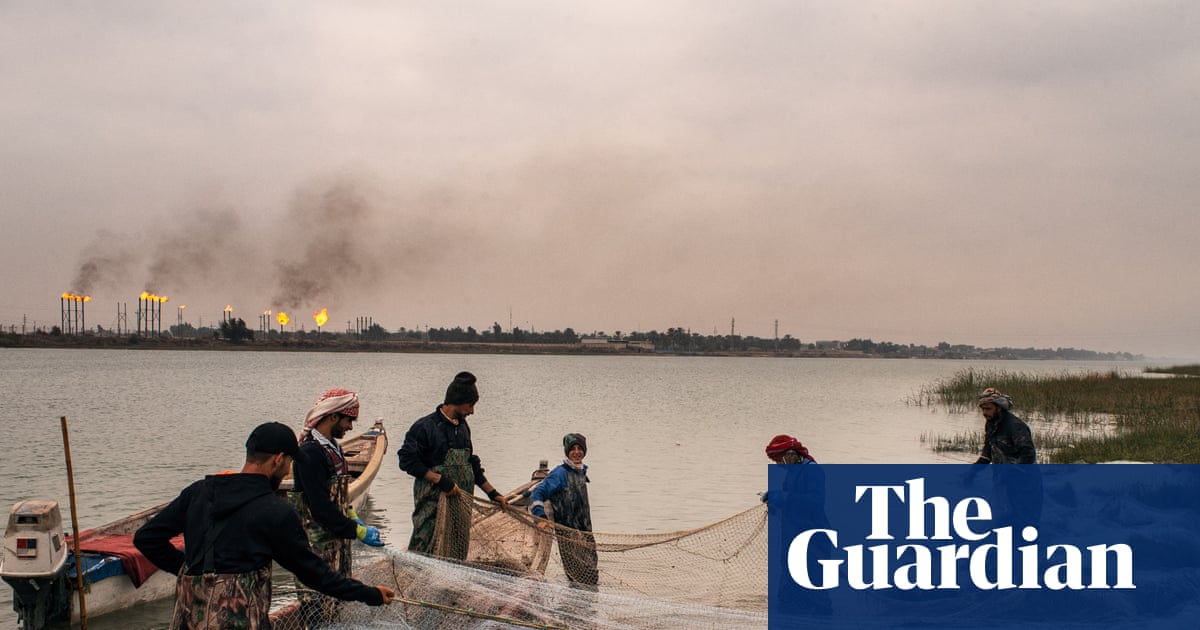

At dawn, a veil of mist clings to the canals of Hawizeh, where sky and water seem to blur into a mirror. In the stern of a narrow wooden boat, 23-year-old Mustafa Hashim scans the marshes’ shallows, cutting the motor and switching to a traditional pole to avoid snagging on invasive roots or thickening mud.
It takes him about half an hour to push through the shrinking marshes to reach Um al-Nea’aj, once a vibrant lake teeming with boats and birdsong. Now, the water is about half a metre deep.
“Two years ago, there were families and fishermen everywhere,” Mustafa says, leaning out of the boat. “You could hear laughter, the splash of fish. Today, there’s nothing.”
On the horizon, flames from the Halfaya oilfield flicker.
Iraq’s southern wetlands – known collectively as the Mesopotamian marshes – are among the world’s most endangered ecosystems. Their expanse is believed by some to have contained the biblical Garden of Eden. Recognised as a Unesco world heritage site in 2016 and protected since 2007 as a wetland of international importance under the Ramsar Convention, the marshes once stretched nearly 120 miles (200km) from Nasiriya to Basra, forming a rich and vast aquatic world.
But beneath the surface lies another kind of wealth: oil. Three strategic oil concessions overlap with the protected area: Halfaya, Huwaiza, and Majnoon. The latter, Majnoon, takes its name from the Arabic word for “crazy”: it is considered one of the world’s “super-giant” oilfields, with estimated reserves of up to 38bn barrels (5.2bn tonnes).
But the processes used to extract that oil have a voracious appetite for water. In a land already threatened by drought and desertification, the wetlands are being sucked dry.
Mustafa’s grandfather, Kasid Wanis, 87, once took his boat from Hawizeh to Basra (about 70 miles) using nothing but a pole and his memory of the route. “We didn’t know what cars were. We didn’t need them. We were a people of water,” he says.
His 41-year-old son Hashim, Mustafa’s father, grew up fishing these waters. But four years ago, he packed his nets away. “There’s not enough water to live,” he says quietly.
Crude oil is Iraq’s economic lifeline, accounting for more than 95% of its total exports and 69% of GDP. The country is the world’s sixth-largest crude producer, and the fate of the Hawizeh marshes is tightly bound to that of the oil industry. Since Russia’s invasion of Ukraine in 2022, Europe has sought alternatives to Moscow’s crude, with Iraq becoming a key source.
The connection between oil extraction and water scarcity is direct and devastating. The Halfaya oilfield – in which the French energy company TotalEnergies also holds a stake – is operated by a consortium led by PetroChina.
Spanning an area three times the size of Paris, it includes 300 wells, three oil-processing plants, a water-treatment facility, and its own airport to transport foreign workers between the site and international airports. It is state-owned PetroChina’s largest overseas project.
About a decade ago, shortly after PetroChina began operations in the region, six water-pumping stations were built along the Tigris River – the lifeline that feeds the marshes.
Every day, they extract about 60,000 cubic metres of water, roughly the daily consumption of a mid-sized city. That water is diverted to the oilfields, where it is injected into wells to boost crude extraction – a standard practice across the region.
The pumping stations are drawing from already diminished reserves. Dams built upstream in Turkey and the Kurdish region of Iraq have reduced water flow into southern Iraq by more than 50% since the 1970s, while Iranian dams on the Karkheh River – which feeds the Hawizeh marshes – have also reduced the region’s water supply. Now, feeding this industrial oil complex is costing residents their environment and their way of life, they say.
These days, Hashim is less worried about dwindling fish stocks than about the military checkpoints. The canals that once led deep into the wetlands are cut off and patrolled. Armed guards control access, requiring local fishers and buffalo herders to hand over their ID cards to enter.
The marshes have become a militarised zone. Authorities say the heightened police and military presence is meant to prevent smuggling and secure the nearby border with Iran just a few miles away. But according to residents, it also serves to suppress local protests.
“The occupation follows the oil,” Mustafa says. “They want to cut us off from our land so they can exploit it without resistance.”
As the marshes dried, Mustafa did what many others have been forced to do – he joined the industry he blames for their destruction. In 2023, he and his father worked as subcontracted labourers for PetroChina. “I saw it up close,” he says. “They call this development, but it’s destruction disguised as progress.”
By the summer, he had quit. That same year, drought peaked and protests erupted across the region, and Mustafa joined them, organising blockades of oilfield access roads. “At first I told Mustafa to stop,” Hashim says. “But then he made me see it: this is political, and we can’t stay silent.”
As well as its thirst for water, oil extraction in the region has been linked to devastating pollution. “This economy is literally killing people,” says Majid al-Saadi, director of the agriculture department in Maysan province. In late 2024, Saadi and his team compiled a confidential local government report into the effects of oil extraction on the region.
The report, seen by the Guardian, documents alarming concentrations of hydrocarbons and heavy metals, chemicals into drinking water, and the collapse of local agriculture. “This is not just pollution – it’s expropriation,” Saadi says.
In early 2025, Saadi delivered the report to Iraq’s environment ministry, and says that officials promised to open talks with the oil ministry. But he is sceptical that any action will follow.
For now, the expansion of oilfields in the area continues. Leaked photographs and videos, geolocated by the Guardian, now show excavators, pipelines, and workers digging directly into the heart of the protected zone – where the new Huwaiza oilfield is now under development.
The exploration has been confirmed by satellite imagery analysis carried out for the Guardian by Placemarks, an independent geo‑analysis studio that uses satellite imagery and data to map environmental changes.
A contract signed in February 2023 between Iraq’s state-owned Maysan Oil Company and China’s Geo-Jade Petroleum paved the way for the field’s development. The new excavations would directly violate Ramsar protections. But the pact is not legally binding, and depends on states complying voluntarily.
Iraq’s oil and environment ministries did not respond to requests for comment. In July, the interior ministry’s federal security affairs agency said in a social media post that environmental police had “conducted a field inspection … to monitor potential environmental violations resulting from the activities of oil companies in the Hor al-Huwaiza area”.
It continued: “The field visit revealed that the pond had completely dried up, with no ongoing drilling, extraction, or disposal of oil waste at the site. However, there were excavations … being carried out by local companies contracted with the Chinese company Geo-Jade for exploration purposes and the future installation of oil rigs.”
Jassem Falahi, an environment ministry official, has previously told AFP that the protected status of the marshes did not bar development projects.
However, he added in May: “Investment is subject to specific conditions and standards that must not disturb the core area … or affect the site and its biodiversity.” A spokesperson for TotalEnergies said that while it had a 22.8% stake in Halfaya oilfield, it was not an operator, and that questions about the field should be directed to PetroChina.
PetroChina and GeoJade did not respond to requests for comment.
Contacted by the Guardian, Unesco stressed its “significant concern over the continued vulnerability of the natural components of the property to oil and gas developments”.
Deprived of their livelihoods, Hawizeh’s residents are left with few options. In Mustafa’s village, hundreds of homes have been abandoned.
Fresh protests broke out across the marshes three months ago. Hundreds marched near the Halfaya oilfield, denouncing new drilling permits. “This isn’t just about today’s drilling rights,” Mustafa said. “We’re fighting so the next generation can know the wetlands our ancestors protected for thousands of years.”
The unrest comes as Iraq boosts oil production amid a worsening water crisis. With another scorching summer under way, the head of Basra’s Human Rights Commission has called for a state of emergency to be imposed, warning of a looming humanitarian disaster from scarcity, pollution and rising toxicity.
What remains in the marshes is a quiet war – over land, water and memory. “The government and the companies have turned us into a cake to be divided,” Mustafa says. “They treat these waters like a business opportunity. For us, it’s life.”
This investigation was supported by Journalismfund Europe and IJ4EU