
The Oracle of Omaha once called this ratio “probably the best single measure of where valuations stand at any given moment.”
Though the stock market has been a bona fide wealth creator for well over a century, this doesn't mean stocks rise in an orderly fashion. Through the first seven months of 2025, investors have been taken on quite the historic ride.
In early April, the iconic S&P 500 (^GSPC -1.60%) shed 10.5% of its value in just two trading sessions, which marked its fifth-steepest two-day percentage decline dating back to 1950. The struggle was also felt by the growth-focused Nasdaq Composite (^IXIC -2.24%) and ageless Dow Jones Industrial Average (^DJI -1.23%), which respectively fell into a bear market (Nasdaq) and correction territory (Dow).
However, Wall Street's relatively short-lived swoon sparked by President Donald Trump's tariff and trade policy quickly gave way to a booming bull market. The S&P 500 has enjoyed one of its strongest three-month returns in 75 years, with it and the Nasdaq Composite blasting to numerous record-closing highs.
But though optimism is high, so are stock valuations.
Image source: Getty Images.
Based on billionaire Warren Buffett's favorite valuation tool, the stock market has never been pricier — and history is crystal clear what comes next for stocks.
A grim reality: The stock market has never been more expensive
To preface the following discussion, “value” is something of a subjective term. What you believe is a bargain might be viewed as pricey by another investor. This subjectivity toward stock valuations is what makes the stock market so dynamic and unpredictable.
For most investors, the traditional price-to-earnings (P/E) ratio is the go-to when valuing stocks. The P/E ratio is arrived at by dividing a company's share price by its trailing-12-month earnings per share (EPS). Generally, a lower P/E ratio equates to a perceived-to-be cheaper stock — but comparisons need to be made among a company's peers to confirm this.
While the P/E ratio is a fantastic tool for quickly evaluating mature businesses, it loses its luster during recessions or when attempting to value growth stocks.
For Berkshire Hathaway‘s (BRK.A -1.27%) (BRK.B 0.18%) billionaire CEO Warren Buffett, no valuation tool holds more historical importance than the market cap-to-GDP ratio. This measure adds up the total value of all publicly traded companies and divides it by U.S. gross domestic product (GDP). Ideally, a lower number is indicative of cheaper valuations for equities.
In a rare interview with Fortune magazine nearly a quarter-century ago, Buffett referred to the market cap-to-GDP ratio as “probably the best single measure of where valuations stand at any given moment.” Perhaps unsurprisingly, given the Oracle of Omaha's investment success at Berkshire Hathaway, this valuation measure became known as the “Buffett Indicator.”
Recently, the Buffett Indicator has pushed to never-before-seen levels.
JUST IN 🚨: Warren Buffet Indicator jumps to most expensive stock market valuation in history, surpassing the Dot Com Bubble and the Global Financial Crisis 👀 pic.twitter.com/xTmDlxJsjB
— Barchart (@Barchart) July 25, 2025
When back-tested to 1970, the Buffett Indicator has averaged a reading of 85%, which is to say that the aggregate value of all stocks has averaged about 85% of U.S. GDP spanning 55 years. In recent trading sessions, this ratio has pushed above 213%, equating to a roughly 151% premium to its mean since 1970.
Previous instances where the Buffett Indicator decisively moved to new highs were eventually followed by significant pullbacks in the benchmark S&P 500, Nasdaq Composite, and Dow Jones Industrial Average. For example, the Buffett Indicator topped out at 195.62% on Nov. 7, 2021, just two months prior to the 2022 bear market taking shape. This bear market eventually lopped 25% off of the broad-based S&P 500, and even more from the growth-heavy Nasdaq.
On March 23, 2000, immediately prior to the bursting of the dot-com bubble, the Buffett Indicator rocketed to 144.25%, representing a mammoth increase from the sub-60% range it had settled into in December 1994. The S&P 500 and Nasdaq respectively lost 49% and 78% when the dot-com bubble burst. The point being that premium valuations have historically been a warning to Wall Street that it's not a matter of “if” but “when” significant downside pressure on equities returns.
Even though it's been a very long time since Buffett has referenced the market-cap-to-GDP ratio, his actions speak loudly. Through the end of March 2025, he's been a net seller of stocks for 10 consecutive quarters, to the cumulative tune of $174.4 billion.
Berkshire's billionaire chief is a stickler for value, and he's struggling to find a good deal on Wall Street. The historical warning signs couldn't be more evident for investors.
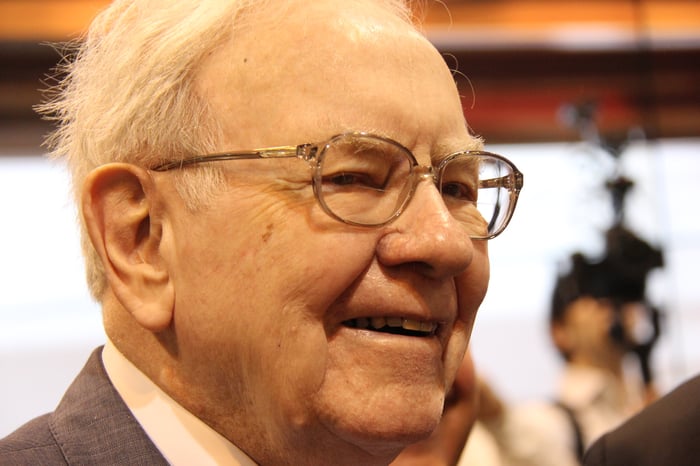
Berkshire Hathaway CEO Warren Buffett. Image source: The Motley Fool.
Warren Buffett is a long-term investor for a reason!
Although historical precedent couldn't be clearer, it's important for investors not to be too focused on short-term directional movements. While Buffett has been a very selective buyer for nearly three years, he and his trusted top advisors continue to hold dozens of stocks for the long term.
For decades, Berkshire Hathaway's billionaire chief has approached nearly all of his investments with the idea that he'll be holding for years, if not considerably longer. The reason for approaching investments this way is simple: Economic and stock market cycles aren't linear.
The Oracle of Omaha isn't oblivious to the fact that economic downturns and stock market corrections are going to occur. He just understands that time is working in his favor.
Since the end of World War II nearly 80 years ago, the average U.S. recession has lasted only 10 months, and the longest downturn on record endured for just 18 months. In comparison, the typical period of economic growth clocks in at approximately five years, with two growth spurts surpassing the decade mark. Buffett and his team have listened to what history has to say and angled Berkshire Hathaway's investment portfolio to take advantage of long-winded economic expansions.
This disparity observed in economic cycles is readily visible in the stock market, as well.
It's official. A new bull market is confirmed.
The S&P 500 is now up 20% from its 10/12/22 closing low. The prior bear market saw the index fall 25.4% over 282 days.
Read more at https://t.co/H4p1RcpfIn. pic.twitter.com/tnRz1wdonp
— Bespoke (@bespokeinvest) June 8, 2023
In June 2023, which is when the S&P 500 officially entered a new bull market following its 2022 bear market tumble, the analysts at Bespoke Investment Group published a data set on X (formerly Twitter) comparing the length of every S&P 500 bull and bear market dating back to the start of the Great Depression (September 1929).
In total, there were 27 separate bull and bear market events covering this nearly 94-year period. Whereas the average S&P 500 bear market resolved in just 286 calendar days, or less than 10 months, the typical bull market endured for 1,011 calendar days, or roughly two years and nine months.
The reason Warren Buffett doesn't spend too much of his time worrying about inevitable stock market downturns is because they're short-lived. He relies on this numbers game to put the odds of making money on Wall Street decisively in his favor.
Even if history repeats and the priciest stock market on record comes tumbling down at some point in the not-too-distant future, historical precedent also shows that, over multidecade timelines, the S&P 500, Nasdaq Composite, and Dow Jones Industrial Average can be counted on to move progressively higher.