
By Mimosa Spencer and Sami Marshak
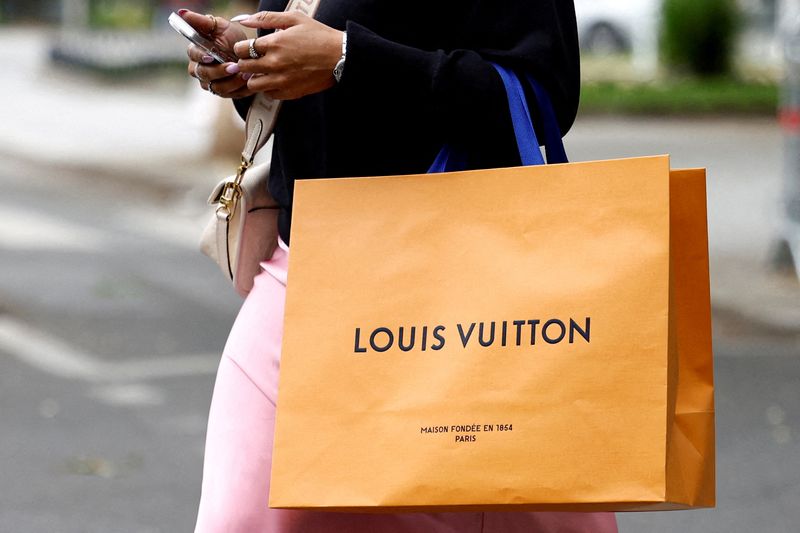
PARIS/NEW YORK (Reuters) -Luxury goods companies were spared their worst case scenario in Sunday's EU-U.S. trade deal but they face a delicate balancing act as already weak consumer demand tests their ability to raise prices further.
Big labels like Chanel and LVMH's Louis Vuitton and Dior have relied on dramatic price increases in recent years to drive a chunk of their profit growth.
Jacques Roizen, managing director, China, at Digital Luxury Group, said the deal struck by U.S. President Donald Trump and European Commission President Ursula von der Leyen on Sunday, imposing a 15% tariff on EU goods, brings much needed certainty to luxury's key U.S. market.
Yet, “brands are treading carefully with further price hikes to avoid alienating younger and occasional shoppers,” he said.
Although baseline duties are below a hefty 30% levy that Trump had threatened just a couple of weeks ago, they are a far cry from the zero-for-zero tariff deal Brussels was hoping to clinch.
Fresh tariffs also come as the luxury goods industry is counting on the U.S. as former growth engine China sputters and sales globally are in decline.
“Tariffs are definitely going to affect my buying behaviour, depending on the rate of the tariff. I would think twice before I just pick things up,” said Abida Taher, a 53-year-old physician who was out shopping at Saks Fifth Avenue in New York City last week and likes Valentino among other Italian and French brands.
Bernard Arnault, chairman and CEO of French luxury giant LVMH, embarked on an intense lobbying campaign with EU leaders to ease tensions with the Trump administration and last week announced plans for a new Louis Vuitton factory in Texas.
Such a move, however, would be too complicated and costly for most European brands – involving the transfer of local skills that take years to build up, industry experts caution.
Some high end labels say they will be able to draw on pricing power to offset the cost of tariffs, but analysts and industry practitioners warn some players have limited wiggle room after a series of outsized price tag hikes.
Big luxury companies profited from a rebound of consumer demand after the pandemic, hiking prices by 33% on average between 2019 and 2023, according to RBC estimates.
The price tag of Chanel's classic quilted flap bag more than tripled between 2015 and 2024, while the Lady Dior bag and Louis Vuitton Keepall travel bag more than doubled, according to UBS analysts.
LUXURY DISCONNECT
Half of the luxury industry's sales growth came from price hikes in the four years from 2019, compared to a third between 2016 and 2023, UBS analysts said.