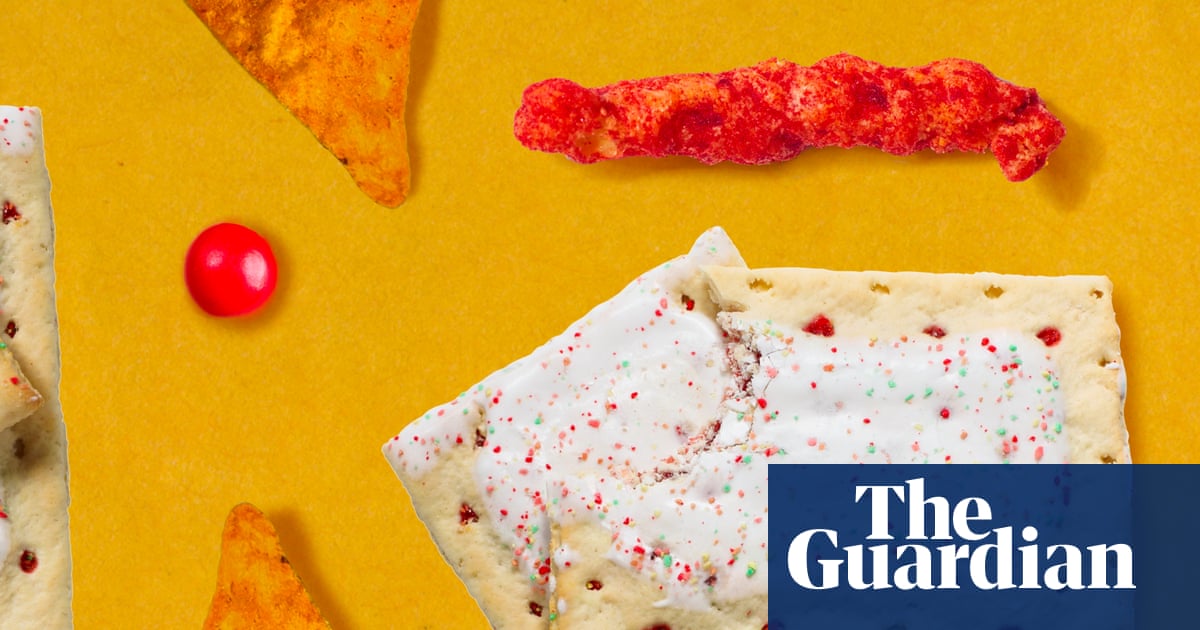

The Make America Healthy Again (Maha) movement celebrated this month after the US dairy industry voluntarily pledged to remove all artificial dyes from ice-cream by 2028. In April, US health secretary Robert F Kennedy Jr prevailed upon the food industry to stop using artificial dyes, and many of the nation’s largest food manufacturers, including Nestle, Kraft Heinz and PepsiCo, have already promised to comply. But the ice-cream pledge made Kennedy especially happy because, he said, ice-cream is his favorite food.
Prepare to say goodbye to the brilliant pink (from red dye No 40) that signifies strawberry, the cool green (yellow 5 and blue 1) of mint chocolate chip, and the heroic combination of red 40, blue 1, and yellow 5 and 6 that makes up Superman.
One of the goals of the Maha movement is to prevent childhood diseases, which Kennedy argues can be accomplished by, among other things, addressing the use of additives in ultra-processed foods. A recent study published in the Journal of the Academy of Nutrition and Dietetics calculated that, in 2020, 19% of food products contained artificial dyes – “the most egregious” additive, according to Kennedy. Those dyes, he claims, are responsible for a host of health issues, including cancer, hyperactivity and possibly autism.
“The American people have made it clear – they want real food, not chemicals,” Kennedy said in a statement.
Aside from jokes on social media about Donald Trump’s skin tone and Kennedy’s alleged use of methylene blue (an artificial dye that some claim boosts “mitochondrial efficiency” and longevity), the initiative has faced little political opposition. In January, when Joe Biden was still president, the FDA announced a ban on red dye No 3 scheduled to go into effect in 2027. Red 3, the FDA explained, was shown to cause cancer in rats, and while it does not show up in food in large enough quantities to affect humans, it still violates a law forbidding additives that contain carcinogens.
Meanwhile, states as politically varied as West Virginia, Texas and California have already established their own bans or requirements that foods containing artificial dyes carry warning labels, citing the need to protect kids. (In the UK and the EU, restrictions on artificial dyes have been in place for years.)
Why the fuss over food coloring? Are natural dyes really that much better for our health?
“They’re better for some people’s health,” says Jamie Alan, a professor of pharmacology and toxicology at Michigan State University. “There is a very small percentage of children who are very sensitive to these dyes. And when they eat these dyes, they display behaviors that we sometimes associate with ADHD.”
Alan stresses that there is no evidence that those kids actually develop ADHD. But research has found that after eating foods containing certain dyes, children, including those diagnosed with ADHD or autism, can show signs of hyperactivity, moodiness and inattentiveness. However many of these foods, particularly candy and soda, also contain sugar, which has also been connected to hyperactive behavior.
Alan recommends that parents talk to a pediatrician and try an elimination diet to make sure the dye and not another ingredient is to blame. But she largely supports phasing out artificial dyes; most public health advocates think this is a good idea. “In my opinion,” Alan says, “because we’re talking about children and because they are a vulnerable population, I do think this is a great thing to do. But I will recognize that it is not going to impact the vast majority of the population.”
One group that the change in dyes will certainly affect is the food manufacturers themselves. Switching from artificial to natural dyes is a complex process, says Travis Zissu, the co-founder and innovation lead of Scale Food Labs in Golden, Colorado, which offers a program to help manufacturers with the dye conversion.
Unlike artificial dyes, which are derived from petroleum, natural dyes come mostly from plants: turmeric, for example, is used for yellows; algae and butterfly pea flower for blues; lycopene from carrots and tomatoes for reds. These dyes can be less stable, so Scale’s program begins with finding natural pigments that will not be affected by heat and other chemicals, followed by tests to determine which combination of dyes will produce the most reliable color. Next, Scale helps companies lock in contracts that will not force them to raise their prices too much and secure light-sensitive packaging to protect the colors. Finally, there are nine to 12 months of product testing to make sure production runs smoothly and that there are no adverse effects for consumers, such as red-dyed feces (something that has been known to happen with beet powder and extract; Alan says it’s harmless, but admits it can be unnerving).
But Zissu’s biggest concern is that there won’t be enough to go around. Natural color demand is already up between 30-50% across the industry since food companies began announcing their intentions to stop using artificial color, he says, and the earliest deadline – 2027 – is still years away.
“There is simply not enough supply to replace every single item in the market,” he says. “You’ll see the largest companies locking down colors soon, but there will not be enough until 2030.”
There is also the worry that American consumers will reject the new colors altogether. While their counterparts in Europe, Canada and Japan have peacefully accepted the duller hues of natural dyes, Americans remain stubbornly attached to neon-bright candy and cereal.
Case in point: in 2015, General Mills pledged to remove all artificial colors and flavorings from its products. The following year, it rolled out a natural version of Trix, the kid-friendly fruity breakfast cereal. But the muted Trix, colored by radishes, purple carrots and turmeric, was a flop. Customers missed the vibrant colors and complained that the new version didn’t taste right. By 2017, “classic Trix” had returned to grocery stores.
On the other hand, when Kraft reformulated the powder for its macaroni and cheese and quietly began selling the all-natural version in December 2015, there was much less protest. As an Eater headline at the time put it: “Kraft Changed Its Mac and Cheese and Nobody Noticed.” Perhaps it was the marketing strategy – Kraft did not bother to make a big announcement until after it had sold 50m boxes – or maybe it was because the natural dyes were just as orange as the original. (Alan recalls that her young nieces and nephews were slightly worried about the change but accepted the new mac and cheese without much fuss.)
As the adage goes, we eat with our eyes. The appearance of food should not change our perceptions of how it tastes, but, as anyone who has ever bought produce knows, it definitely does. In nature, brighter colors indicate that foods are ripe and will taste good. This principle also applies to human-made food.
As far back as the Middle Ages, according to Ai Hisano, a professor of business history at the University of Tokyo and author of Visualizing Taste: How Business Changed the Look of What You Eat, dairy farmers would mix carrot juice and annatto from achiote trees into their butter to make it a more appetizing yellow. When scientists discovered petroleum-based dyes in the mid-19th century, the dairy industry was one of the earliest adopters: the artificial dyes were cheaper, and they helped create uniform yellows for butter and cheese that appealed to shoppers.
Other food producers quickly followed suit. Meat would be red! Sandwich bread would be white! Oranges – which sometimes stayed green, even when they were ripe – would be orange! By the early 20th century, the US government had started regulating food coloring to make sure it didn’t kill anyone.
This was also the beginning of the golden age of industrial food such as candy, breakfast cereal and, most notoriously, Jell-O, which came in colors never seen in nature. Food dye became vital for branding, Hisano writes. Even if brighter color didn’t really affect flavor because the food was entirely manufactured, people perceived that it did, and that was what mattered. Would a beige Flamin’ Hot Cheeto taste as spicy?
“I assume many consumers in the early 20th century were frightened by those bright-red foods,” Hisano told the Atlantic in 2017. “But one reason consumers liked them is because they were excited about these colors they had never seen before.” And the knowledge that they were regulated by the FDA made them feel they were safe to eat.
Because the identity of their products depends on color, the most resistance to Kennedy’s initiative has come from America’s candy manufacturers. A spokesman for the National Confectioners Association said that candy makers will not adopt natural dyes until federal regulations compel them to. Of all the biggest US food companies, only Mars, maker of M&Ms, Skittles and Starburst (incidentally, Trump’s favorite candy), has not yet pledged to give up artificial dye, except for the already banned red 3. However, FDA commissioner Marty Makary told Fox News that he thinks Mars will come around sooner than later.
Zissu, the food dye consultant, foresees “an R&D sprint” to develop natural dyes before the 2027 deadline. And indeed, since May, the FDA has approved four new natural colors – three blues and one white – for a wide range of food, including juices, milk-based meal replacements, cereal, chips, sugar and ready-to-eat chicken products.
But Zissu does not think that a transition to natural dyes means that the color of food will revert to a pre-industrial dullness. “I believe we will always see the bright colors in candy and other items that consumers come to expect,” he says. “There will just be a lot more research dedicated to getting those colors if artificial [dye] is banned.”
It may also help if America’s food manufacturers act en masse, as they appear to be doing: the change will be so overwhelming that, as Zissu puts it, “neon synthetics will look as dated as trans fats.” Perhaps in a few years, we will look back at green mint chip ice-cream in wonder. (Some people already do: many ice-cream producers, including Ben & Jerry’s and Häagen-Dazs, don’t use green as the signifier for mint.)
It seems Maha is poised to help shake America of its affair with artificial colors. But it celebrates this victory at the same time as the Trump administration guts public health infrastructure.
The ice-cream industry’s pledge came just 11 days after Congress passed a spending bill that will cut Medicaid spending, and therefore healthcare for millions of children, and slash Snap food assistance for US families. It came the same day that the Department of Health laid off thousands of employees. Under Trump, the government has also cut research grants to scientists studying, among other things, disease prevention and vaccines (of which Kennedy is a notorious skeptic). Underlying issues such as food and housing insecurity and child poverty that devastate children’s wellbeing are likely to worsen.
Alan thinks that if Kennedy is serious about improving the health of America’s kids, there are much more pressing issues than food dye to work on. “I just can’t believe that someone would be given a chance to make such an impact,” she says, “and this is what they choose to do.”