

Updated on July 24th, 2025 by Bob Ciura
In the world of investing, volatility matters. Investors are reminded of this every time there is a downturn in the broader market and individual stocks that are more volatile than others experience enormous swings in price.
Volatility is a proxy for risk; more volatility generally means a riskier portfolio. The volatility of a security or portfolio against a benchmark is called Beta.
In short, Beta is measured via a formula that calculates the price risk of a security or portfolio against a benchmark, which is typically the broader market as measured by the S&P 500.
Here’s how to read stock betas:
- A beta of 1.0 means the stock moves equally with the S&P 500
- A beta of 2.0 means the stock moves twice as much as the S&P 500
- A beta of 0.0 means the stocks moves don’t correlate with the S&P 500
- A beta of -1.0 means the stock moves precisely opposite the S&P 500
Interestingly, low beta stocks have historically outperformed the market… But more on that later.
You can download a spreadsheet of the 100 lowest beta S&P stocks (along with important financial metrics like price-to-earnings ratios and dividend yields) below:

This article will discuss beta more thoroughly, why low-beta stocks tend to outperform, and provide a discussion of the 5 lowest-beta dividend stocks in the Sure Analysis Research Database.
The table of contents below allows for easy navigation.
Table of Contents
The Evidence for Low Beta Stocks Outperformance
Beta is helpful in understanding the overall price risk level for investors during market downturns in particular. The lower the Beta value, the less volatility the stock or portfolio should exhibit against the benchmark.
This is beneficial for investors for obvious reasons, particularly those that are close to or already in retirement, as drawdowns should be relatively limited against the benchmark.
Importantly, low or high Beta simply measures the size of the moves a security makes; it does not mean necessarily that the price of the security stays nearly constant.
Securities can be low Beta and still be caught in long-term downtrends, so this is simply one more tool investors can use when building a portfolio.
The conventional wisdom would suggest that lower Beta stocks should underperform the broader markets during uptrends and outperform during downtrends, offering investors lower prospective returns in exchange for lower risk.
However, history would suggest that simply isn’t the case.
Indeed, this paper from Harvard Business School suggests that not only do low Beta stocks not underperform the broader market over time – including all market conditions – they actually outperform.
A long-term study wherein the stocks with the lowest 30% of Beta scores in the US were pitted against stocks with the highest 30% of Beta scores suggested that low Beta stocks outperform by several percentage points annually.
Over time, this sort of outperformance can mean the difference between a comfortable retirement and having to continue working.
While low Beta stocks aren’t a panacea, the case for their outperformance over time – and with lower risk – is quite compelling.
How To Calculate Beta
The formula to calculate a security’s Beta is fairly straightforward. The result, expressed as a number, shows the security’s tendency to move with the benchmark.
For example, a Beta value of 1.0 means that the security in question should move in lockstep with the benchmark. A Beta of 2.0 means that moves in the security should be twice as large in magnitude as the benchmark and in the same direction, while a negative Beta means that movements in the security and benchmark tend to move in opposite directions or are negatively correlated.
Related: The S&P 500 Stock With Negative Beta.
In other words, negatively correlated securities would be expected to rise when the overall market falls, or vice versa. A small value of Beta (something less than 1.0) indicates a stock that moves in the same direction as the benchmark, but with smaller relative changes.
Here’s a look at the formula:
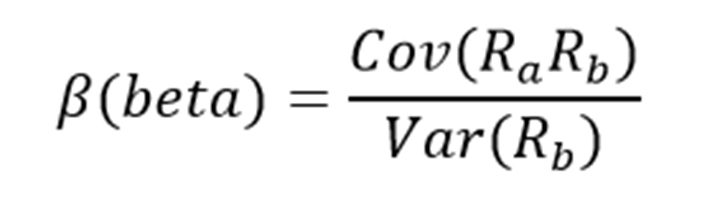
The numerator is the covariance of the asset in question with the market, while the denominator is the variance of the market. These complicated-sounding variables aren’t actually that difficult to compute – especially in Excel.
Additionally, Beta can also be calculated as the correlation coefficient of the security in question and the market, multiplied by the security’s standard deviation divided by the market’s standard deviation.
Finally, there’s a greatly simplified way to calculate Beta by manipulating the capital asset pricing model formula (more on Beta and the capital asset pricing model later in this article).
Here’s an example of the data you’ll need to calculate Beta:
- Risk-free rate (typically Treasuries at least two years out)
- Your asset’s rate of return over some period (typically one year to five years)
- Your benchmark’s rate of return over the same period as the asset
To show how to use these variables to do the calculation of Beta, we’ll assume a risk-free rate of 2%, our stock’s rate of return of 7% and the benchmark’s rate of return of 8%.
You start by subtracting the risk-free rate of return from both the security in question and the benchmark. In this case, our asset’s rate of return net of the risk-free rate would be 5% (7% – 2%).
The same calculation for the benchmark would yield 6% (8% – 2%).
These two numbers – 5% and 6%, respectively – are the numerator and denominator for the Beta formula. Five divided by six yields a value of 0.83, and that is the Beta for this hypothetical security.
On average, we’d expect an asset with this Beta value to be 83% as volatile as the benchmark.
Thinking about it another way, this asset should be about 17% less volatile than the benchmark while still having its expected returns correlated in the same direction.
Beta & The Capital Asset Pricing Model (CAPM)
The Capital Asset Pricing Model, or CAPM, is a common investing formula that utilizes the Beta calculation to account for the time value of money as well as the risk-adjusted returns expected for a particular asset.
Beta is an essential component of the CAPM because without it, riskier securities would appear more favorable to prospective investors. Their risk wouldn’t be accounted for in the calculation.
The CAPM formula is as follows:

The variables are defined as:
- ERi = Expected return of investment
- Rf = Risk-free rate
- βi = Beta of the investment
- ERm = Expected return of market
The risk-free rate is the same as in the Beta formula, while the Beta that you’ve already calculated is simply placed into the CAPM formula. The expected return of the market (or benchmark) is placed into the parentheses with the market risk premium, which is also from the Beta formula. This is the expected benchmark’s return minus the risk-free rate.
To continue our example, here is how the CAPM actually works:
ER = 2% + 0.83(8% – 2%)
In this case, our security has an expected return of 6.98% against an expected benchmark return of 8%. That may be okay depending upon the investor’s goals as the security in question should experience less volatility than the market thanks to its Beta of less than 1.
While the CAPM certainly isn’t perfect, it is relatively easy to calculate and gives investors a means of comparison between two investment alternatives.
Now, we’ll take a look at five stocks that not only offer investors low Beta scores, but attractive prospective returns as well.
Analysis On The Top 5 Low Beta Stocks
The following 5 low beta stocks have the lowest (but positive) Beta values, in ascending order from lowest to highest. They also pay dividends to shareholders.
We focused on Betas above 0, as we are still looking for stocks that are positively correlated with the broader market:
5. PepsiCo Inc. (PEP)
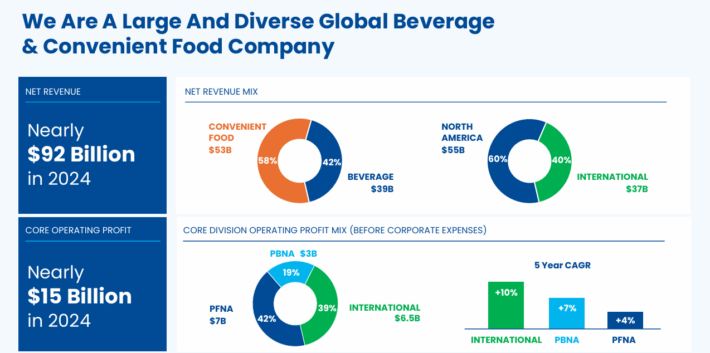
PepsiCo is a global food and beverage company. Its products include Pepsi, Mountain Dew, Frito-Lay chips, Gatorade, Tropicana orange juice and Quaker foods.
Its business is split roughly 60-40 in terms of food and beverage revenue. It is also balanced geographically between the U.S. and the rest of the world.
Source: Investor Presentation
On July 18th, 2025, PepsiCo announced second-quarter earnings results for the period ending June 30th, 2025. For the quarter, revenue grew 1.0% to $22.7 billion, which topped estimates by $430 million.
Adjusted earnings-per-share of $2.12 compared unfavorably to $2.28 the prior year, but this was $0.09 ahead of expectations. Currency exchange reduced revenue by 1.5% and adjusted earnings-per-share by 5%.
Organic sales grew 2.1% for the second quarter. For the period, volume for beverages was once again unchanged while food fell 1.5%.
PepsiCo Beverages North America’s organic revenue grew 1% for the period even as volume declined by 2%. Revenue for Frito-Lay North America decreased 2%, largely due to divestitures. Food volume was lower by 1%.
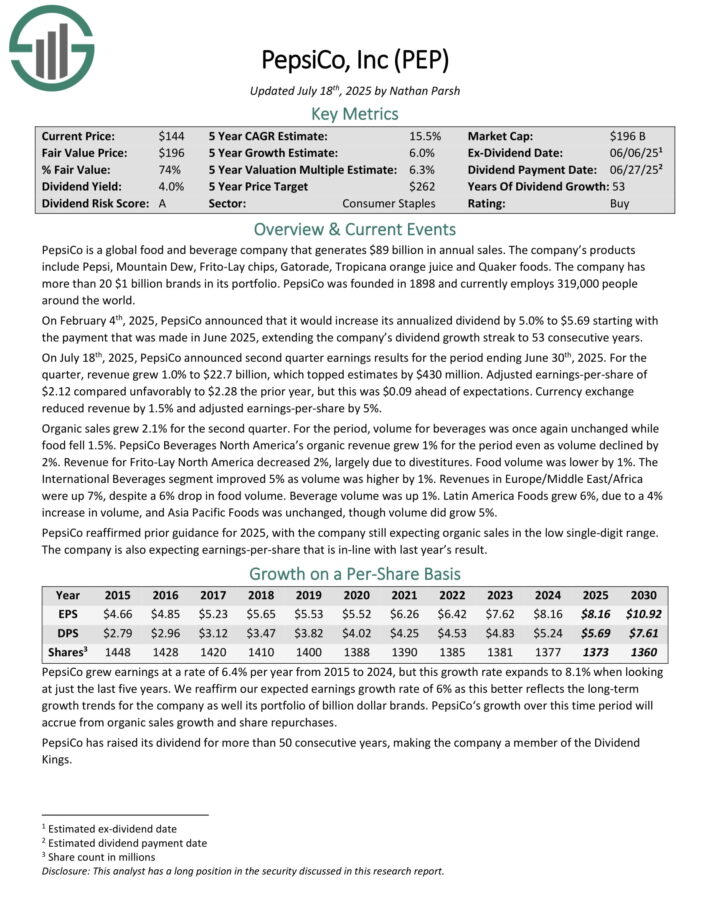
Click here to download our most recent Sure Analysis report on PEP (preview of page 1 of 3 shown below):
4. J.M. Smucker Co. (SJM)
The J.M. Smucker company has grown into an international powerhouse of packaged food and beverage products including iconic brands like Smucker’s, Jif and Folgers, along with various pet food brands.
The company generated nearly $9 billion in sales in each of the last two fiscal years.

Source: Investor Presentation
In early June, Smucker’s reported (6/10/25) results for the fourth quarter of fiscal 2025, which ended on April 30th, 2025.
Currency-neutral, organic sales dipped -1% over the prior year’s quarter, mostly due to supply chain disruptions. Adjusted earnings-per-share decreased -13%, from $2.66 to $2.31, though they exceeded the analysts’ estimates by $0.06.
Smucker has beaten the analysts’ earnings-per-share estimates for 23 consecutive quarters but it provided weak guidance for fiscal 2026 due to the impact of tariffs and an unfavorable overall economic landscape.
It expects 2%-4% growth of sales but adjusted earnings-per-share of only $8.50-$9.50.
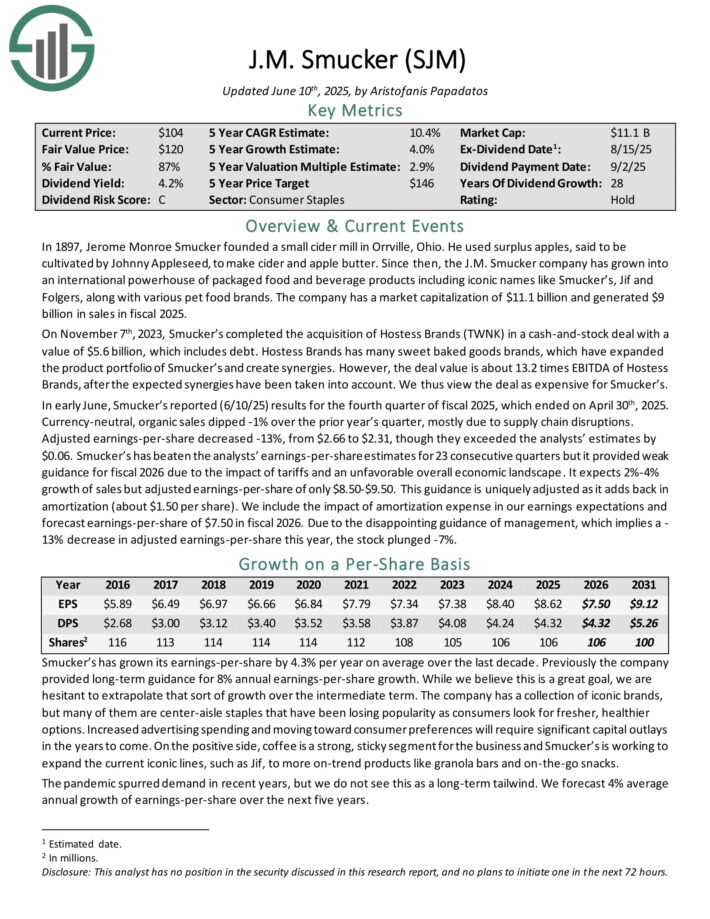
Click here to download our most recent Sure Analysis report on SJM (preview of page 1 of 3 shown below):
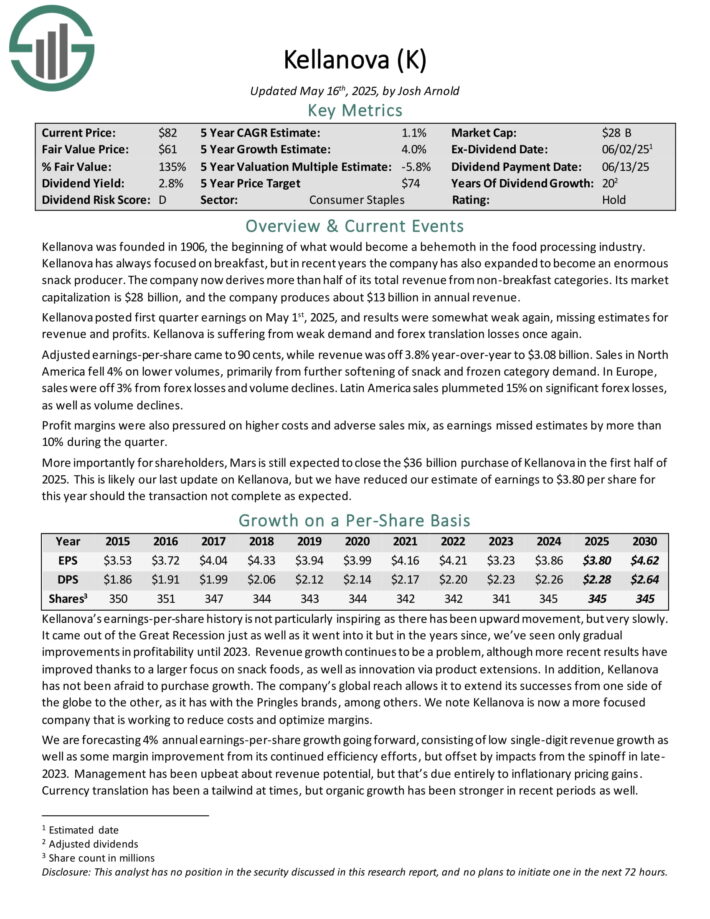
3. Kellanova (K)
Kellanova was founded in 1906, the beginning of what would become a behemoth in the food processing industry.
Kellanova has always focused on breakfast, but in recent years the company has also expanded to become an enormous snack producer. The company now derives more than half of its total revenue from non-breakfast categories.
It produces about $13 billion in annual revenue.
Kellanova posted first quarter earnings on May 1st, 2025, and results were somewhat weak again, missing estimates for revenue and profits. Kellanova is suffering from weak demand and forex translation losses once again.
Adjusted earnings-per-share came to 90 cents, while revenue was off 3.8% year-over-year to $3.08 billion. Sales in North America fell 4% on lower volumes, primarily from further softening of snack and frozen category demand. In Europe, sales were off 3% from forex losses and volume declines.
Latin America sales plummeted 15% on significant forex losses, as well as volume declines. Profit margins were also pressured on higher costs and adverse sales mix, as earnings missed estimates by more than 10% during the quarter.
Click here to download our most recent Sure Analysis report on K (preview of page 1 of 3 shown below):
2. Kraft-Heinz Co. (KHC)
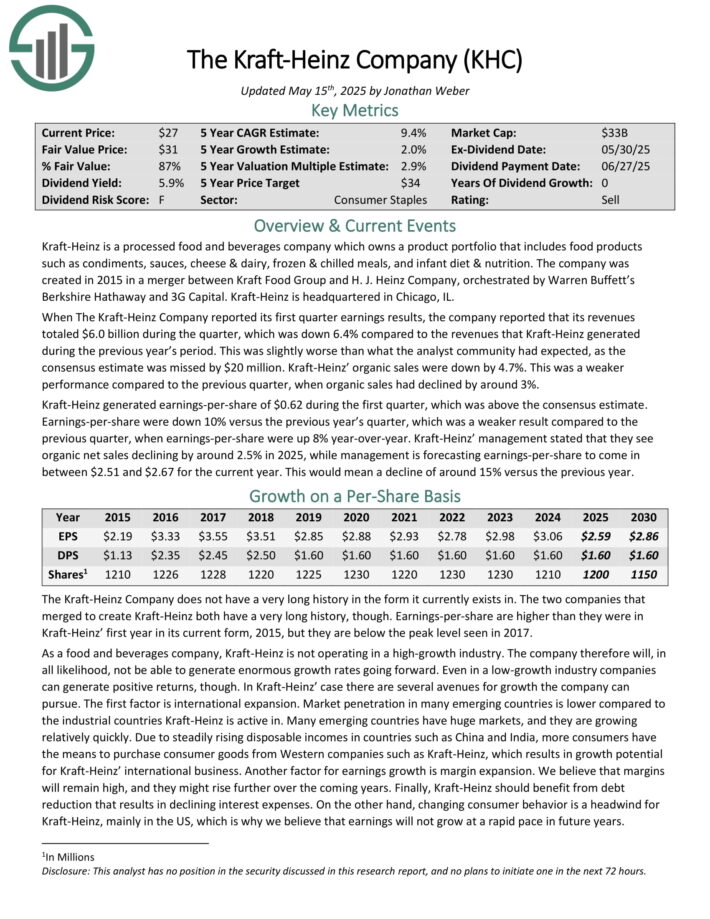
Kraft-Heinz is a processed food and beverages company which owns a product portfolio that includes food products such as condiments, sauces, cheese & dairy, frozen & chilled meals, and infant diet & nutrition.
When The Kraft-Heinz Company reported its first quarter earnings results, the company reported that its revenues totaled $6.0 billion during the quarter, which was down 6.4% compared to the revenues that Kraft-Heinz generated during the previous year’s period.
This was slightly worse than what the analyst community had expected, as the consensus estimate was missed by $20 million. Kraft-Heinz’ organic sales were down by 4.7%.
Kraft-Heinz generated earnings-per-share of $0.62 during the first quarter, which was above the consensus estimate. Earnings-per-share were down 10% versus the previous year’s quarter, which was a weaker result compared to the previous quarter, when earnings-per-share were up 8% year-over-year.
Kraft-Heinz’ management stated that they see organic net sales declining by around 2.5% in 2025, while management is forecasting earnings-per-share to come in between $2.51 and $2.67 for the current year. This would mean a decline of around 15% versus the previous year.
Click here to download our most recent Sure Analysis report on KHC (preview of page 1 of 3 shown below):
1. Cboe Global Markets (CBOE)
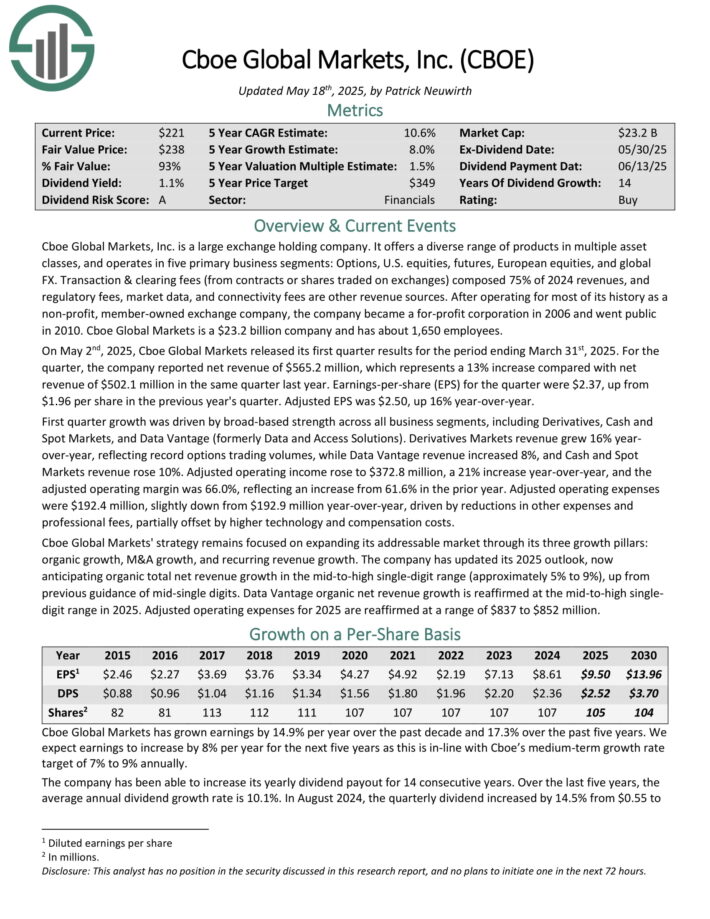
Cboe Global Markets, Inc. is a large exchange holding company. It offers a diverse range of products in multiple asset classes, and operates in five primary business segments: Options, U.S. equities, futures, European equities, and global FX.
Transaction & clearing fees (from contracts or shares traded on exchanges) composed 75% of 2024 revenues, and regulatory fees, market data, and connectivity fees are other revenue sources.
On May 2nd, 2025, Cboe Global Markets released its first quarter results for the period ending March 31st, 2025. For the quarter, the company reported net revenue of $565.2 million, which represents a 13% increase compared with net revenue of $502.1 million in the same quarter last year.
Earnings-per-share (EPS) for the quarter were $2.37, up from $1.96 per share in the previous year’s quarter. Adjusted EPS was $2.50, up 16% year-over-year.
First quarter growth was driven by broad-based strength across all business segments, including Derivatives, Cash and Spot Markets, and Data Vantage (formerly Data and Access Solutions).
Derivatives Markets revenue grew 16% year-over-year, reflecting record options trading volumes, while Data Vantage revenue increased 8%, and Cash and Spot Markets revenue rose 10%. Adjusted operating income rose to $372.8 million, a 21% increase year-over-year.
Click here to download our most recent Sure Analysis report on CBOE (preview of page 1 of 3 shown below):
Final Thoughts
Investors must take risk into account when selecting from prospective investments. After all, if two securities are otherwise similar in terms of expected returns but one offers a much lower Beta, the investor would do well to select the low Beta security as they may offer better risk-adjusted returns.
Using Beta can help investors determine which securities will produce more volatility than the broader market and which ones may help diversify a portfolio, such as the ones listed here.
The five stocks we’ve looked at not only offer low Beta scores, but they also offer attractive dividend yields. Sifting through the immense number of stocks available for purchase to investors using criteria like these can help investors find the best stocks to suit their needs.
At Sure Dividend, we often advocate for investing in companies with a high probability of increasing their dividends each and every year.
If that strategy appeals to you, it may be useful to browse through the following databases of dividend growth stocks:
Thanks for reading this article. Please send any feedback, corrections, or questions to support@suredividend.com.