
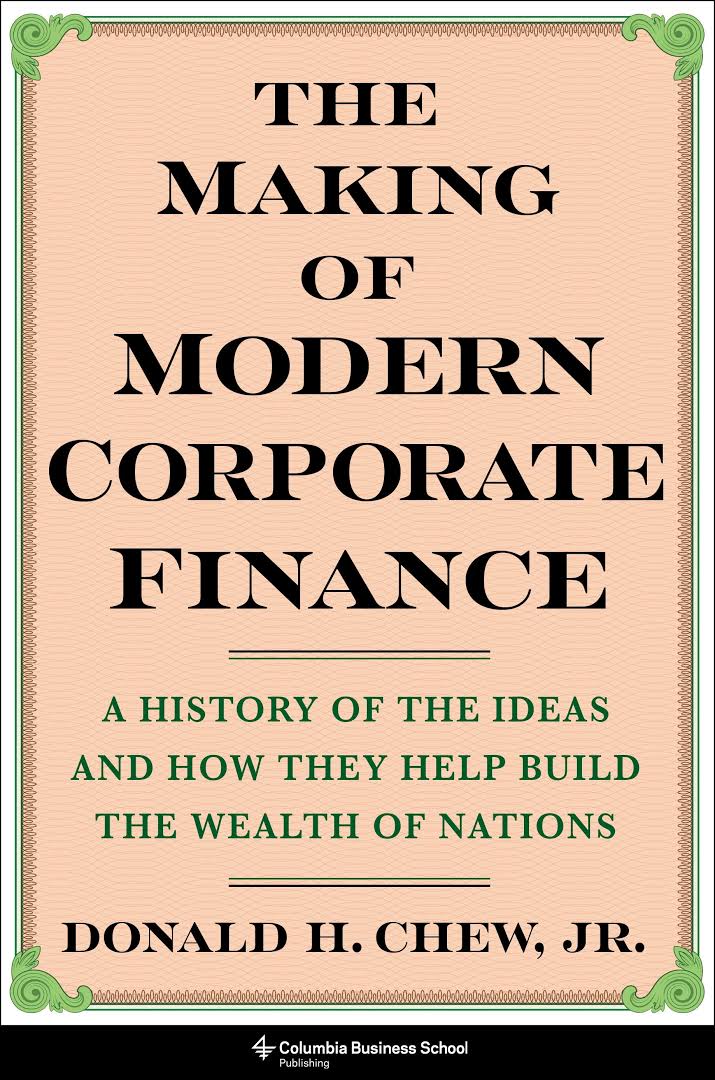

The Making of Modern Corporate Finance. 2025. Donald H. Chew, Jr. Columbia University Press, Available February 2025.
Donald Chew’s forthcoming book, The Making of Modern Corporate Finance, is a love letter to those who published in the Journal of Applied Corporate Finance, of which the author is the founder and remains its publishing editor. It is a love letter to unfettered capitalism and the financial system that oils the gears of commerce. The book will be of interest to a broad readership but should be required reading for CFA charterholders, like me, who pursued their designation decades ago and who may have — while keeping up with the day-to-day developments in finance — missed the broader perspective on the financial innovations that underpin today’s global system.
The subtitle, “A History of the Ideas and How They Help Build the Wealth of Nations,” aptly describes the book’s narrative arc as it works chronologically through four “core subjects”:
- The corporate investment decision
- The corporate financing decision
- Enterprise risk management
- Corporate governance and investor communication
After a chapter case study on Japan that effectively links corporate finance and social wealth, the history begins with Franco Modigliani and Merton Miller’s late 1950s and early 1960s work on “capital structure and dividend irrelevance.” Rather than capital structure, investors should focus on earnings power — investment in projects that earn at least their cost of capital — and how corporate risks are managed. If capital structure is a red herring, so too is the focus on near-term earnings per share (EPS). Chew offers, as a good example: investors who focused on quarterly EPS figures rather than future earnings power at Amazon.
The author follows his robust opening with a discussion of Michael Jensen and William Meckling’s well-cited paper on the agency costs of professional management to the interests of beneficial owners, i.e., shareholders. In the market for corporate control, management is incented to grow rather than focus on earnings power. This led to corporate takeovers in disparate sectors and to the bloated conglomerates of the 1970s, which in turn fostered the reimposition of control through leveraged buyouts (LBOs) and, eventually, private equity.
The hefty interest payments imposed by the debt financing of LBOs redirected management’s attention from acquisitions to operational efficiency. The private equity (PE) corporate structure eliminated Jensen and Meckling’s agency issue by controlling board seats or wholesale removal of target companies from public markets.
With each theoretical development — Modigliani and Miller, Jensen and Meckling and Stewart Meyers, who helped incorporate the Weighted Average Cost of Capital (WACC)) into discounted cash flow methodologies and subsequently into corporate decisions to continue or abandon a project, and Clifford Smith and Rene Stulz, whose work showed the importance of corporate risk management as an essential component of maximizing shareholder returns – there were practitioners eager to use the new tools. Practitioners included company management, who adopted Bennet Stewart’s concept of “economic value added” (EVA), which resulted in a shift of responsibility from a centralized EPS focus to the various operating units and a focus on earnings power.
Modern corporate finance also included a reimagination of corporate incentive structure for executives. Chew contends that if executives at PE-owned companies are paid like owners (recall that this helps eliminate the agency issue), executives at public companies should be paid in a similar fashion. If pay structure and amount are inadequate, public companies will become mere training grounds for the best leaders as they seek superior pay under private equity. Chew discusses at some length the optimal structure of long-term incentives.
Finally, the transformation of corporate finance included the development of new markets to support financial innovations. Longtime readers of CFA Institute Financial Analysts Journal and other publications will be delighted to see a full chapter highlighting the pivotal role of book review editor Marty Fridson in helping develop the high yield debt markets that accommodated the surge of debt associated with LBOs.
The preceding paragraphs give a sense of the book’s structure and content. However, the overarching narrative is of the United States’s economic power– not its accumulated capital or military strength, but its financial innovation and dynamism. The opening chapter on Japan is bookended by a concluding chapter on China and the differences between its financial system and that of the United States. So far, Chew contends, the Chinese financial system has fallen short of its promise as it has traded off innovation and dynamism for state control — a façade of Western capital markets but without the substance.
Examples from history and geography are thought-provoking. For example, a parallel can be drawn between 1970s conglomerates and today’s expansive technology companies, which exhibit both synergies, e.g., Alphabet and advertising, and silos, such as Amazon’s AWS and online sales portal, across multiple business lines.
Have the managers of these enterprises solved the agency issue identified by Jensen and Meckling and developed better governance and more disciplined management? Many have dual-class share structures, which tilt control closer to the PE model, but as Chew notes, the effect may be time-limited. Shareholders may accept founder control during periods of superior growth but advocate an eventual switch to a one-share, one-vote regime.
Might the technology giants’ expansive reach reflect other factors such as market concentration and monopoly or oligopoly returns? This is clearly a different subject than Chew sets out to address (see Tim Wu’s book, The Curse of Bigness). A second set of questions arises when Chew links the lofty US stock market valuations to the country’s financial dynamism. While he makes a compelling case, market historians will note that the premiums of US and international equity markets have seesawed back and forth over time.

Throughout the book, Chew emphasizes the superiority of the US model and the power of corporate finance to generate wealth and alleviate environmental and social problems. To this end, he includes a thoughtful discussion on ESG issues and their relevance to companies and boards. Still, at times, his comments are too broad and categorical about companies’ role in addressing issues and too dismissive of government’s role in providing the rules and infrastructure upon which companies depend. Many of the issues arose from corporate activities in the first place and might not have been addressed without stakeholder or government action to force the issues.
That is a small complaint, to be sure, given the book’s attention to detail, thoughtful and engaging structure, and lively anecdotes. What in less capable hands would be a dry textbook is, with Chew’s expert touch, a wonderful historical overview of corporate finance and the United States’s continued pre-eminence. If you have liked earlier works on risk and capital markets by Peter Bernstein, you will most certainly enjoy The Making of Corporate Finance.